SBF Files Formal Pardon Petition With Trump DOJ
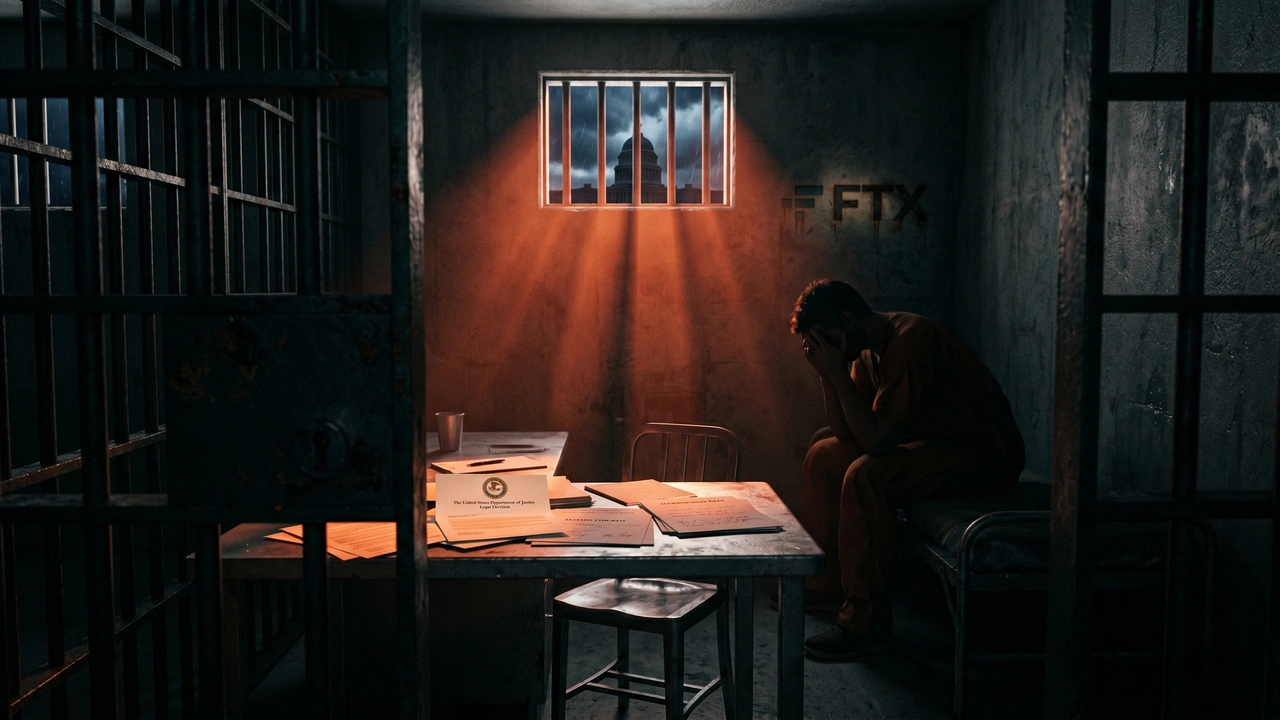
Sam Bankman-Fried has submitted an official clemency application to the Justice Department while simultaneously appealing his conviction - a long-shot bid that Trump has already signaled he intends to reject.
Key Takeaways
- Bankman-Fried has filed a formal DOJ clemency petition while also appealing his conviction and sentence, pursuing two simultaneous avenues toward early release.
- Trump has publicly ruled out a pardon as recently as January, making the application a long shot despite the president's willingness to grant clemency to other crypto figures including Ulbricht and Zhao.
- SBF continues to dispute that he committed theft, citing the 170 percent creditor repayment rate - a framing prosecutors and the court have already rejected.
- His deliberate alignment with Trump-friendly rhetoric mirrors the political repositioning strategies used by other defendants who eventually secured clemency, though his Democratic donor background is a significant complicating factor.
- The outcome of this petition will say more about the limits of political calculation than about any substantive reassessment of the FTX fraud itself.
The Man Who Lost $8 Billion Wants a Presidential Lifeline
From a federal prison cell, Sam Bankman-Fried is making his most direct move yet to walk free: a formal clemency petition submitted to the U.S. Department of Justice. The application lands on Donald Trump's desk at a politically charged moment, when the president has already handed pardons to several other crypto-adjacent figures - and yet has publicly stated he has no intention of extending that courtesy to the disgraced FTX founder. The gap between SBF's hopes and Washington's apparent appetite to fulfill them is wide, but that has not stopped him from trying.
This is more than a legal maneuver. It is a window into how one of the most consequential fraudsters in financial history is navigating his captivity - and how far the crypto world's reckoning with its own excesses has, or has not, traveled.
The Facts
Bankman-Fried, now 34, is currently serving a 25-year federal sentence handed down on March 28, 2024 [2]. A New York jury had convicted him on all seven criminal counts against him in November 2023, covering two wire fraud charges and five separate conspiracy charges [2]. The court determined that FTX customers absorbed an $8 billion loss, while equity investors in the exchange lost a further $1.7 billion and creditors to the affiliated hedge fund Alameda Research lost an additional $1.3 billion [2]. Presiding judge Lewis Kaplan ordered a forfeiture of $11 billion [2].
The formal pardon request now sits in the DOJ's Office of the Pardon Attorney system, listed as pending with the designation of a pardon sought after sentence completion [2]. The office has confirmed its standard policy of keeping active review details confidential. Crucially, the clemency bid runs alongside a simultaneous appellate challenge to both the conviction and the length of the sentence itself [2], meaning Bankman-Fried is pursuing relief on two tracks at once [1][2].
His first on-record media conversation from behind bars, a phone interview with Fox Business correspondent Susan Li, made his intentions explicit [2]. When Li put it to him directly whether he was angling for a White House pardon, his reply was unambiguous: "Absolutely," he told her, adding that the decision would ultimately rest with the president, not with him [2]. On the question of whether his parents or close associates were working behind the scenes to lobby the administration, he gave nothing away, saying only that he could not speak on their behalf [1][2].
Despite the scale of the verdict against him, Bankman-Fried continues to reject the characterization of what happened as theft. He pointed to the fact that FTX creditors have now been repaid roughly 170 percent of their original deposits during the bankruptcy process, attributing the surplus to the cryptocurrency market's recovery during that period [1][2]. "I didn't steal user funds either," he told Li, framing the outcome as evidence of a platform that was overcollateralized rather than insolvent by design [2]. Prosecutors, by contrast, demonstrated that he had redirected billions in customer deposits into speculative bets at Alameda Research, while also funding political contributions and personal real estate [2].
The political choreography surrounding the petition is deliberate. Over recent months, Bankman-Fried has issued statements through approved prison communications praising Trump's foreign policy decisions, crediting the administration with reforming the Securities and Exchange Commission via the appointment of Paul Atkins to replace Gary Gensler, and highlighting fuel price trends under the current government [2]. The approach echoes a realignment he had attempted before his arrest: after years as a prominent Democratic mega-donor, he appeared on Tucker Carlson's program in 2025 seeking credibility with conservative audiences [2]. His pardon application arrives alongside a wave of clemency actions Trump has already taken in the crypto space, having freed Silk Road creator Ross Ulbricht, former Binance chief Changpeng Zhao, and the co-founders of BitMEX [2]. Despite that track record, Trump stated plainly in a January interview with the New York Times that pardoning Bankman-Fried was not on his agenda [1][2].
Analysis & Context
The most instructive pattern here is not legal - it is political. Bankman-Fried's deliberate pivot toward Trump-aligned messaging follows a well-worn playbook of defendants who calculate that ideological proximity to the pardon-granting authority is more powerful than legal argument alone. Ross Ulbricht's supporters spent years cultivating libertarian and eventually MAGA-adjacent networks before the pardon came through. Changpeng Zhao's legal resolution, while different in nature, also benefited from a broader thaw between the crypto industry and the incoming Republican administration. SBF is attempting to replicate that alignment from a position of far weaker political capital - his Democratic donor history is a liability in this environment, and no amount of prison-issued praise for Trump's Iran policy is likely to fully erase it.
There is also a disambiguation worth making for anyone watching this case as a proxy for broader crypto rehabilitation. SBF's pardon bid is not a signal that the FTX case is being relitigated in the public mind. The $8 billion customer loss, the Alameda misuse of deposits, the testimony of Caroline Ellison and Gary Wang - those facts are settled. What is actually being contested is whether political expediency will override judicial finality, which is an entirely different question. The crypto market's maturation since November 2022 has largely happened despite SBF, not because of any reassessment of his conduct. Conflating his possible release with any vindication of his business model would be a serious misreading.
Sources
AI-Assisted Content
This article was created with AI assistance. All facts are sourced from verified news outlets.