ADA Stagnates While HYPE Climbs: Two Altcoins, One Market Verdict
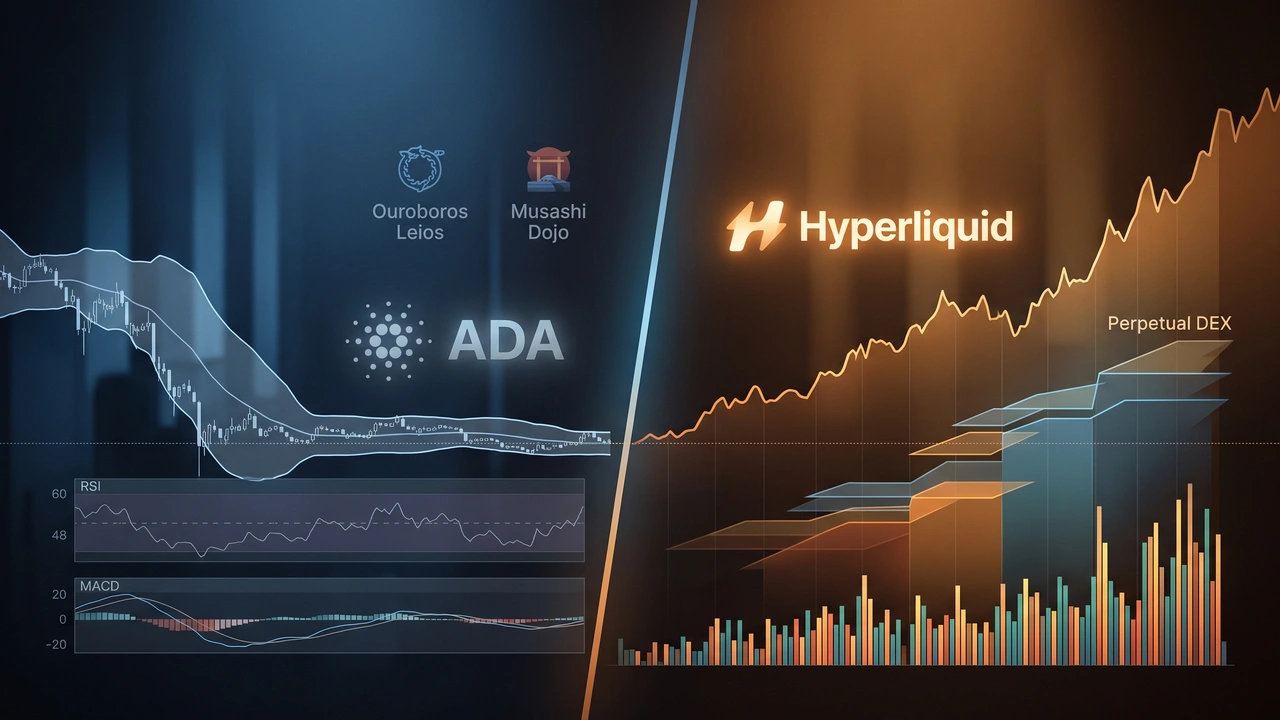
Cardano's Leios testnet launch offers a fundamental catalyst, but technical signals remain muted. Meanwhile, Hyperliquid quietly outpaces larger rivals - raising broader questions about where altcoin momentum is actually flowing.
Key Takeaways
- Cardano's Leios testnet is a meaningful technical milestone, but with RSI near 48 and price pinned below the 20-day EMA, the market has not yet treated it as a buying catalyst.
- ADA's base-case scenario is continued sideways consolidation in the $0.14 to $0.15 range; a confirmed close above $0.15 would be the minimum requirement to shift that outlook bullish.
- Hyperliquid gained roughly 3% on the week while larger-cap rivals declined, suggesting that relative strength is concentrated in assets tied to demonstrable trading activity rather than development narratives.
- The key risk for HYPE is not project-specific - a broad market selloff remains the scenario most capable of unwinding its current momentum.
- For Cardano, the more interesting price signal may arrive not at testnet completion but when Leios goes live on mainnet and on-chain usage data begins to reflect the upgrade's throughput gains.
ADA Stagnates While HYPE Climbs: Two Altcoins, One Market Verdict
The altcoin market is sorting itself with unusual clarity right now. On one side sits Cardano - a blockchain with genuine engineering ambitions, a freshly launched scaling testnet, and a price chart that refuses to cooperate. On the other sits Hyperliquid, a perpetual decentralized exchange that shed its correction faster than its peers and is quietly posting weekly gains while Ethereum and Ripple lag. Together, these two assets tell a story not just about individual tokens, but about how the market is currently pricing development narratives versus actual trading volume and momentum.
The divergence matters because both projects are at inflection points. One is waiting for its technology to justify its valuation; the other appears to already be accumulating buyer conviction. Understanding the gap between them is more useful than watching either chart in isolation.
The Facts
Cardano shed roughly 5% over the past seven days, leaving even committed ADA bulls questioning whether a sustained recovery is plausible in the near term [1]. The daily trading range has compressed into a narrow $0.14 to $0.15 corridor, with the most recent closing price anchored at the lower end of that band - a market cap of approximately $5.39 billion [1]. Price action since late June has traced a sequence of marginally lower highs, a textbook sign of weakening structure [1]. The 20-day exponential moving average sits at $0.15, and ADA remains just beneath it - a position that analysts typically read as neutral tilting toward bearish [1].
Momentum indicators reinforce the subdued picture. The Relative Strength Index is hovering near 48, comfortably in no-man's-land between oversold and overbought territory, and the MACD histogram is showing only marginal negative acceleration close to the zero line [1]. Bollinger Band width has contracted to roughly $0.01, suggesting that directional volatility has dried up and that whatever breakout or breakdown arrives next may carry outsized significance [1].
Against this technical backdrop, Cardano did deliver a notable fundamental development. The project launched the public testnet for Ouroboros Leios - branded as Musashi Dojo - which represents one of the most consequential scaling upgrades the network has pursued in recent years [1]. The protocol redesign is engineered to substantially raise blockchain throughput, directly targeting the throughput limitations that critics have cited as a persistent weakness [1]. Should the rollout prove successful and on-chain usage respond accordingly, the argument for a recovery rally becomes considerably more concrete. For now, however, that remains a prospective thesis rather than a present catalyst [1].
The probability distribution from technical analysts currently weights a neutral consolidation at 55%, a bullish breakout at 25%, and a deeper decline at 20% [1]. The bull case requires ADA to close above $0.15 on both the daily and four-hour timeframes, with RSI pushing past 50 to confirm renewed buying pressure [1]. The upside targets in that scenario extend first to $0.16 - a key Fibonacci level - and then toward $0.18 [1]. The bear case activates if RSI falls below 45 and ADA closes beneath the lower Bollinger Band near $0.14, opening the path toward $0.12 [1].
Hyperliquid tells a different story this week. Where Cardano drifted lower, HYPE managed a weekly gain of approximately 3%, even after correcting down to its 50-day moving average during the period [2]. Competitors in the decentralized finance space - including Ethereum and Ripple - continued to underperform, which makes Hyperliquid's relative resilience stand out [2]. The chart structure appears to be positioning for a continuation of the prior uptrend, with bulls seemingly absorbing the pullback rather than capitulating through it [2]. The principal risk identified for HYPE is not internal - it is a broader crypto market capitulation that would drag all assets down regardless of individual project fundamentals [2].
Analysis & Context
The contrast between Cardano and Hyperliquid reflects a pattern that recurs in crypto cycles: the market frequently struggles to price long development timelines against visible, near-term utility. Cardano has spent years building methodically toward a high-throughput, formally verified architecture. The Leios upgrade is a serious piece of engineering. But markets are not patient institutions, and a testnet launch - however significant technically - is not the same as on-chain activity that produces fee revenue, user growth, and the kind of data that short-term traders can point to as proof of demand.
Hyperliquid, by contrast, operates in perpetual derivatives - a segment of crypto that generates measurable, real-time volume. Traders can see order books, open interest, and liquidation data. That transparency creates a feedback loop that reinforces confidence when price holds up, and it helps explain why the token's holder base appears reluctant to sell even during a pullback. The comparison is somewhat unfair - these are fundamentally different types of projects - but the market does not always make fair comparisons, and right now it seems to be rewarding observable activity over developmental milestones.
Historically, altcoins with genuine scaling upgrades in progress have often seen their strongest price responses not at the testnet stage but at mainnet deployment or - more precisely - at the point when on-chain metrics begin to reflect the upgrade's impact. If Leios performs as intended on the testnet and a mainnet timeline becomes credible, ADA's suppressed price structure could look quite different in subsequent months. The setup for a delayed but meaningful repricing is arguably intact. It just has not triggered yet.
Sources
- [1]btc-echo.de
- [2]btc-echo.de
AI-Assisted Content
This article was created with AI assistance. All facts are sourced from verified news outlets.