AI Expansion Challenges U.S. Bitcoin Mining Dominance, but Coexistence Remains Possible
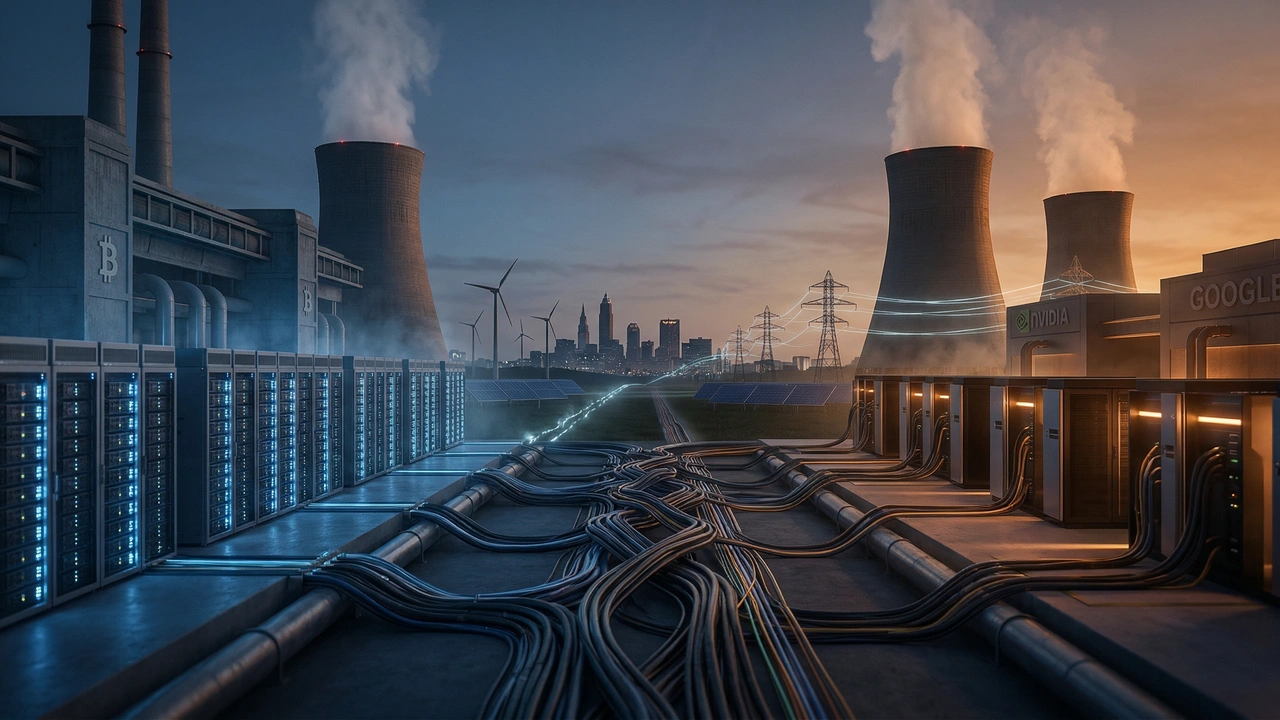
As major U.S. mining firms pivot toward AI infrastructure, analysts see both risks and opportunities for America's commanding position in global Bitcoin mining.
The United States currently contributes approximately 400 EH/s to the Bitcoin network — roughly 37.5% of global hashrate — a position secured after China curtailed mining operations in 2021 [1]. That dominance is now being tested as the artificial intelligence boom draws investment, energy, and capital away from traditional mining operations.
Some companies are making dramatic shifts. Core Scientific CEO Adam Sullivan has announced plans to convert most of the firm's facilities to AI workloads and wind down mining long-term, while tech giants including Google and Nvidia have acquired stakes in mining companies to leverage their existing infrastructure [1].
However, researchers and industry analysts argue the two sectors are fundamentally different rather than directly interchangeable. Bitcoin mining rigs can rapidly scale energy consumption up or down, making them valuable tools for grid stabilization and monetizing surplus renewable energy. AI data centers, by contrast, require near-continuous high-load operation and stable grid connections [1].
MARA Holdings, the largest U.S. miner with over 1.2 GW of capacity, exemplifies a dual-track strategy — integrating AI capabilities while maintaining its Bitcoin mining core, including developing cooling systems compatible with both workloads [1].
Regulatory risk remains a key variable. Proposed legislation such as the Clean Cloud Act of 2025 could raise energy costs for data centers broadly, potentially undermining mining economics. The Trump administration has expressed support for the sector, pledging to make the U.S. a "Bitcoin mining powerhouse" [1].
Sources
AI-Assisted Content
This article was created with AI assistance. All facts are sourced from verified news outlets.