AI Hype Fades as NEAR Collapses, While TRX Quietly Outperforms
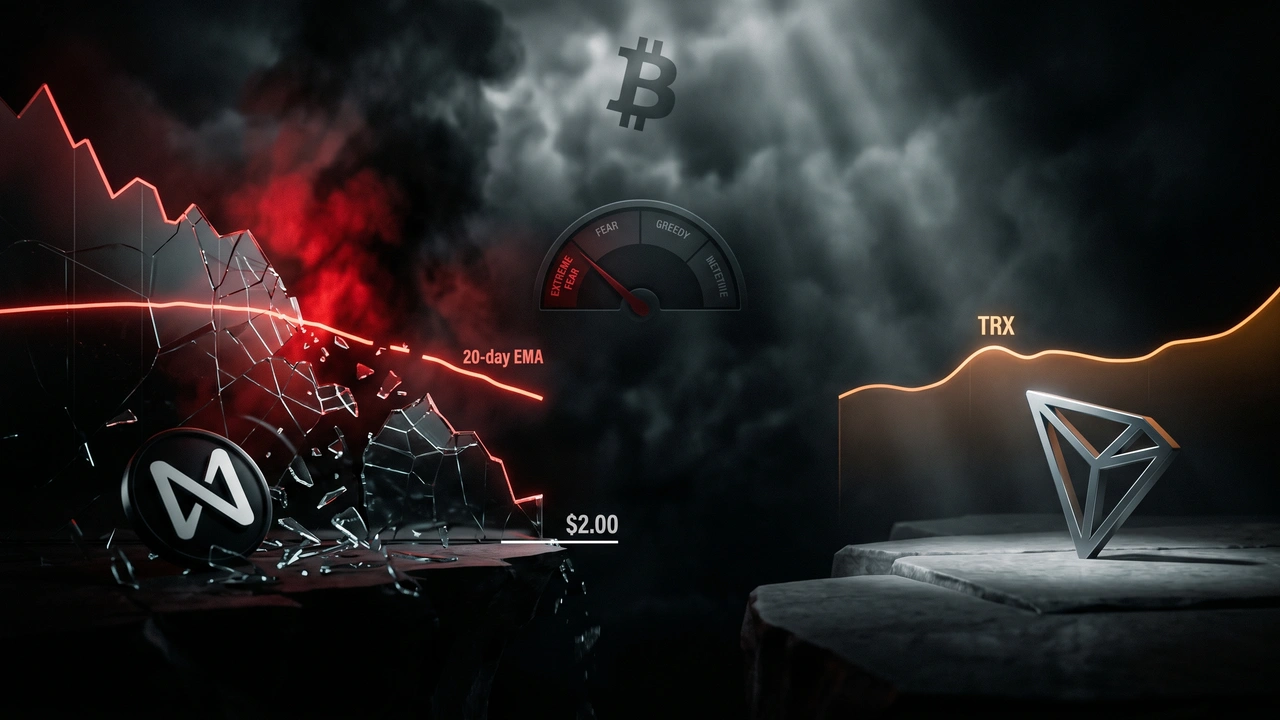
NEAR Protocol is flirting with the psychologically critical $2 level after shedding nearly 17% in a week, while Tron continues to defy broader market weakness with modest gains - a tale of two altcoins that reveals deeper structural truths about the current cycle.
Key Takeaways
- NEAR Protocol has erased most of its AI-hype gains from early June, dropping roughly 17% in a week to hover just above the critical $2 support level, with the bear case carrying the highest probability at around 55%.
- The $2 floor is the decisive near-term line: a sustained break lower opens a path toward $1.70, while reclaiming the $2.14 EMA would be the first prerequisite for any credible recovery.
- RSI near 28 signals technical oversold conditions, but that alone is not sufficient for a trend reversal - negative macro sentiment can keep oversold tokens under pressure for longer than expected.
- Tron's roughly 4% weekly gain amid broad market weakness highlights how utility-driven blockchains with real transaction demand tend to outperform speculative narrative tokens during risk-off episodes.
- The divergence between NEAR and TRX is a broader reminder: when evaluating altcoin exposure, the source of a token's prior rally matters enormously - narrative-driven gains are far more fragile than those built on measurable on-chain activity.
AI Hype Fades as NEAR Collapses, While TRX Quietly Outperforms
The altcoin market is delivering a masterclass in narrative-driven volatility. Tokens that rode the artificial intelligence storyline to sharp gains earlier this summer are now surrendering those advances at a punishing pace, while quieter, utility-focused blockchains hold their ground. The contrast between NEAR Protocol and Tron right now is not just a tale of two tokens - it is a window into how speculative capital rotates when sentiment sours.
The Facts
NEAR Protocol, which briefly traded near the $3 mark in early June on the back of AI-related enthusiasm, has since shed those gains with alarming speed [1]. Over the past seven days alone, the token dropped roughly 17%, with an additional 7% decline recorded in a single 24-hour window [1]. That puts NEAR hovering just above $2 - a price point that has now become the central battleground between buyers and sellers [1].
The broader market backdrop is not helping. Bitcoin slipped below $63,000, and the Fear and Greed Index remains deep in extreme fear territory [1]. Profit-taking in the technology sector more broadly has begun bleeding into crypto markets, and tokens most associated with the AI narrative are bearing the sharpest losses as investors systematically cash out recent gains [1].
From a technical standpoint, the chart structure for NEAR looks broken. The token has been printing a sequence of lower highs and lower lows since its early June peak, and it is trading well beneath the 20-day exponential moving average at $2.14 [1]. That EMA now functions as immediate overhead resistance. The Relative Strength Index has dropped to approximately 28 - a reading that technically qualifies as oversold territory [1]. Historically, RSI levels this low have preceded short-term bounces, though oversold conditions can persist for extended periods when overall sentiment remains negative [1].
The scenario distribution as analysts see it leans heavily bearish. A breakdown below $2 - and further beneath the $1.93 support level - opens a path toward the $1.70 zone, a scenario assigned roughly 55% probability [1]. A sideways consolidation between $2.00 and $2.14 carries about a 25% probability, conditional on that $2 floor holding firm [1]. Only around 20% of likely outcomes feature a recovery - which would require NEAR to reclaim the EMA-20 and then clear $2.19 before any extension toward $2.50 becomes plausible [1].
Tron (TRX) tells a strikingly different story. Justin Sun's Layer-1 blockchain added approximately 4% over the same seven-day stretch that crushed NEAR, positioning TRX as one of the rare outperformers among the top 100 cryptocurrencies by market cap in 2026 [2]. At around $0.329, TRX sits only about 13% below its yearly high set last month - a relatively shallow drawdown compared to what most altcoins have suffered during the same period [2]. Tron's resilience in down markets has historically made it a recurring talking point when analysts discuss defensive positioning within the altcoin space, a reputation the current episode appears to reinforce [2].
Analysis & Context
The NEAR situation fits a recognizable pattern from previous cycles: narrative-driven tokens tend to overshoot on the way up and undershoot on the way down. When a token rallies primarily because of an external hype theme - in this case, AI - rather than measurable on-chain growth or revenue generation, the unwind can be vicious precisely because there is no fundamental floor to anchor it. Investors who bought the narrative, not the fundamentals, have little reason to hold through a drawdown, and their exits cascade.
This same dynamic played out with metaverse tokens in 2022 and DeFi tokens after the summer of 2020. The current AI-crypto narrative overlap is newer, but the mechanics are identical. Tokens that served as proxies for a macro technology theme attract capital faster than their actual development roadmaps justify, then give it all back - and sometimes more - when the macro theme loses momentum. The $2 level for NEAR is psychologically significant not because it reflects any intrinsic value, but because round numbers concentrate both stop-loss orders and limit bids. A decisive close below it removes that artificial support layer.
Tron's resilience, by contrast, is grounded in something more durable: consistent transaction volume, a stablecoin transfer ecosystem - particularly USDT on Tron - that continues to process real economic activity, and a user base concentrated in markets where dollar-denominated transfers are a practical necessity rather than a speculative exercise. Bear markets tend to reward exactly this kind of utility-anchored demand, because the use case does not disappear when price declines. That structural advantage explains why TRX consistently shows up in outperformer lists during risk-off periods, and why the gap between it and AI-narrative tokens widens precisely when fear dominates.
Sources
- [1]btc-echo.de
- [2]btc-echo.de
AI-Assisted Content
This article was created with AI assistance. All facts are sourced from verified news outlets.