AI IPO Fever Sparks Crypto Rally While Bitcoin Operators Build for the Long Game
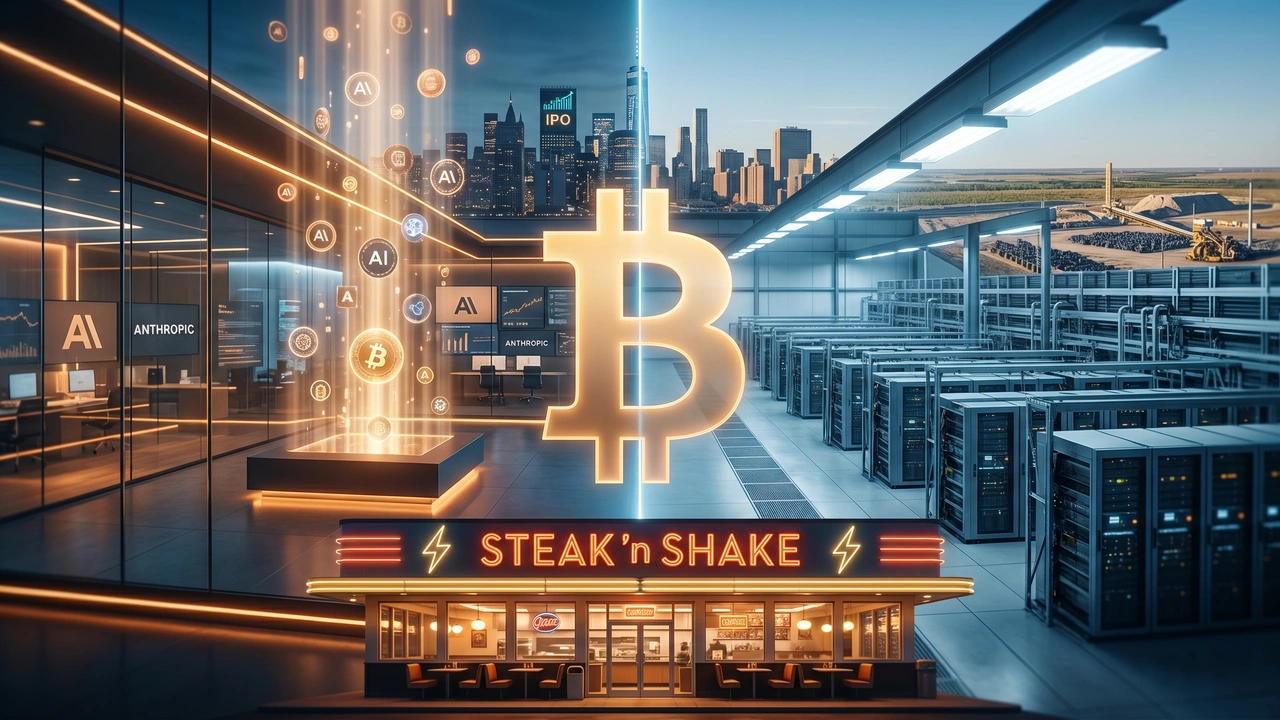
Anthropic's confidential SEC filing at a near-$1 trillion valuation sent AI-linked tokens surging, even as Bitcoin slipped below $70,000. The divergence exposes a deeper story: while speculators chase sentiment, a growing cohort of corporate operators is quietly transforming Bitcoin into multi-stage operational infrastructure.
Key Takeaways
- Anthropic's near-$1 trillion valuation and SEC filing triggered sharp gains in AI-linked crypto tokens, but Bitcoin itself fell below $70,000 during the same period - underscoring that AI token rallies are sentiment-driven events largely decoupled from Bitcoin's structural adoption story.
- Corporate Bitcoin integration is best understood as a multi-stage operational framework; the most defensible competitive position comes not from the size of a BTC holding but from how many stages of the stack are wired together.
- Steak 'n Shake's Operations Pragmatist model - routing Lightning payment savings directly into a Strategic Reserve that funds employee compensation and product investment - demonstrates that deep Bitcoin integration is viable well beyond the financial sector.
- Strategy's preferred stock suite, including STRC yielding 11.50% annually, has helped the company deploy over $43 billion into Bitcoin in under two years, establishing a new asset class Saylor describes as "digital credit."
- Square's default activation of Lightning for roughly 4 million merchants makes Stage 01 adoption essentially frictionless in 2026; the strategic fork is now whether operators wire those inflows to a reserve or let them disappear into fiat conversion.
AI IPO Fever Sparks Crypto Rally While Bitcoin Operators Build for the Long Game
Two currents are reshaping the Bitcoin and crypto landscape simultaneously in mid-2026: a wave of speculative excitement around AI company valuations spilling into AI-linked tokens, and a quieter but more consequential movement of corporate operators integrating Bitcoin into the structural backbone of their businesses. These developments are not unrelated. Together they illustrate the widening gap between how Bitcoin is perceived in headline markets versus how the most serious operators are actually using it.
The contrast matters. When Anthropic's IPO filing moved markets, it moved AI tokens - not Bitcoin. Bitcoin dropped. That asymmetry tells you something important about where durable value is being built.
The Facts
Anthropic, the company behind the Claude AI assistant and one of the most valuable private technology firms alive today, formally submitted a confidential draft S-1 registration statement to the U.S. Securities and Exchange Commission, taking its first concrete step toward a public listing. [1] The filing came days after a private funding round that placed the company's valuation above $965 billion - vaulting it ahead of rival OpenAI, most recently valued at roughly $852 billion in its own private markets. [1] OpenAI is itself reportedly weighing a public offering, though Sam Altman has signaled no particular urgency and will move when conditions suit. [1]
The immediate market reaction was telling. AI-themed crypto tokens surged on the combined signal of Anthropic's IPO news and strong recent Nvidia earnings. Humanity (H) jumped roughly 208% over the trailing seven days, Near Protocol (NEAR) added 14%, and Internet Computer (ICP) gained around 7%. [1] Bitcoin, by contrast, slipped below the psychologically important $70,000 threshold, while Ethereum retreated under $2,000. [1] Speculative money poured into AI-adjacent tokens precisely as the broader market fell back.
That divergence looks very different through the lens of what corporate operators are actually doing with Bitcoin in 2026. A growing cohort of businesses is treating Bitcoin not as a single treasury bet but as layered operational infrastructure - what analysts describe as vertical integration across four distinct stages: accepting Bitcoin as payment, holding it as a reserve asset, producing it through mining, and building financial products or services on top of the treasury position. [2] The core argument is that each stage feeds the next, creating compounding structural advantages rather than isolated decisions.
The most documented consumer-facing example is Steak 'n Shake. The chain enabled Lightning Network payments across all U.S. locations in May 2025, and by the Bitcoin 2026 Conference, executive Michael Boes reported that Bitcoin payments cut processing costs by approximately 50% compared to standard credit card fees - savings that, at full customer adoption, would translate to roughly $6 million annually. [2] Crucially, those Bitcoin receipts are not converted to dollars. They flow into a Strategic Bitcoin Reserve that funds a $0.21-per-hour Bitcoin bonus for hourly employees and underwrites a menu overhaul to 100% grass-fed beef. [2] Same-store sales climbed 11% in Q2 2025 and accelerated to 15% in Q3. [2] Stage 01 (Accept) and Stage 02 (Hold) are deliberately wired together, and the numbers show it working.
At the capital markets end of the spectrum, Strategy holds 843,706 BTC at an average cost basis near $75,500 per coin - a position approaching $60.4 billion and representing nearly 4% of all Bitcoin in existence. [2] What makes Strategy more than just a large holder is its suite of preferred stock instruments designed to give institutional investors structured exposure to its Bitcoin treasury thesis. STRC, a variable-rate perpetual preferred currently yielding 11.50% annually paid monthly, is intended to compete directly with money market funds. [2] The flywheel is self-reinforcing: a larger Bitcoin reserve strengthens the credibility of the preferred stock, better pricing on the preferred raises more capital, and that capital acquires more Bitcoin. Across equity, preferred, and convertible debt, Strategy has deployed over $43 billion into Bitcoin in under two years. [2]
Elsewhere in the integration landscape, LQWD Technologies (TSXV: LQWD) deploys its 262 Bitcoin not in cold storage but as working capital across a global network of enterprise-grade Lightning nodes, earning routing fees on the same asset it holds on the balance sheet. [2] Block, meanwhile, spans all four stages: Square for payments, a corporate treasury of 8,997.89 BTC verified on-chain via quarterly Proof of Reserves disclosures, its Proto division developing an open-source 3-nanometer custom ASIC chip to make industrial mining more accessible, and Bitkey and Cash App anchoring the consumer and custody layers. [2]
Analysis & Context
The Anthropic IPO story and the Bitcoin integration playbook represent two different time horizons inside the same macro moment. AI token rallies driven by a high-profile IPO filing are sentiment plays - the market pricing narrative proximity to a hot sector. [3] The near-$1 trillion valuation Anthropic commands after just five years reflects genuine growth but also the kind of multiple that tends to compress under public market scrutiny. Bitcoin's concurrent drop below $70,000 is a reminder that short-term sentiment and structural adoption operate on entirely different clocks.
The vertical integration framework reframes the corporate Bitcoin conversation away from "how much BTC did you buy?" toward how many operational stages the position actually touches. When Strategy made its initial treasury declaration in August 2020, the move was widely read as a defensive financial maneuver against cash drag. What 2026 shows is that the most advanced operators have moved far past that framing. The Steak 'n Shake model - a fast-food chain using Lightning payment savings to build a Bitcoin reserve that pays employee bonuses - would have sounded implausible five years ago. Today it has accelerating same-store sales behind it. Square's activation of Lightning payments by default for roughly 4 million eligible merchants globally as of March 2026 - free through year-end, then 1% flat from 2027 - removes the friction barrier for the first stage of integration at scale. [2] The question is no longer whether a merchant can accept Bitcoin. It is whether they wire the inflow forward rather than converting it back to fiat.
Sources
AI-Assisted Content
This article was created with AI assistance. All facts are sourced from verified news outlets.