AI Meets Crypto: ChatGPT Payments and the WLD Rally Redefine Adoption
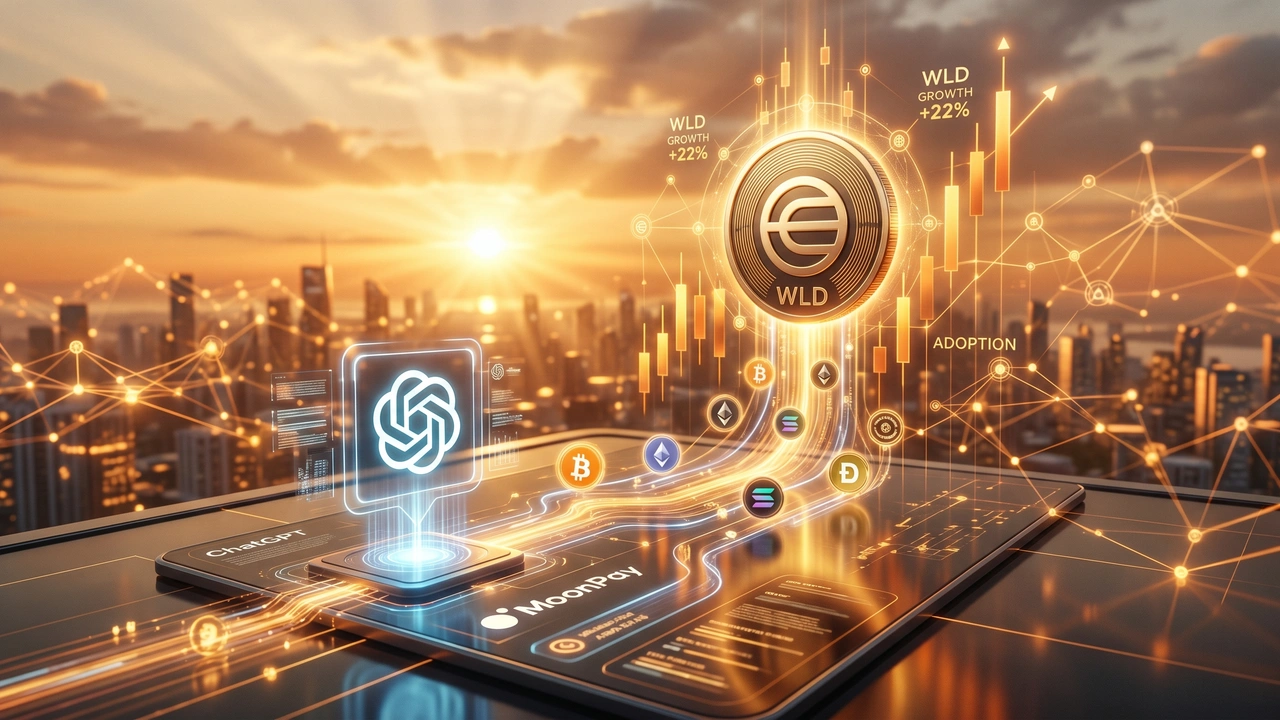
MoonPay's ChatGPT integration and Worldcoin's 22-percent surge are not isolated events - they mark the clearest signal yet that AI infrastructure is becoming the primary distribution layer for crypto assets.
Key Takeaways
- The MoonPay-ChatGPT integration is the clearest example to date of AI acting as a crypto distribution channel, reducing the multi-platform friction that historically discourages first-time buyers.
- Worldcoin's 22-percent surge reflects a broader market pattern in which AI-narrative crypto tokens rally in response to macro AI sector catalysts - a dynamic that cuts both ways as sentiment shifts.
- MoonPay's parallel MoonPay Agents initiative signals that the next phase is not just AI-assisted human purchasing but autonomous on-chain transactions by AI agents themselves - a structural shift still in its early stages.
- Technical indicators for WLD, including an RSI near 78 and expanded Bollinger Bands, suggest the immediate rally carries elevated reversal risk; sustained upside requires continued volume and a breakout above the key 0.3757 US dollar resistance level.
- The friction reduction offered by in-chat crypto buying is real but partial - KYC requirements remain, and the competitive edge in this channel will ultimately belong to whichever payment processor delivers the fastest and smoothest verification experience.
AI Integration and Crypto Payments: Two Signals, One Inevitable Direction
The past week handed crypto markets two developments that, on the surface, look unrelated: a sharp rally in an AI-linked token and a payment processor quietly embedding itself inside the world's most used AI chatbot. Taken together, they sketch the clearest picture yet of where the next wave of crypto adoption is being built - not on trading floors, but inside artificial intelligence.
Worldcoin's WLD token surged more than 22 percent in a single trading session [1], while MoonPay simultaneously launched a crypto-buying capability directly within ChatGPT [2]. These are not coincidences. They are two early data points in a structural convergence between AI infrastructure and digital assets that is only beginning to accelerate.
The Facts
Worldcoin's rally was swift and substantial. The WLD token gained roughly 22 percent on a daily basis, with trading volume more than doubling - up 109 percent to approximately 391 million US dollars over 24 hours [1]. The price oscillated in a 12-hour range between roughly 0.32 and 0.37 US dollars before settling near 0.37 US dollars, representing a 23-percent premium over the prior day's close of around 0.30 US dollars [1]. At that level, the project carried a market capitalisation approaching 1.27 billion US dollars [1]. Analysts noted that the move was driven by continuing momentum in the broader AI sector - the same tailwind that propelled NEAR Protocol sharply higher the previous week, following the release of Nvidia's quarterly earnings [1].
From a technical standpoint, WLD's chart showed all the hallmarks of an aggressive breakout. The price pushed well above its 20-period exponential moving average, establishing a sequence of higher highs and higher lows [1]. The RSI reading climbed to approximately 78, a level that signals overbought momentum conditions [1]. Bollinger Band width expanded to roughly 0.099 US dollars, placing the asset in what technical analysis describes as a volatile breakout phase carrying elevated risk [1].
On the adoption front, MoonPay's ChatGPT integration represents a more structurally significant milestone. The payment processor launched a dedicated application within OpenAI's app ecosystem, enabling users to initiate crypto purchases without ever leaving the chatbot interface [2]. The workflow is deliberately simple: a user types a plain-language instruction such as buying a set euro amount of Bitcoin, and MoonPay returns a payment link within seconds [2]. The integration covers more than 100 cryptocurrencies across 30 blockchain networks, including Bitcoin, Ethereum, Solana, XRP, and the stablecoin USDC [2].
The practical implication is a compression of friction at exactly the point where most retail investors historically drop off. Previously, a first-time buyer had to navigate wallet addresses, select a network, manage transaction fees, and complete identity verification across multiple platforms before completing a single purchase [2]. The ChatGPT integration reduces that journey to a single conversational thread.
Analysis & Context
The two events described above belong to the same underlying thesis: AI is becoming a distribution layer for crypto. MoonPay's move is perhaps the more historically significant. Major platform integrations have repeatedly served as genuine inflection points for crypto adoption. PayPal's decision to allow crypto purchases in late 2020 is the clearest precedent - within weeks of that announcement, Bitcoin crossed its previous all-time high. The difference here is that ChatGPT is not merely a payment interface; it is a trusted conversational companion for hundreds of millions of users globally. Embedding crypto purchasing inside that relationship lowers the psychological barrier in a way that a new exchange or wallet app simply cannot replicate.
MoonPay also revealed a parallel initiative called MoonPay Agents - a non-custodial infrastructure layer designed to let AI agents create wallets and execute transactions autonomously. That detail is easy to miss, but it deserves attention. If the ChatGPT integration is about lowering barriers for human buyers, MoonPay Agents is about enabling a future where software itself becomes a crypto market participant. The emerging "agent economy," in which AI systems conduct financial transactions on behalf of users or independently, is still nascent - but MoonPay is clearly building the rails for it now, not later.
Worldcoin's surge fits a well-established pattern: AI narrative tokens trade in sympathy with broader AI sector catalysts, even when the underlying project's own progress is not the immediate driver. NEAR Protocol's spike following Nvidia's earnings report, cited just days before WLD's own rally [1], confirms that traders have constructed a category called "AI crypto" and rotate capital across its members on macro AI signals. This is both an opportunity and a risk. The opportunity is that genuine projects building at the intersection of AI and blockchain - Worldcoin's biometric identity system being one - can benefit from elevated market attention. The risk is the inverse: when AI sentiment cools, these tokens tend to give back gains quickly, regardless of project-specific developments. An RSI near 78 is a quantitative flag that WLD's near-term move may have outrun the underlying catalyst.
A common misreading worth addressing: MoonPay's ChatGPT integration does not make crypto purchasing truly frictionless. Users must still complete MoonPay's standard know-your-customer and checkout process before any transaction clears [3]. The integration moves friction downstream - it does not eliminate it. That distinction matters for projecting adoption curves. The bottleneck for new entrants shifts from finding a platform to completing identity verification, which remains a regulatory constant across jurisdictions. The medium-term implication is that platforms offering the smoothest KYC experience within AI-native interfaces will command disproportionate distribution advantages as this channel scales.
Sources
- [1]btc-echo.de
- [2]btc-echo.de
- [3]decrypt.co
AI-Assisted Content
This article was created with AI assistance. All facts are sourced from verified news outlets.