AI Mega-IPOs Are Reshaping Capital Flows Across Crypto
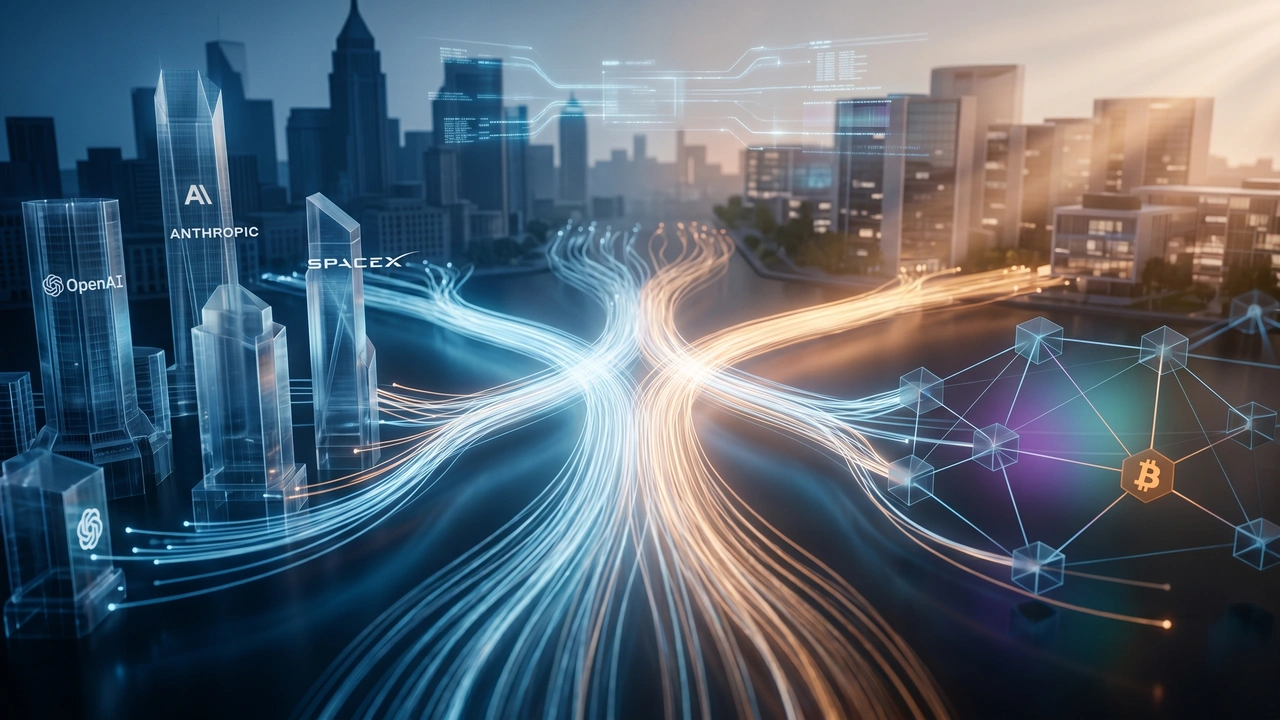
As OpenAI, Anthropic, and SpaceX command record valuations, billions in speculative capital are rotating toward AI - and the crypto market is feeling the gravitational pull. But the story is more nuanced than simple competition.
Key Takeaways
- Capital is visibly rotating toward AI companies like OpenAI, Anthropic, and SpaceX as their valuations climb to record levels, creating a headwind for crypto markets that has persisted for some time.
- This rotation is not purely extractive - the SpaceX IPO revealed substantial demand for tokenized equity on blockchain rails, suggesting crypto infrastructure may benefit from the very trend that is pressuring crypto prices.
- Solana stands to gain more than most blockchain networks from the tokenized equities narrative, particularly if upcoming IPOs from OpenAI and Anthropic generate comparable on-chain trading activity.
- The tokenized stock space carries real risk for retail participants, as token holders may lack the full legal and economic protections that come with owning underlying shares directly.
- Framing AI and crypto as simple competitors likely misreads the situation - the more durable question is whether blockchain networks can position themselves as settlement infrastructure for the AI-era equity market.
AI Mega-IPOs Are Reshaping Capital Flows Across Crypto
Every market cycle produces a dominant narrative, and right now that narrative has a name: artificial intelligence. With headline-grabbing valuations attached to companies like OpenAI, Anthropic, and SpaceX, a genuine reallocation of speculative capital appears to be underway. Bitcoin and the broader crypto market are not immune to this gravitational shift - but whether this represents a structural threat or simply a temporary headwind depends on how you read the deeper signals.
The more interesting question is not whether AI competes with crypto for investor attention. It is whether this rotation is quietly building new infrastructure that could, paradoxically, benefit blockchain networks in the medium term.
The Facts
The current environment is defined by a wave of high-profile public market events. OpenAI, Anthropic, and SpaceX are among the companies ascending from one record-breaking valuation to the next, drawing enormous pools of risk capital that might otherwise have found a home in digital assets [1]. For observers watching Bitcoin's price action, the timing is uncomfortable - momentum in crypto has been fading for some time, and the AI sector's ascent appears to be coinciding with, if not actively contributing to, that softness [1].
The core concern among some market watchers is straightforward: capital is finite, and when a compelling new technology narrative emerges, it tends to cannibalize adjacent speculative categories [1]. The question of whether this is a cyclical pause or something more durable - a genuine displacement of crypto as the premier venue for technology-driven speculation - is now being debated seriously rather than dismissed [1].
Meanwhile, the mechanics of this capital rotation are already producing second-order effects on blockchain networks. The SpaceX IPO demonstrated something noteworthy: appetite for equity exposure through on-chain instruments was substantially larger than most analysts had anticipated [2]. Tokenized versions of SpaceX shares traded on blockchain rails attracted meaningful demand, suggesting that the IPO boom is not purely pulling investors away from crypto - it is also pulling crypto infrastructure into the orbit of traditional equity markets [2].
For Solana in particular, this dynamic carries significant strategic weight. The network has been navigating a difficult period following the collapse of memecoin trading volumes and persistently weak performance in the decentralized physical infrastructure sector [2]. Tokenized equities are emerging as a potential new identity for the chain - one that could attract a different class of user entirely [2]. If the pattern established during the SpaceX listing repeats itself when OpenAI and Anthropic eventually come to market, the resulting attention could provide Solana with a much-needed narrative reset [2].
The structural logic here is worth spelling out. Tokenized stocks occupy a genuinely novel position: they give global retail investors access to pre-IPO or newly-listed equity that would otherwise be gated behind brokerage requirements, geographic restrictions, or minimum investment thresholds. Demand for that kind of access is real and demonstrably large [2]. The risk, however, lies in the fine print - token holders do not always receive the same legal protections or economic rights as holders of the underlying shares, a distinction that retail participants may not fully appreciate until it matters [2].
Analysis & Context
Historically, Bitcoin and the broader crypto market have weathered several cycles in which competing technology narratives - the metaverse era, the NFT supercycle, the DeFi summer - appeared to permanently divert capital away from core digital assets. In each case, the rotation proved temporary, and Bitcoin eventually reclaimed its position as the primary store-of-value asset within the crypto universe. The current AI moment shares some features with those episodes: extreme investor enthusiasm, genuinely transformative underlying technology, and a willingness to pay almost any multiple for exposure.
What distinguishes this cycle, though, is the scale of the companies involved and the maturity of the capital behind them. OpenAI and Anthropic are not venture-stage experiments - they are businesses with real revenue, institutional backing, and credible paths to public markets. The capital rotating toward them is not purely retail speculation; it includes institutional allocators who are making deliberate portfolio decisions. That makes the competitive pressure on crypto somewhat more structural than previous narrative rotations, and it argues for taking the medium-term headwind seriously rather than dismissing it as noise.
At the same time, the tokenized equity trend represents a genuine wildcard. If blockchain networks become the preferred settlement layer for the next generation of equity products - particularly around high-demand IPOs - the practical utility case for holding and using those networks strengthens considerably. This is not a zero-sum game. AI companies going public could simultaneously drain speculative capital from Bitcoin in the short run while building the real-world demand foundation that validates blockchain infrastructure over a longer horizon. Investors who frame this as AI versus crypto may be missing the more consequential story.
Sources
- [1]btc-echo.de
- [2]btc-echo.de
AI-Assisted Content
This article was created with AI assistance. All facts are sourced from verified news outlets.