Altcoin Breakouts Under Pressure: SOL and LTC at Crossroads
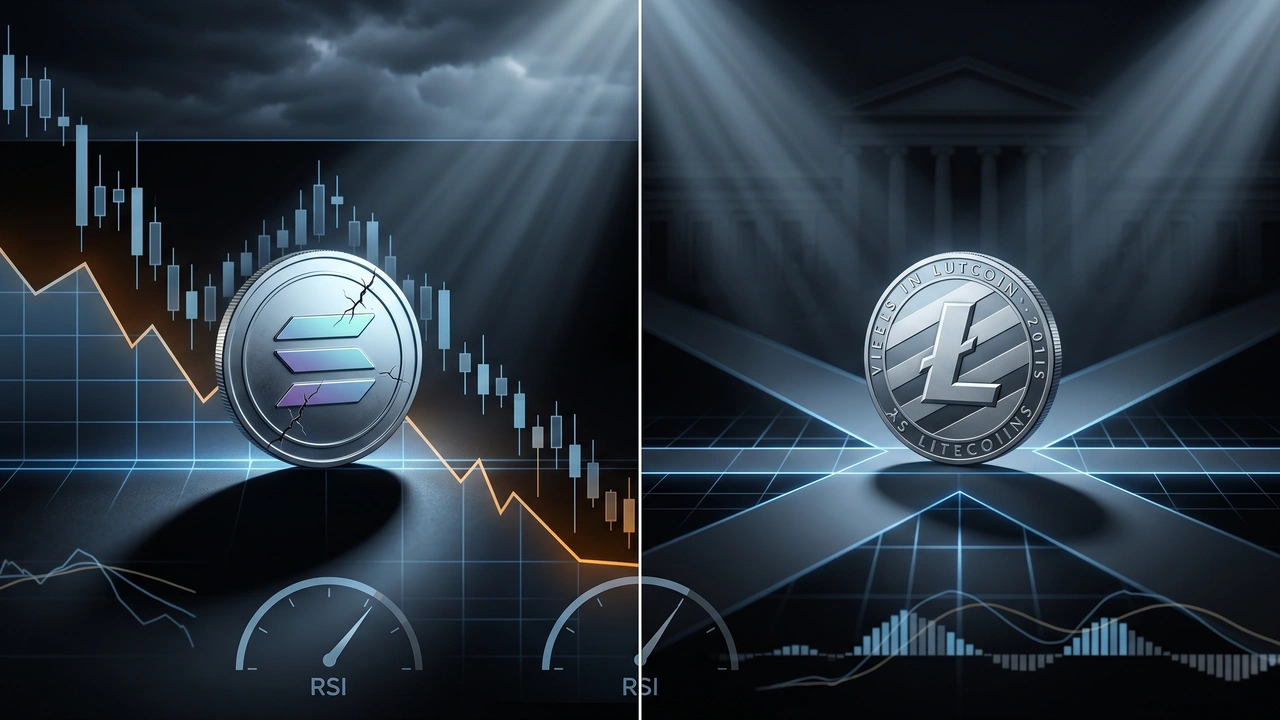
Solana and Litecoin both attempted price breakouts recently, but technical signals now suggest that sustaining those moves will require more than hope - here is what the data actually shows.
Key Takeaways
- Solana's "Alpenglow" upgrade is a legitimate technical development targeting long-standing network stability issues, but with mainnet launch set for Q3 2026, the immediate price catalyst is limited - the brief breakout above $100 appears to have been a forward-pricing event that has now reversed [1].
- SOL's RSI at 26.7 places it in oversold territory, which can precede relief rallies, but the $83.23 Fibonacci support level is the line in the sand - a break below that level would open the door to a move into the $70-$82 range [1].
- Litecoin's SEC "Digital Commodity" classification and the $48.2 million Lite Strategy treasury position represent meaningful institutional credibility gains, but the market has yet to translate these fundamentals into sustained upside price action [2].
- For LTC, the $56.33 support level is the critical threshold - a confirmed close below this level would invalidate the current consolidation thesis and likely trigger a more significant correction toward the $54 range [2].
- Both assets illustrate a broader pattern: in the current market environment, fundamental improvements are necessary but not sufficient conditions for breakouts - volume confirmation and macro tailwinds remain essential co-factors that are currently absent.
Altcoin Breakouts Are Stalling - And the Charts Are Telling a Familiar Story
The altcoin market entered mid-2025 with two notable narratives competing for investor attention: Solana chasing a psychologically critical $100 level on the back of a promising new protocol upgrade, and Litecoin consolidating after a modest breakout supported by fresh institutional interest. Both stories carry genuine substance. Both are also, for the moment, losing momentum. The divergence between the fundamental case for each asset and the reality of their price action is exactly the kind of tension that defines pivotal moments in crypto markets - and exactly the kind of situation that rewards careful, patient analysis over reactive trading.
For Bitcoin-focused investors watching the broader digital asset landscape, these developments matter. Altcoin price behavior is often a leading indicator of broader market sentiment, and the struggles of mid-cap coins to hold breakout levels tells us something important about where risk appetite actually stands right now.
The Facts
Solana made headlines earlier this week when it briefly pushed above $100 - a threshold that has carried heavy symbolic weight for the community after a prolonged period of underperformance. The rally, however, did not hold. At the time of writing, SOL is trading near $85.83, well below both its intraday high of $91.27 and the psychologically significant three-digit level [1]. The retreat has been accompanied by deteriorating technical indicators: SOL is trading meaningfully below its 20-period exponential moving average of $90.55, and the price structure has shifted into a pattern of lower highs and lower lows - a textbook short-term downtrend [1].
The momentum picture reinforces the bearish reading. The 14-period RSI has dropped to approximately 26.7, placing SOL firmly in oversold territory [1]. While oversold readings can precede sharp relief bounces, the MACD histogram is simultaneously signaling accelerating downside pressure, which complicates any near-term recovery thesis [1]. Key support levels to watch sit at $85.52 (the recent intraday low) and $83.23, a Fibonacci-derived level that would represent meaningful structural damage if broken [1].
The underlying fundamental catalyst is the "Alpenglow" protocol upgrade, which entered its first testnet phase this week [1]. The update targets one of Solana's most persistent weaknesses - network stability and validator consensus efficiency - and is designed to improve both speed and resilience during periods of high user activity [1]. The mainnet launch is not expected until the third quarter of 2026, meaning any price impact from the upgrade itself remains a future story, not a present one [1].
Litecoin presents a different but equally instructive picture. LTC is trading around $58.10, hovering just above its 20-period EMA at $57.91 and consolidating after a prior peak of $60.61 [2]. The fundamental backdrop has improved meaningfully: Lite Strategy now holds LTC worth approximately $48.2 million as a treasury asset, and the SEC's classification of Litecoin as a "Digital Commodity" has reduced regulatory ambiguity in a way that could open doors for institutional participation [2]. The market, however, has not rushed to reprice these developments. The RSI sits at a neutral 46.8, the Bollinger Band width is a relatively tight $2.83, and volume has not yet confirmed a directional conviction [2]. A break above $58.92 would be the first meaningful signal that bulls are reasserting control; a close below $56.33 would flip the technical picture decisively negative [2].
Analysis & Context
What we are witnessing with both Solana and Litecoin is a dynamic that has played out repeatedly across crypto market cycles: genuine fundamental improvements running into a wall of macro caution and thin liquidity. Solana's Alpenglow upgrade is a real development - addressing validator consensus latency is not cosmetic work, it is infrastructure-level progress that could meaningfully improve the network's reliability for DeFi applications and high-frequency use cases. But markets price in known catalysts in advance, and when the mainnet launch is more than a year away, the present-day price impact of a testnet announcement is inherently limited. The brief spike toward $100 may well have represented that advance pricing, and the subsequent pullback is the market reverting to fundamentals that are not yet fully realized.
For Litecoin, the SEC's "Digital Commodity" designation is genuinely significant in the context of 2025's evolving regulatory environment. It reduces one of the major overhangs that has historically kept institutional allocators cautious about direct crypto exposure. The Lite Strategy treasury position echoes the corporate accumulation strategies that transformed Bitcoin's institutional narrative in 2020-2021. The critical difference is that Litecoin lacks Bitcoin's absolute scarcity narrative and its network effect moat - which means institutional interest, while positive, does not carry the same reflexive, self-reinforcing momentum that Bitcoin treasury adoption has generated. LTC needs organic demand growth alongside the institutional story to sustain a breakout, and the current technical picture suggests that demand has not yet arrived in sufficient size.
Historically, RSI readings below 30 in assets with improving fundamentals have preceded some of the more explosive bounces in crypto markets - but timing those bounces has been notoriously difficult, and the environment matters enormously. In a risk-off macro environment, oversold assets can stay oversold far longer than seems reasonable. The 45% probability assigned to a continued bearish scenario for SOL is a sober assessment, not a pessimistic one [1].
Sources
- [1]btc-echo.de
- [2]btc-echo.de
AI-Assisted Content
This article was created with AI assistance. All facts are sourced from verified news outlets.