Altcoin Markets Signal Resilience Amid Institutional Wave
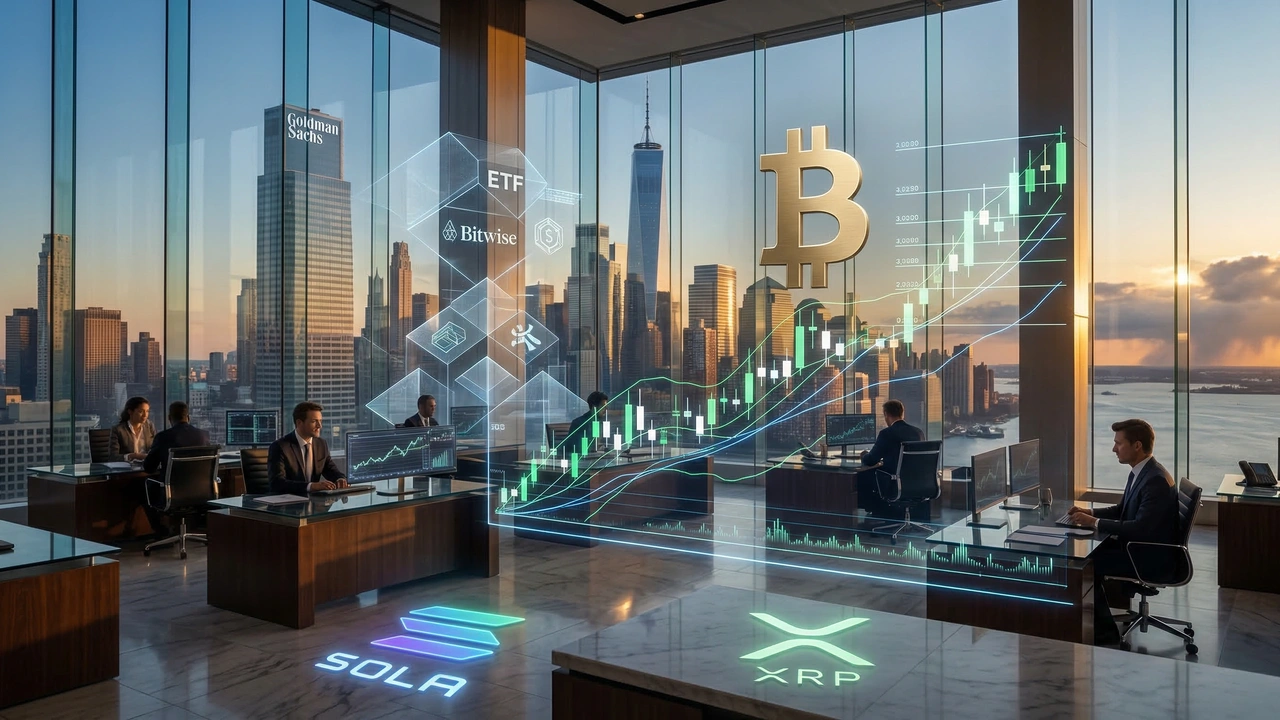
Solana holds key support levels despite geopolitical headwinds, Goldman Sachs emerges as the largest known XRP ETF investor, and Bitwise's CIO makes a compelling case for Bitcoin's long-term store-of-value dominance — three developments that together reveal a maturing digital asset landscape.
Key Takeaways
- Solana's technical setup is cautiously bullish: holding above $80 with narrowing Bollinger Bands and negative futures funding rates reduces downside risk, but bulls must reclaim the $87–$91 resistance zone to confirm a trend reversal toward $105+.
- Goldman Sachs holding ~$154 million in XRP ETF exposure marks a watershed moment for altcoin institutional credibility, signaling that regulatory clarity is translating into real capital allocation beyond Bitcoin and Ethereum.
- XRP spot ETFs have already accumulated $1.44 billion in AUM with over $1 billion in cumulative inflows, yet the visible investor base represents only a small fraction of actual demand due to 13F reporting thresholds.
- Bitwise's Hougan reframes the $1 million Bitcoin thesis not as a moonshot fantasy but as a natural consequence of a growing store-of-value market — Bitcoin needs only 17% of a projected $121 trillion market in a decade to reach that level.
- The overarching trend connecting all three developments is accelerating institutional normalization of digital assets, a structural shift that historically creates sustained demand floors rather than speculative spikes.
Altcoin Markets Are Quietly Signaling Something Big
While headlines have been dominated by Middle East tensions and macro uncertainty, the altcoin market is delivering a quietly bullish message. Solana is holding critical support levels that many expected to crack, XRP exchange-traded funds are drawing serious institutional capital led by none other than Goldman Sachs, and Bitwise's chief investment officer is making a rigorous, data-driven case that Bitcoin's long-term price trajectory is far more grounded than skeptics assume. Taken individually, each development is noteworthy. Taken together, they tell a coherent story about a digital asset market that is growing up fast.
The connecting thread here is institutional conviction. Whether it is Wall Street money quietly accumulating SOL exposure through spot ETFs, Goldman Sachs building a nine-figure position in XRP funds, or Bitwise constructing a framework that positions Bitcoin as a credible competitor to gold's $36 trillion market cap, sophisticated capital is no longer treating crypto as a speculative curiosity. It is treating it as an emerging asset class with structural demand drivers — and that shift has real implications for price discovery across the entire market.
The Facts
Solana has demonstrated notable resilience in recent weeks, holding above the $80 support level despite fresh multi-month lows in U.S. equity indices triggered by geopolitical conflict in the Middle East [1]. Rather than collapsing toward its annual low, SOL posted a modest three-percent recovery, pulling back toward its 20-day exponential moving average around $86 [1]. Technical indicators are adding nuance to this picture: Bollinger Bands are narrowing, a classic precursor to a directional breakout, while negative funding rates in the Solana futures market suggest futures traders are not positioned with excessive greed, reducing the risk of a market-maker-driven flush [1].
For bulls to regain control of the SOL chart, the key near-term hurdle is a sustained close above the resistance zone between $87 and $91 [1]. A successful reclaim of that band would open the path toward the 50-day EMA near $95, with the next meaningful target sitting in the $105 to $112 range — a zone that coincides with the 50% Fibonacci retracement from the recent decline [1]. On the downside, a failure to hold $75 on a daily closing basis would likely send price back toward the annual low of $67, and a breakdown beneath that level with high volume could expose the $56 to $51 support region last tested in late 2023 [1].
Over in the XRP ecosystem, the institutional footprint is becoming impossible to ignore. Goldman Sachs has emerged as the single largest known investor in spot XRP ETFs, holding positions valued at approximately $154 million as of year-end 2025, according to Bloomberg Intelligence data [2]. The 30 largest identifiable investors collectively held around $211 million in XRP ETF shares, while total assets under management across Ripple-focused spot funds have reached roughly $1.44 billion, with cumulative inflows already surpassing the $1 billion milestone [2]. Bloomberg analyst James Seyffart cautioned, however, that the visible investor base represents only a fraction of actual demand, since the 13F reporting threshold of $100 million in managed securities excludes the majority of market participants [2]. Bloomberg's Eric Balchunas added a cultural dimension to the analysis, suggesting much of the demand likely originates from the committed Ripple enthusiast community rather than conventional retail investors [2].
Meanwhile, Bitwise CIO Matt Hougan published a memo arguing that the dismissal of a $1 million Bitcoin price target relies on a fundamental analytical error: treating the store-of-value market as a fixed-size denominator [3]. Hougan calculates the current global store-of-value market at just under $38 trillion, with gold accounting for roughly $36 trillion and Bitcoin representing approximately $1.4 trillion, or less than 4% of the total [3]. His argument is not that Bitcoin should immediately seize half the market, but rather that the market itself will expand — pointing to gold's growth from $2.5 trillion in 2004 to nearly $40 trillion today, driven by rising government debt, geopolitical instability, and monetary expansion [3]. Projecting forward a decade, Hougan estimates the store-of-value market could reach $121 trillion, at which point Bitcoin would need only a 17% share to trade at $1 million per coin [3].
Analysis & Context
Solana's ability to absorb geopolitical shockwaves without testing its annual lows is technically meaningful. In previous risk-off events — including the March 2020 COVID crash and the 2022 rate-hike cycle — altcoins amplified Bitcoin's downside moves dramatically. The fact that SOL is forming higher lows on the daily chart while equity indices are breaking to multi-month lows suggests a degree of structural demand that was absent in prior cycles. The inflows into Solana's spot ETF products referenced by analysts reinforce this reading: institutional buyers appear to be using dips as accumulation opportunities rather than exits. The narrowing Bollinger Bands are a technical wildcard — they signal that volatility compression is ending, but the direction of the eventual breakout is not predetermined. If macro conditions stabilize, the setup favors the bulls; if Bitcoin deteriorates sharply, the bears retain the ability to reclaim the narrative.
The Goldman Sachs XRP position deserves particular attention because of what it represents symbolically as much as financially. Goldman managing a $154 million ETF exposure in what was, until recently, a legally embattled token signals that institutional risk committees are now comfortable with the regulatory trajectory of altcoins beyond Bitcoin and Ethereum. This mirrors the pattern seen in the gold ETF era Hougan references: once institutional custody and regulated product wrappers arrive, capital allocation accelerates in ways that are difficult to predict in real time. The XRP ETF story is still in its early innings — total AUM of $1.44 billion is modest compared to Bitcoin ETF assets — but the velocity of inflows and the caliber of early investors suggest this market is not a retail curiosity.
Hougan's store-of-value framework is analytically disciplined precisely because it does not require Bitcoin to "win" — it only requires the market Bitcoin competes in to grow as it has historically grown. The parallels to gold's post-ETF trajectory are compelling: the launch of accessible, regulated products unlocked demand from institutional allocators who were previously sidelined. Bitcoin spot ETFs in the U.S. replicate that dynamic, and the early data on institutional adoption — endowments, sovereign wealth funds, and large asset managers raising Bitcoin allocations from roughly 1% toward 5% — supports the directional logic even if the specific price targets carry uncertainty [3].
Sources
AI-Assisted Content
This article was created with AI assistance. All facts are sourced from verified news outlets.