Altcoin Reality Check: Structural Flaws and Memecoin Drift
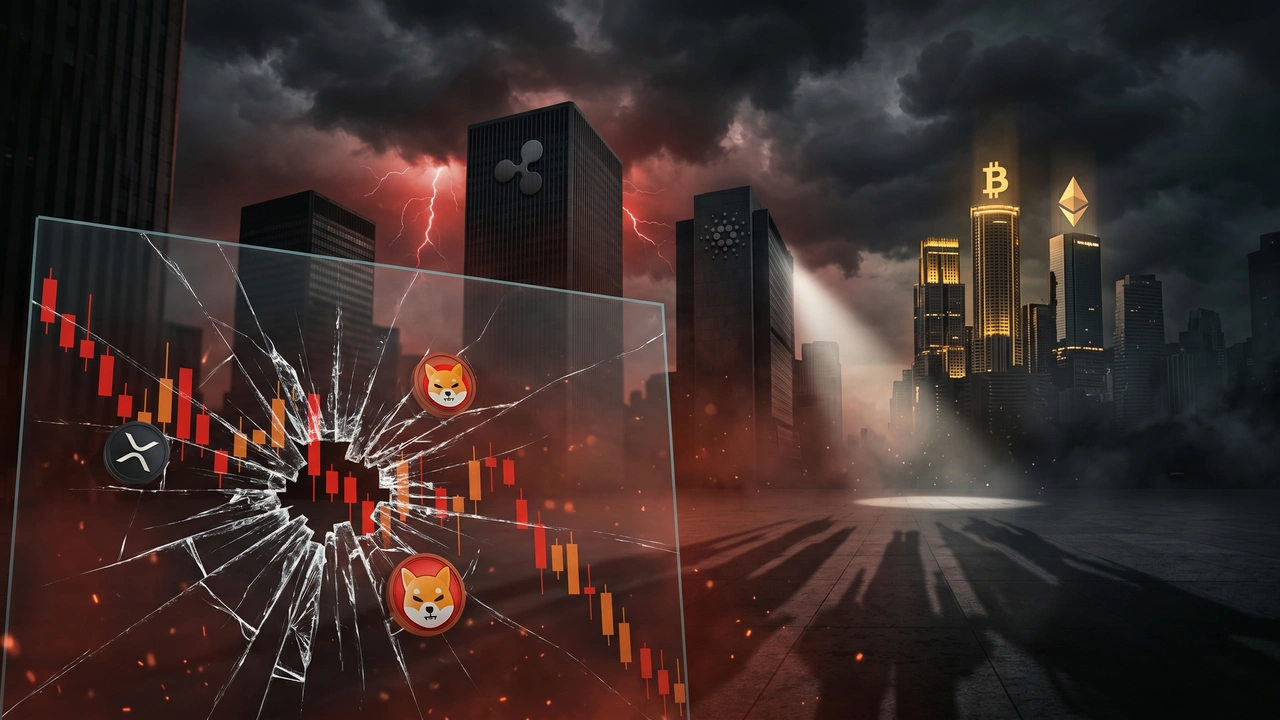
As XRP slides 24% year-to-date and Shiba Inu consolidates near multi-year lows, a broader reckoning is underway for altcoins: fundamentals matter, and the gap between corporate success and token holder returns is widening.
Key Takeaways
- Token ≠ company equity: XRP holders have no legal or financial claim on Ripple's revenues or asset acquisitions — Hoskinson's critique underscores that corporate success in crypto does not automatically benefit token holders, a structural flaw absent in Bitcoin [1].
- The EOS precedent is a live warning: The pattern of companies raising capital through token sales and then decoupling from holder interests has repeated itself multiple times in crypto history; due diligence on token economics is non-negotiable [1].
- Hoskinson's credibility problem: While his structural criticism of Ripple holds merit, ADA's 64% annual decline versus XRP's 37% makes the messenger a problematic one — investors should evaluate the argument on its own terms, not its source [1].
- SHIB's 93% drawdown illustrates memecoin lifecycle risk: Assets driven purely by sentiment and community hype have no fundamental floor; the current consolidation phase offers no reliable signal of a sustained recovery [2].
- Bitcoin's structural advantage grows clearer in bear markets: The absence of a corporate issuer, token unlocks, or executive-held reserves means Bitcoin carries none of the counterparty risks that are visibly eroding confidence in both XRP and memecoin assets right now [1][2].
The Altcoin Illusion: When Hype Meets Structural Reality
The crypto market in 2026 is delivering a sobering lesson to altcoin investors: brand recognition and corporate momentum do not automatically translate into token value. From XRP's decoupling from Ripple's business success to Shiba Inu's post-hype consolidation near historic lows, the altcoin landscape is painting a picture that Bitcoin maximalists have long argued was inevitable. The structural weaknesses that were easy to ignore during bull-market euphoria are now impossible to paper over.
Two developments — Cardano founder Charles Hoskinson's renewed broadside against Ripple's token economics, and a technical analysis of Shiba Inu's languishing price action — together tell a coherent story about where value actually resides in the crypto ecosystem, and more importantly, where it does not.
The Facts
XRP has shed approximately 24% of its value since the start of 2026, currently trading around $1.40, and is underperforming both Bitcoin and Ethereum, which managed at least a partial recovery over the past month [1]. Against this backdrop, Cardano's Charles Hoskinson renewed his long-standing criticism of Ripple's business model in a recent interview, arguing that the company and its token are fundamentally disconnected entities.
"[Ripple] will continue to dump XRP and make billions of dollars and then buy real-world assets with a company that is decoupled from that, and XRP holders will have no part of it," Hoskinson stated [1]. His core argument is that Ripple's operational and financial success — including its RLUSD stablecoin initiative — creates no structural mechanism by which retail XRP holders benefit. There is, he contends, neither a financial nor a legal incentive for Ripple's leadership to share profits with token holders [1].
Hoskinson pointed to Hyperliquid as a contrasting example, suggesting that Ripple should tie its business model directly to XRP buybacks — a mechanism that would create genuine alignment between corporate performance and token value [1]. He also invoked the cautionary tale of Block One, the company behind EOS, which raised $4 billion and subsequently declared it had no fiduciary obligation to U.S. token holders before walking away with the funds [1].
The irony, however, is not lost: Hoskinson's own Cardano (ADA) has fallen approximately 64% over the past year — a significantly steeper decline than XRP's 37% annual loss [1]. Hoskinson has been more visible recently for his public criticisms of Ripple, the U.S. government, and the proposed Clarity Act — which he dismissed as "terrible garbage" — than for any catalytic developments within the Cardano ecosystem itself [1].
Meanwhile, Shiba Inu is presenting a textbook case of post-hype stagnation. The memecoin is down roughly 54% over the past year and approximately 11.5% since the start of 2026 [2]. More starkly, SHIB has lost approximately 92.9% of its value since its all-time high in October 2021 [2]. Current technical indicators place SHIB in a consolidation phase, with the price trading just below its 20-day EMA at approximately $0.00000615, an RSI of around 45.6 — below the neutral 50 threshold — and Bollinger Bands indicating moderate but not extreme volatility [2]. Key support levels sit at $0.00000603 and $0.00000596, while resistance lies at $0.00000620 and $0.00000629 [2].
Analysis & Context
Hoskinson's critique of Ripple, while pointed, is also a mirror. The EOS comparison he raises is historically apt: Block One's 2018 ICO was the largest in history at the time, and the subsequent abandonment of token holders became one of crypto's defining cautionary tales. Ripple's situation is structurally similar in one key respect — the company holds enormous XRP reserves and generates revenue independently of token price appreciation. This creates an asymmetric relationship: Ripple benefits from XRP's high price (as a form of treasury asset), while its operational revenue streams do not feed back into token value in any guaranteed way. That is not a new observation, but in the context of a 37% annual decline, it carries more urgency.
What makes Hoskinson's intervention noteworthy — despite his own project's underperformance — is that it highlights a systemic issue across much of the altcoin space: the conflation of token price with project or company value. Investors frequently buy into the narrative of a company's success without scrutinizing whether the token itself has any legal, contractual, or economic claim on that success. Bitcoin, by contrast, has no issuing company, no executive team dumping coins, and no venture capital overhang. Its value proposition is precisely its absence of such intermediaries.
The Shiba Inu analysis reinforces a parallel truth about the memecoin segment. SHIB's near-93% drawdown from its 2021 peak is not an anomaly — it is the norm for assets whose price is driven almost entirely by sentiment and speculative momentum rather than utility or cash flows. The current technical consolidation may resolve with a short-term bounce, but the medium-term trajectory for assets with no fundamental value anchor remains structurally challenged. Historical precedent from Dogecoin, SafeMoon, and dozens of other memecoins suggests that once a hype cycle ends, the road back to former highs is extraordinarily long — or never comes at all. For Bitcoin-focused investors, these developments serve as a recurring reminder of why store-of-value properties and fixed supply mechanics are not just talking points, but the foundational difference between speculative instruments and sound money.
Sources
- [1]btc-echo.de
- [2]btc-echo.de
AI-Assisted Content
This article was created with AI assistance. All facts are sourced from verified news outlets.