Altcoins at a Crossroads: Myth, Market Drift, and the Payment Race
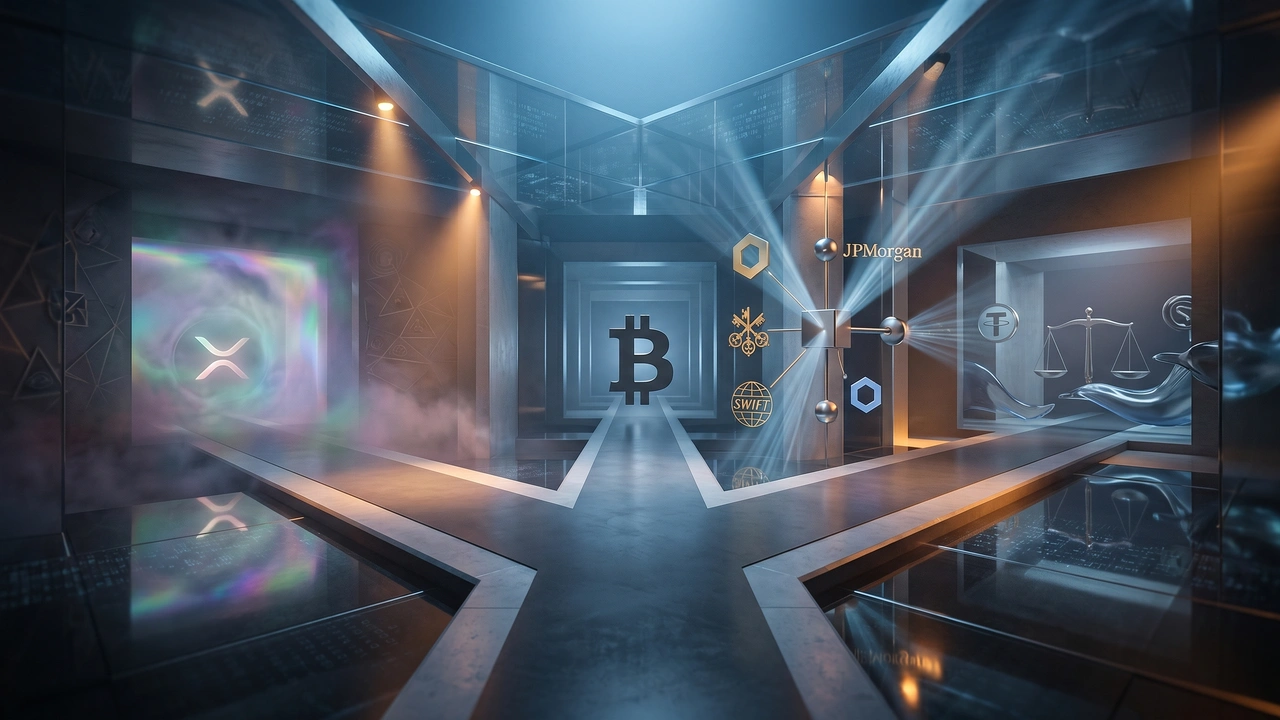
From XRP conspiracy theories to Chainlink's AI pivot and stablecoins challenging Bitcoin's payment narrative, the altcoin landscape is being reshaped by forces that Bitcoin investors cannot afford to ignore.
Key Takeaways
- The XRP "589" narrative and Great Reset conspiracy theories are textbook examples of speculative mythology replacing fundamental analysis — retail investors drawn in by such stories face asymmetric downside risk with no credible price catalyst to sustain the thesis [1]
- Chainlink's institutional partnerships with JPMorgan, UBS, Swift, and others represent genuine infrastructure buildout, but strong fundamentals and bullish price action are not the same thing — the token remains technically weak below its EMA-20 and requires a confirmed close above $9.35 before short-term sentiment shifts [2]
- Stablecoins — not Bitcoin, not XRP — are emerging as the dominant digital payment instrument, backed by regulatory clarity under MiCA in Europe and deep corporate investment from Visa, Mastercard, and PayPal in the US [3]
- Bitcoin's optimal positioning remains as a long-term store of value and savings technology; investors conflating this with short-term payment utility are likely to be disappointed by adoption metrics [3]
- The digital euro's 2029 target timeline is realistically optimistic at best — Euro-denominated stablecoins from consortia like AllUnity and Qivalis may fill the practical gap in the interim, making private Euro stablecoins worth monitoring as an emerging category [3]
The Altcoin Landscape Is Fragmenting — and the Winners May Surprise You
The altcoin market has never been a monolith, but in mid-2025 the fractures are becoming impossible to ignore. Three distinct forces are pulling the space in radically different directions simultaneously: the persistence of irrational narrative-driven speculation, genuine institutional infrastructure buildout, and a regulatory-regulatory-shaped realignment of what digital money is actually for. Understanding how these currents interact is essential for anyone trying to make sense of where value will ultimately settle — and, critically, what all of this means for Bitcoin's own position.
The connecting thread running through each of these developments is a fundamental question: which digital assets will earn lasting relevance, and which will remain prisoners of their own mythology?
The Facts
Beginning with the most flamboyant corner of the altcoin world: XRP and Ripple remain uniquely entangled in a web of conspiracy theories that are, arguably, more revealing of retail investor psychology than of any actual financial reality. A 2024 study published in the Journal of Politics in Central Europe documented how XRP is frequently portrayed in online communities as either a future world reserve currency or an instrument of global financial surveillance — framing driven largely by the project's close ties to banks and its comparatively centralized structure [1]. These narratives have evolved over time, increasingly linking Ripple to the so-called "Great Reset" hypothesis, casting it as the technological backbone of an elite-controlled global financial system [1].
Among the most durable artifacts of this ecosystem is the "589" price target — a figure traced back to a 2018 YouTube channel called "Bearableguy123" that published cryptic videos in which the number featured prominently [1]. The figure subsequently went viral, amplified by a fabricated Simpsons screenshot purportedly showing Bart Simpson writing "XRP to hit 589" on a chalkboard — later confirmed to be a fake [1]. Despite XRP never having breached the four-dollar mark, the target endures as a symbol of inevitable triumph for the so-called XRP Army [1]. As X analyst Zach Rynes characterized it, the entire thesis is a "bizarre retail narrative" sustained by influencer exaggeration and conspiratorial thinking about secret banking cartels engineering an "XRP Standard" [1].
Chainlink tells a starkly different story — one grounded in verifiable institutional traction. LINK's development team has forged active pilot programs with JPMorgan, UBS, Swift, Euroclear, and the DTCC, positioning the oracle network at the intersection of traditional finance and emerging AI-driven data infrastructure [2]. A late-2025 stablecoin collaboration with AllUnity further raised the project's profile among institutional observers [2]. Yet despite this fundamental momentum, LINK's price action tells a sobering counternarrative: the token trades around $9.20, below its 20-period EMA of $9.35, with an RSI of approximately 39.4 signaling weak buying momentum [2]. Fibonacci support sits near $9.07, while overhead resistance clusters at the EMA and the recent high of $9.65 [2]. Strong fundamentals and weak price action coexisting is a pattern the market has seen before — and it cuts both ways.
Perhaps the most consequential development, however, is the growing expert consensus that Bitcoin is losing the payments race — not to other proof-of-work chains, but to stablecoins. Dr. Jonas Groß, speaking with BTC-ECHO, was direct: price volatility of five to ten percent within short windows makes Bitcoin fundamentally unsuitable as a day-to-day payment instrument, regardless of Lightning Network improvements [3]. Stablecoins — overwhelmingly dollar-denominated at roughly 98 percent market share — are increasingly backed by major payment infrastructure, with Mastercard, Visa, PayPal, and Stripe all deepening their stablecoin commitments, particularly in the United States [3]. The EU's MiCA framework has created regulatory clarity that Euro-denominated stablecoins are beginning to grow into, though volumes remain modest [3]. The digital euro, meanwhile, targets a 2029 launch — a timeline Dr. Groß described as "optimistic" given that the legislative process remains incomplete [3].
Analysis & Context
For Bitcoin-focused investors, these three narratives converge on a single uncomfortable truth: the altcoin market is maturing in ways that create both genuine competition and genuine distraction — and distinguishing between the two is now a core analytical skill.
The XRP conspiracy ecosystem is best understood as a leading indicator of retail irrationality at cycle peaks. Historically, the proliferation of outlandish price targets and secret-plan narratives — whether 589 for XRP or similar meme-driven targets for other tokens — has preceded significant corrections rather than preceded them. The pattern is consistent: speculative narratives fill the vacuum left by absent fundamentals, and retail capital chases stories rather than substance. Bitcoin went through its own version of this in its early years, but the difference is that Bitcoin's underlying thesis — fixed supply, decentralized issuance, censorship resistance — has survived sustained scrutiny. XRP's thesis rests on regulatory favor and banking partnerships that are, by definition, revocable.
Chainlink's situation is more nuanced and arguably more interesting from a structural standpoint. The project is executing exactly the kind of institutional integration that was once promised as a universal altcoin value driver. That execution is not yet reflected in price is a reminder that markets are pricing mechanisms, not merit-recognition systems. The broader lesson for Bitcoin investors is that institutional adoption alone does not guarantee price appreciation on any particular timeline — a point equally relevant to those projecting Bitcoin treasury adoption translating immediately into price discovery. That said, LINK's accumulation zone characteristics — compressed Bollinger Bands, RSI nearing oversold territory, strong support near $9.00 — historically precede either a significant bounce or a breakdown, with volume being the key discriminator [2].
The payments narrative is where Bitcoin's community faces its most substantive long-term challenge. Dr. Groß's assessment aligns with what Bitcoin maximalists have historically resisted acknowledging: the Lightning Network, while technically impressive, has not achieved the penetration required to make Bitcoin a dominant payments rail at the consumer level [3]. Stablecoins have, in practical terms, already won the "crypto payments" debate — at least for this cycle. This does not diminish Bitcoin's core value proposition as a savings technology and store of value, but it does suggest that the "peer-to-peer electronic cash" framing from Satoshi's white paper is being operationalized by dollar-pegged instruments rather than by Bitcoin itself.
Sources
- [1]btc-echo.de
- [2]btc-echo.de
- [3]btc-echo.de
AI-Assisted Content
This article was created with AI assistance. All facts are sourced from verified news outlets.