America's Push to Own Its Bitcoin Mining Stack, From Chips to Reserves
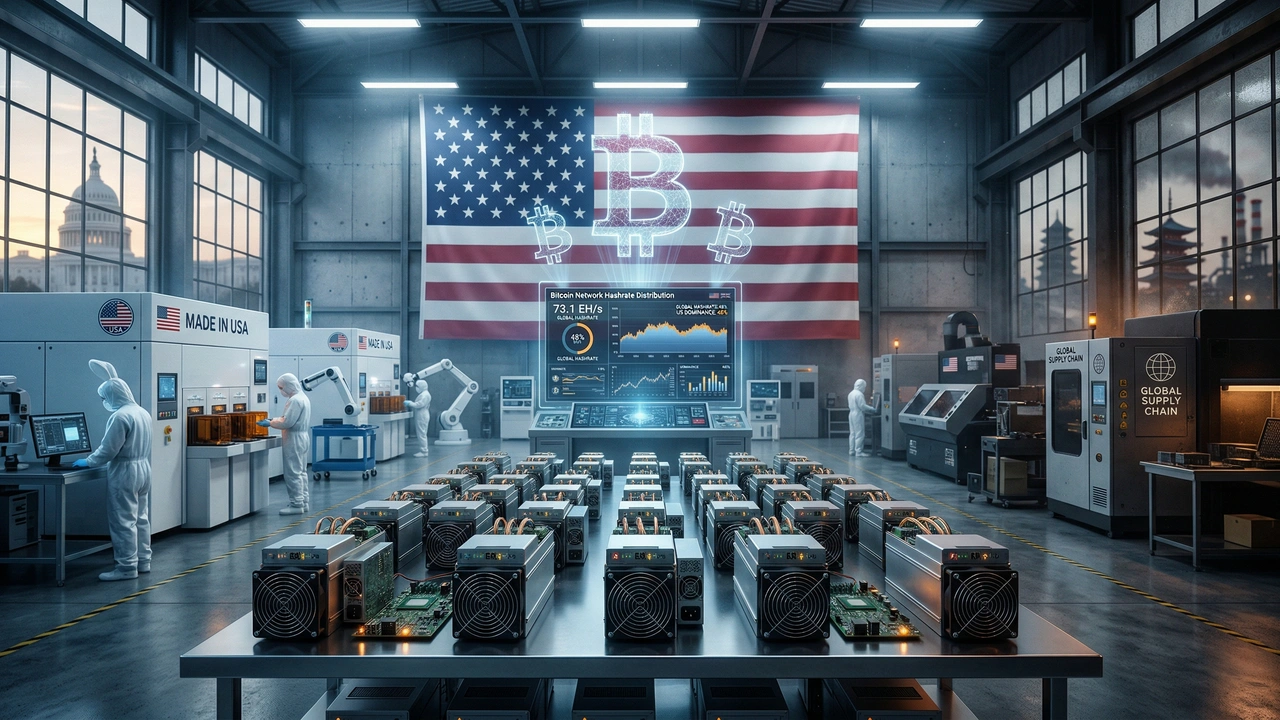
A new Senate bill aims to break the US mining industry's near-total dependence on Chinese hardware manufacturers, while a Bitcoin mining pioneer's real estate sale offers a stark reminder of the opportunity cost baked into every satoshi spent.
Key Takeaways
- The US controls 38% of global Bitcoin hashrate but manufactures virtually none of its own mining hardware, with 97% of ASICs produced by two Chinese firms — a strategic vulnerability now being addressed at the Senate level [1].
- The "Mined in America Act" proposes a voluntary certification scheme for miners, mandates a phase-out of hardware from foreign adversaries, and would codify the Strategic Bitcoin Reserve into law, creating a direct link between domestic mining and national Bitcoin accumulation [1].
- The late 2024 customs seizure of Bitmain machines at US ports demonstrated that supply chain dependence on foreign hardware is not a hypothetical risk — it is a live operational threat that has already cost American miners time and revenue [1].
- Wang Chun's sale of a condo originally purchased for 2,900 BTC for just 7 BTC is a powerful reminder that Bitcoin's appreciation trajectory has historically made any non-Bitcoin denominated asset look like a poor trade in retrospect — a dynamic that increasingly shapes how serious Bitcoin-native companies manage their balance sheets [2].
- For investors and operators in the mining sector, the push toward domestic hardware manufacturing signals a potential long-term shift in the industry's cost structure and supply chain resilience — one that could take years to materialize but represents a genuine inflection point in Bitcoin's geopolitical footprint.
America Wants to Mine Bitcoin — But First It Has to Build the Machines
The United States controls more Bitcoin hashrate than any other nation on earth, yet it manufactures almost none of the hardware that makes that dominance possible. That contradiction is now the target of a new piece of legislation in Washington, one that seeks to rewire the entire Bitcoin mining supply chain from the ground up. At stake is not just industrial policy, but strategic control over the infrastructure that secures the world's largest decentralized monetary network.
Seen alongside a Bitcoin mining pioneer's recent, painfully instructive property sale in Thailand, this week's developments paint a vivid picture of an industry at a crossroads — one wrestling simultaneously with geopolitical risk, supply chain fragility, and the relentless arithmetic of holding versus spending Bitcoin.
The Facts
US Senators Bill Cassidy and Cynthia Lummis introduced the "Mined in America Act" on Monday, a bill designed to reduce the country's dependence on Chinese-manufactured Bitcoin mining equipment and to formalize the country's ambitions around a Strategic Bitcoin Reserve [1]. The legislation would create a voluntary certification program for mining facilities and mining pools operating under a "Mined in America" banner. Certified operations would be required to progressively eliminate hardware sourced from companies linked to foreign adversaries and to actively support the domestic production of mining equipment [1].
"Digital asset mining is a big part of our economy. We should be doing it here in America," Senator Cassidy stated in a Monday release [1]. The bill would also direct the National Institute of Standards and Technology and the Manufacturing Extension Partnership to assist US manufacturers in developing mining hardware that is both more secure and more energy-efficient [1]. Additionally, the legislation seeks to codify President Trump's earlier executive order establishing a Strategic Bitcoin Reserve, creating a legislative pipeline between certified domestic mining output and national Bitcoin holdings [1].
The urgency behind the bill becomes clear when the numbers are examined. While the US hosts approximately 38% of the Bitcoin network's global hashrate — more than double that of second-place Russia — a staggering 97% of Bitcoin mining hardware is produced by just two Chinese companies: Bitmain and MicroBT [1]. Dennis Porter, CEO of the Satoshi Action Fund and a vocal supporter of the legislation, described the dynamic bluntly: "The Mined in America Act breaks that dependency by building a virtuous cycle of domestic manufacturing, certified mining operations, grid-strengthening energy infrastructure and a pipeline to the Strategic Bitcoin Reserve" [1].
The hardware dependency is not merely theoretical. Starting in late 2024, US Customs and Border Protection halted shipments of thousands of Bitmain ASIC machines at American ports, disrupting operations for multiple mining companies over a period of several months [1]. Luxor Technology was among those affected, with its chief operating officer Ethan Vera explaining earlier this year that the machines had been seized due to an erroneous classification as illegally imported radio frequency devices [1].
Meanwhile, from a very different corner of the Bitcoin mining world, F2Pool co-founder Wang Chun offered the industry an inadvertent case study in long-term Bitcoin valuation. Chun disclosed this week that he had sold a condominium in Pattaya, Thailand — originally purchased in 2015 for 2,900 BTC when Bitcoin traded near $270 — for just 7 BTC [2]. At Bitcoin's peak above $126,000, those original 2,900 BTC would have been worth approximately $365 million; at current prices near $67,000, the figure stands at roughly $194 million [2]. The property, valued at around $785,000 at the time of purchase, was sold for a fraction of what the Bitcoin spent on it eventually became worth — a gap that no traditional asset class comes close to bridging, with gold up roughly 275% and the S&P 500 up approximately 284% over the same decade [2].
Analysis & Context
The "Mined in America Act" arrives at a moment when the intersection of national security policy and Bitcoin infrastructure is more politically charged than at any point since China's 2021 mining ban reshuffled the global hashrate map. That ban was, in hindsight, a geopolitical gift to the US mining sector — hashrate flooded westward almost overnight, and American mining companies expanded aggressively to absorb it. But the supply chain never followed. The picks-and-shovels of the Bitcoin mining industry — the ASICs — remained firmly in Chinese hands.
This is a structural vulnerability that could, in a sufficiently adversarial geopolitical environment, prove costly. The late 2024 customs seizures were a preview of what supply chain disruption looks like in practice: thousands of machines sitting idle at ports, mining companies losing hashrate, revenue, and competitive position while bureaucratic classifications were untangled. A fully domesticated hardware manufacturing capability would eliminate this single point of failure. The challenge, of course, is that building a competitive ASIC fabrication capability in the United States is an enormously capital-intensive and technically demanding undertaking. TSMC, Samsung, and a handful of Asian foundries currently dominate the advanced chip fabrication market, and catching up requires years and billions in investment. The bill's direction of NIST and MEP resources toward this goal is a start, but the gap between legislative intent and industrial reality is wide.
Wang Chun's property transaction, while personal in nature, carries a message that resonates across the entire Bitcoin ecosystem: the opportunity cost of spending or converting Bitcoin into non-appreciating assets has been historically devastating for early adopters. This is not a new story — from the infamous Bitcoin pizza purchase to CZ's apartment sale to go long BTC — but each new data point reinforces the same asymmetric calculus. For the mining industry specifically, this dynamic shapes everything from treasury management to how miners choose to denominate infrastructure investments. As Bitcoin matures and its role as a reserve asset hardens, the institutional pressure to hold mined Bitcoin rather than immediately liquidate it for operational costs will only intensify — which makes the Strategic Bitcoin Reserve pipeline embedded in the Mined in America Act all the more strategically coherent.
Sources
AI-Assisted Content
This article was created with AI assistance. All facts are sourced from verified news outlets.