ARMA: Congress Moves to Lock In America's Bitcoin Reserve by Law
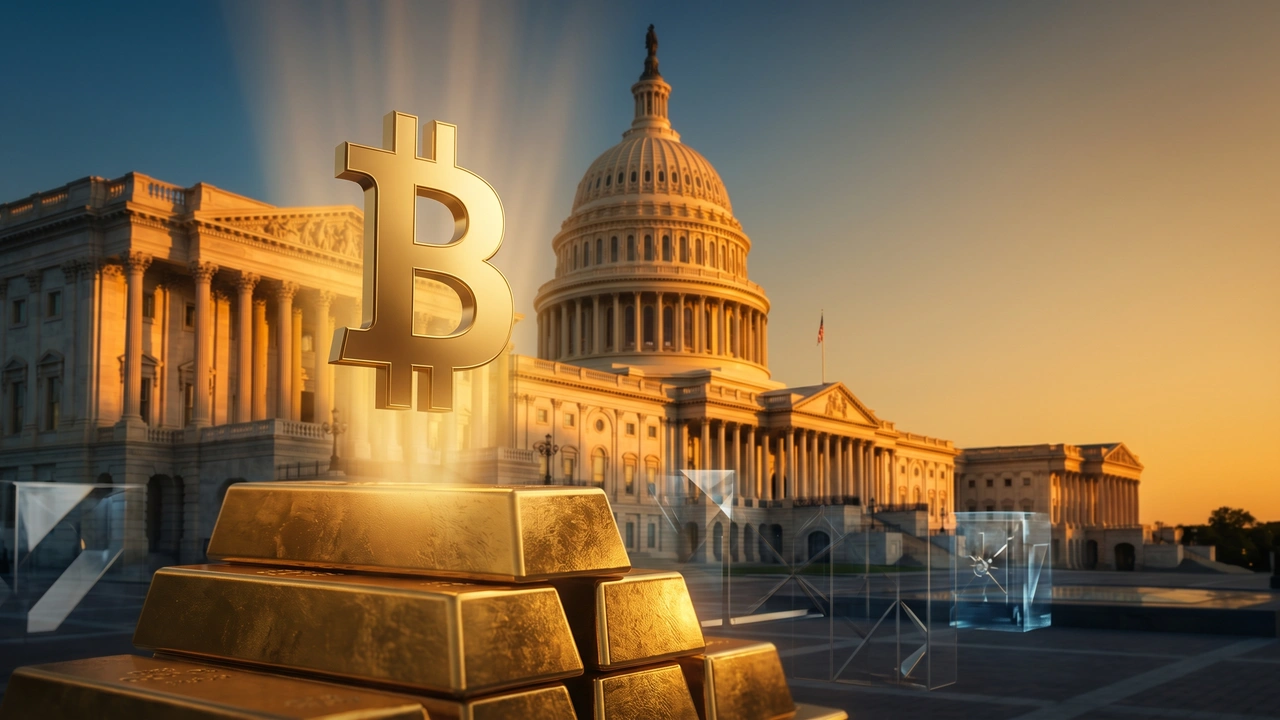
The American Reserve Modernization Act would transform the US government's Bitcoin holdings from an executive-order experiment into a permanent statutory commitment, backed by a plan to accumulate up to one million BTC over five years using gold revaluation proceeds.
Key Takeaways
- ARMA would convert the existing executive-order Bitcoin reserve into a statutory commitment, insulating it from reversal by future administrations - the most durable policy protection Bitcoin has ever received at the federal level.
- The proposed financing mechanism - revaluing gold certificates that still sit on Federal Reserve books at a decades-old price - is designed to make Bitcoin purchases budget-neutral, sidestepping the politically difficult path of new appropriations.
- A hard two-decade holding requirement, with sales only permitted to reduce national debt, would make the US government one of the most committed long-term Bitcoin holders on earth by legal obligation rather than discretion.
- The bill's self-custody protection clause matters independently of the reserve question: federal statutory recognition of individual digital property rights would set a floor against future regulatory overreach.
- Near-term market impact is likely limited - the legislative path through the Senate is uncertain, and even a successful passage would not produce actual Treasury buying for at least a year or more.
ARMA: Congress Moves to Lock In America's Bitcoin Reserve by Law
Washington is no longer just talking about Bitcoin - it is now drafting the legal scaffolding to hold it permanently. The American Reserve Modernization Act, or ARMA, represents the most serious legislative attempt yet to anchor Bitcoin inside the United States' national reserve architecture. Where executive orders bend with changing administrations, federal statute endures - and that distinction is the entire point.
The bill lands at a moment when the US already sits atop the global sovereign Bitcoin leaderboard, yet still has no coherent policy framework governing what those holdings mean or how they should be managed. ARMA is an attempt to fill that vacuum - and its implications reach far beyond the balance sheet of the Treasury.
The Facts
ARMA was introduced with sixteen co-sponsors and has drawn bipartisan support in the House [1]. Patrick Witt, a member of the White House's digital assets advisory body, described the bill as a second-generation successor to the earlier BITCOIN Act, arguing that the new proposal is more legally robust and carefully structured to protect the assets it governs [1].
The mechanics are straightforward but ambitious. The Treasury would be directed to purchase up to 200,000 BTC per year over a five-year window, targeting a cumulative ceiling of one million Bitcoin [2]. Those holdings would then be locked for at least two decades, with one narrow exit clause: sales would only be permitted to pay down the national debt directly, which recently crossed $39 trillion [1]. Financing would come not from new appropriations but from revaluing existing gold certificates - the Federal Reserve still carries gold on its books at $42.22 per ounce, a figure that has not been updated to reflect market reality for decades [2]. The gap between that legacy valuation and current market prices would generate the headroom needed to fund Bitcoin purchases without touching the general budget.
The bill also draws a hard institutional line between two distinct pools of government-held digital assets. Coins acquired through criminal forfeiture and asset seizures would sit in a separate stockpile, organizationally distinct from the strategic Bitcoin reserve itself [2]. All holdings, in both categories, would be held exclusively in cold storage, with quarterly proof-of-reserve reports and independent third-party audits published for public scrutiny [1].
Beyond the reserve mechanics, ARMA contains a clause that may prove politically significant in its own right: an explicit federal affirmation that individual Americans retain the right to own and self-custody digital assets, and that the federal government may not undermine that right [1][2]. Representative Jared Golden, a co-sponsor, framed the broader motivation bluntly, noting that the US already holds more Bitcoin than any other nation-state but has never established a coherent federal policy around that position [1].
Analysis & Context
The single most important distinction ARMA introduces is legal permanence. President Trump's March 2025 executive order establishing a Strategic Bitcoin Reserve was a meaningful first step, but executive orders occupy fragile legal ground [2]. A future administration could reverse the policy on day one with a stroke of a pen - precisely the scenario that would destabilize any serious long-term reserve strategy. By encoding the reserve in statute, ARMA attempts to elevate Bitcoin alongside gold in terms of institutional durability. The comparison is not accidental: the bill's own text suggests that prevailing views on what constitutes a lasting store of value are capable of changing [2], a direct acknowledgment that gold's dominance is not guaranteed.
Historically, the United States has a complicated record with monetary reserve assets. The Nixon shock of 1971 severed the dollar's link to gold entirely - a unilateral policy shift that reshaped global finance overnight. That episode illustrates both the power of statutory versus executive frameworks and the long-term consequences of reserve policy decisions made without broad legislative consensus. ARMA's architects appear acutely aware of this history: the gold revaluation mechanism itself is a nod to the fact that the US holds enormous latent monetary value in assets priced at decades-old figures. Unlocking that value to acquire a fixed-supply asset is, in structural terms, a rotation trade on the federal balance sheet.
Pattern recognition suggests this bill fits into a larger cycle of sovereign Bitcoin accumulation strategies emerging globally. Several nations and sub-national entities have explored similar legislation in recent years, and the race dynamic is not lost on US legislators - Representative Mike Carey explicitly cited the need to remain competitive internationally [1]. What makes the US case unique is the scale: 328,372 Bitcoin already held through seizures [1] gives the government a meaningful head start, but also exposes the absurdity of the current situation, where those coins have occasionally been sold at auction rather than retained strategically.
A critical misreading to avoid: ARMA passing would not trigger immediate market buying pressure. Even in an optimistic scenario where the bill clears both chambers and survives legal challenges around the gold certificate revaluation mechanism, first Treasury purchases would realistically arrive no earlier than late 2026 [2]. The bill also still faces a Senate vote, Democratic buy-in, and potential constitutional scrutiny around the financing structure. Investors pricing in an imminent federal buying program would be getting ahead of the legislative reality. The genuine second-order effect to watch is more subtle - formal statutory recognition of Bitcoin as a reserve asset would reshape how foreign governments, central banks, and sovereign wealth funds frame their own allocation decisions. Legitimacy, once codified in US federal law, tends to travel.
Sources
AI-Assisted Content
This article was created with AI assistance. All facts are sourced from verified news outlets.