ATM Crackdowns and Reserve Ambitions: Bitcoin's Regulatory Crossroads
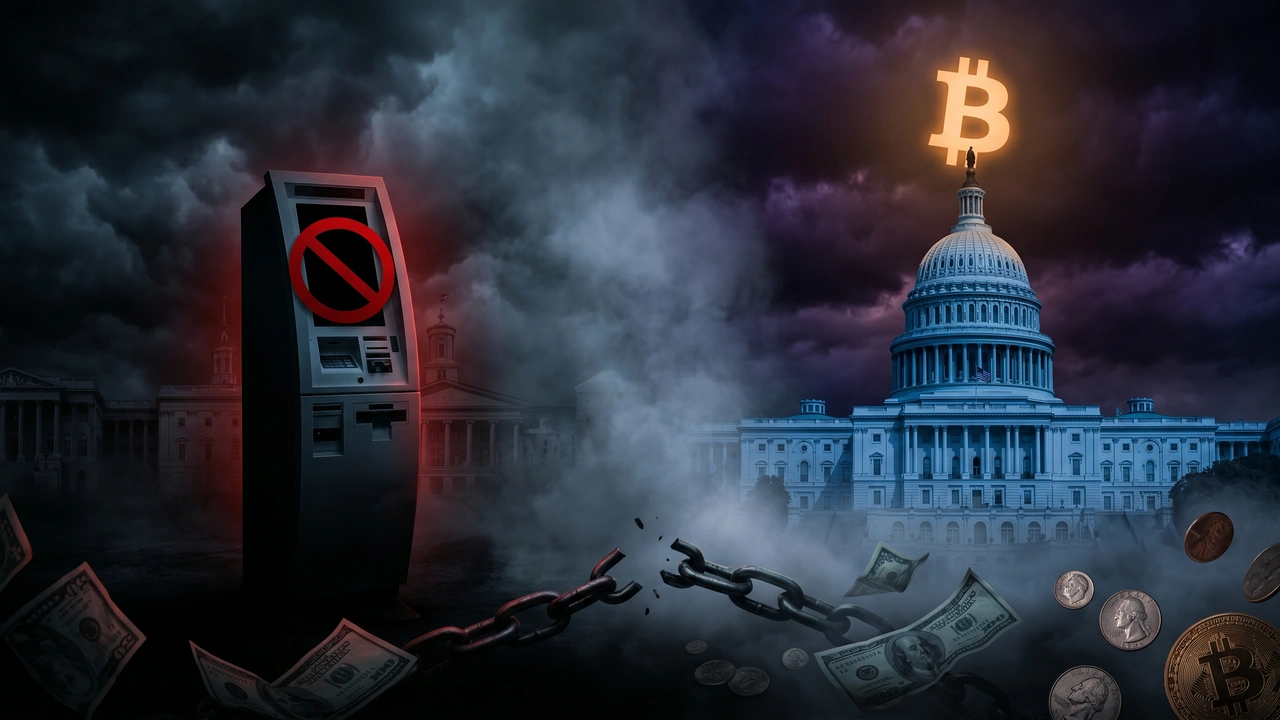
A quiet state-level campaign against Bitcoin ATMs and Treasury Secretary Scott Bessent's push for a Strategic Bitcoin Reserve reveal two contradictory forces shaping how Americans will - or won't - access Bitcoin in the years ahead.
Key Takeaways
- Six U.S. states have effectively eliminated Bitcoin ATM operations through outright bans or profit-killing regulatory caps, targeting a sector with a fraud rate less than half the financial industry average.
- The primary victims of ATM restrictions are the 24.6 million unbanked and underbanked Americans who rely on cash-based access to acquire self-custodied Bitcoin, not the speculative traders regulators nominally aim to protect.
- Treasury Secretary Bessent's public backing of both the Strategic Bitcoin Reserve and the Clarity Act represents the most senior executive-branch endorsement of a comprehensive federal crypto framework to date - but without congressional action, the reserve can be unwound by the next administration.
- The recurring pattern of broadly written legislative proposals that nearly became law - covering miners, node operators, and wallet providers - signals that the ATM crackdown is a visible front in a wider regulatory contest over who gets to participate in Bitcoin's infrastructure.
- Self-custody remains theoretically available to all Americans but is practically accessible only to those with existing bank and exchange relationships if cash-to-Bitcoin on-ramps continue to disappear at the state level.
ATM Crackdowns and Reserve Ambitions: Bitcoin's Regulatory Crossroads
Washington talks up Bitcoin as a pillar of national economic security while state capitals quietly shut the door on the most accessible way ordinary Americans can actually buy it. That contradiction is not a coincidence - it is a preview of the fractured regulatory landscape Bitcoin now inhabits, where federal enthusiasm and state-level hostility can coexist without resolution. The gap between the rhetoric and the reality is widening, and who gets left out matters enormously.
The Facts
Start at the state level, where the erosion is already underway. Full prohibitions on Bitcoin ATM operations have taken effect in Indiana, Tennessee, and Minnesota. Four additional states - California, South Dakota, Wisconsin, and Virginia - have imposed fee and transaction caps so restrictive that operators cannot turn a profit, amounting to effective bans without the formal label [1]. Together, these moves are quietly dismantling a sector that channels roughly $3.63 billion annually into Bitcoin purchases within the United States alone [1].
The regulatory justification centers on fraud prevention, but the numbers undercut that framing. Across traditional financial services, fraud rates typically land somewhere between 3 and 5 percent of transactions. At Bitcoin ATMs, verified fraud accounts for just 1.2 percent - meaning more than 98 of every 100 transactions are entirely legitimate [1]. For context, regulators have not moved to restrict Western Union or prepaid gift cards, both of which carry higher documented fraud exposure [1]. The selective application of the fraud argument points less to genuine consumer protection and more to political convenience.
Who actually uses these machines? Federal Reserve research cited by industry observers identifies the primary Bitcoin ATM customer base as the 24.6 million unbanked and underbanked Americans, a population disproportionately composed of Black, Hispanic, immigrant, rural, and low-income households [1]. The median transaction is $300, with eight in ten purchases falling below $1,000 - the financial profile of someone making incremental, disciplined contributions to an appreciating asset rather than large speculative bets [1]. Banning these machines does not protect that population; it removes one of their only pathways into a self-custodied financial instrument.
At the federal level, the posture looks strikingly different - at least on the surface. Treasury Secretary Scott Bessent appeared before the Senate Finance Committee to defend the administration's fiscal year 2027 budget and used the occasion to champion the U.S. Strategic Bitcoin Reserve [2]. The reserve, established by presidential order in early March 2025, currently holds an estimated 328,372 BTC valued at approximately $25 billion [2]. Every coin in that stockpile arrived through asset forfeitures tied to criminal prosecutions rather than open-market acquisition, and the governing executive order prohibits selling any of it while directing Treasury to devise budget-neutral methods for adding more [2].
Bessent tied the reserve directly to national security doctrine, telling the committee that "economic security is national security" [2]. He was candid about the complexity of the undertaking - describing it as new ground built on new technology - but signaled no intention of slowing down. To insulate the reserve from reversal by a future administration, Congress is weighing the BITCOIN Act, championed by Wyoming Senator Cynthia Lummis, which would authorize Treasury to acquire 200,000 BTC per year over five years, accumulating one million bitcoin held for a minimum of two decades [2]. Without that legislative anchor, the reserve remains a creature of executive will alone [2]. Bessent also pressed lawmakers to pass the Clarity Act before summer ends - a bill that cleared the Senate Banking Committee 15-9 in May and would draw firm regulatory lines between which digital assets qualify as securities and which as commodities [2].
The legislative history, however, contains cautionary chapters that rarely make headlines. Bills introduced in both the current and prior congressional sessions have at various points sought to classify self-custody wallet providers, miners, node operators, and even software developers as money services businesses subject to Bank Secrecy Act obligations [1]. The Infrastructure Investment and Jobs Act briefly contained broker-reporting language broad enough to ensnare miners and node operators before Treasury and the IRS narrowed its scope during implementation [1]. The pattern is consistent: expansive definitions get proposed, industry pushes back, and the final language contracts - but each cycle tests how much further regulators can reach.
Analysis & Context
The ATM crackdown and the reserve ambitions are not unrelated subplots; they are two sides of a single regulatory strategy whose internal logic is worth examining. Federal Bitcoin enthusiasm is largely institutional - it concerns sovereign holdings, market structure legislation, and the positioning of the United States against rival reserve currencies and other nation-states. State-level hostility to ATMs, by contrast, targets the retail, cash-based, permissionless layer of Bitcoin's value proposition. The two can coexist because they serve different political constituencies and because the federal government has not moved to preempt state money-transmission authority in this space.
The deeper risk is the precedent being set. Bitcoin ATMs are the only mechanism through which a person with cash and no existing financial account can acquire Bitcoin that settles directly into a wallet they alone control [1]. If that pathway is closed - framed as consumer protection, operationalized through fee caps and outright bans - then self-custody becomes a privilege reserved for people who already hold bank accounts and exchange relationships. The right exists on paper but not in practice for those without prior institutional access. That outcome would quietly resolve one of the most contested questions in Bitcoin policy without any single decisive vote or court ruling.
The list of near-miss legislation - from the Digital Asset Anti-Money Laundering Act to the CANSEE Act targeting decentralized finance - illustrates that the ATM crackdown is not an isolated local quirk but rather the leading edge of a broader regulatory appetite [1]. Each failed bill normalized a slightly more expansive definition of what counts as regulated financial activity in the Bitcoin ecosystem. The ATM question is, in this sense, a stress test: if the industry cannot defend its most physically accessible and socially inclusive on-ramp, there is little reason to assume more abstract infrastructure will receive stronger protection.
Sources
AI-Assisted Content
This article was created with AI assistance. All facts are sourced from verified news outlets.