Bitcoin as a Geopolitical Weapon: Iran's Strait of Hormuz Gambit
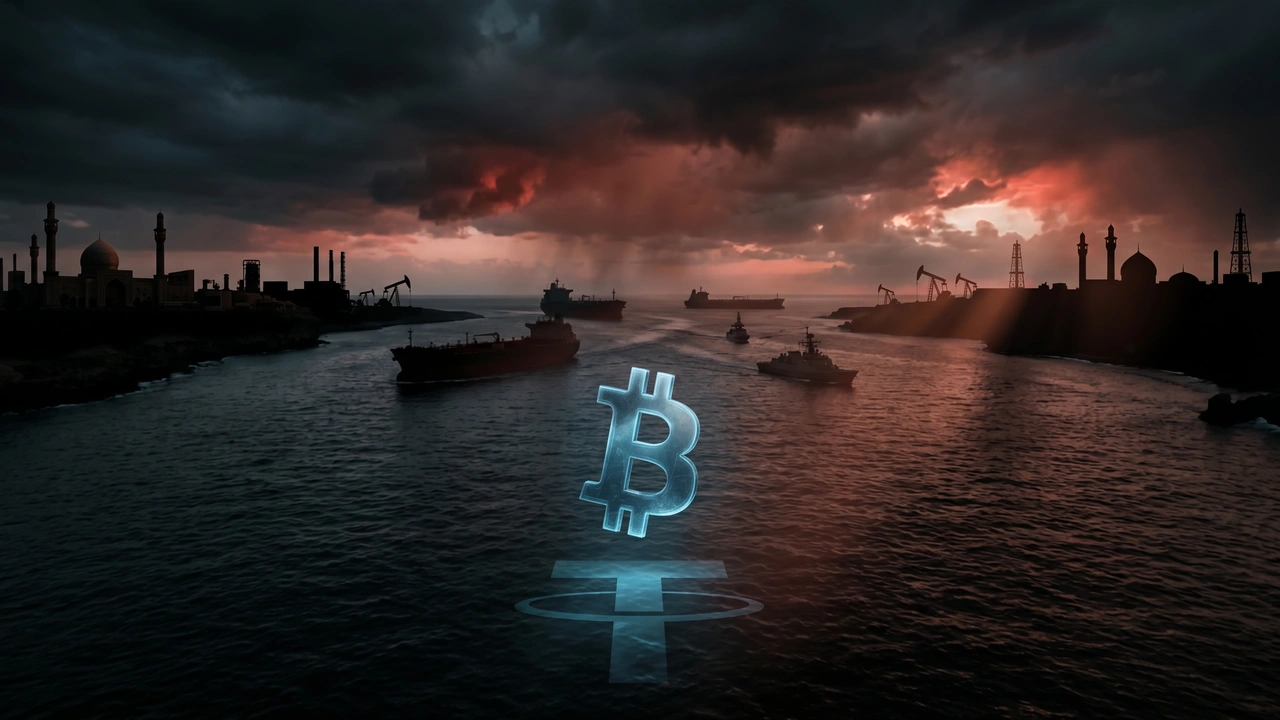
Iran's decision to accept Bitcoin as payment for Strait of Hormuz oil tolls reveals a new dimension of BTC's strategic value — but onchain data tells a more nuanced story about what's actually being used.
Key Takeaways
- Bitcoin's designation as a Strait of Hormuz toll currency is geopolitically significant, but actual BTC usage remains unconfirmed onchain — dollar stablecoins are Iran's dominant crypto instrument for now [2]
- The censorship-resistance thesis is being tested in real time: Iran accepts freeze risk on stablecoins as a calculated trade-off, but Bitcoin remains in its arsenal precisely for scenarios where that risk becomes unacceptable [2]
- Short-term price pressure near $75,000 aligns with historical patterns of geopolitical shock-driven sell-offs, which have typically resolved as the underlying use cases driving the crisis become clearer [1]
- Iran's $3 billion in crypto flows since 2022 — with only $600 million frozen — demonstrates that blanket sanctions enforcement against crypto is far less effective than US policymakers may assume [2]
- US lawmakers face a strategic choice: engage with Bitcoin's role as neutral financial infrastructure on their own terms, or allow adversarial states to define Bitcoin's geopolitical narrative by default [2]
Bitcoin as a Geopolitical Weapon: Iran's Strait of Hormuz Gambit
When a nation-state designates Bitcoin as an accepted payment method for one of the world's most strategically critical waterways, it is no longer a fringe monetary experiment — it is geopolitical infrastructure. Iran's move to require toll payments for oil tankers transiting the Strait of Hormuz, with Bitcoin listed alongside the Chinese yuan and dollar-pegged stablecoins, marks a watershed moment in how sovereign actors are beginning to think about censorship-resistant money. The story, however, is more complex than the headlines suggest.
The broader context amplifies the significance: renewed military tensions in the Middle East, a re-blockaded strait, and a Bitcoin price under pressure. What's unfolding is a real-time stress test of Bitcoin's thesis as a neutral, apolitical financial network — and the results are both validating and instructive.
The Facts
Bitcoin fell 2.7% on the day to $75,043, while Ethereum dropped a sharper 4.1% to $2,308, as anxiety over a potential escalation of Middle Eastern conflict rippled through crypto markets [1]. The immediate trigger was Iran's decision to re-close the Strait of Hormuz after a brief opening for maritime traffic, with Iranian Parliamentary Speaker Mohammad Bagher Ghalibaf citing a US naval blockade as justification: "It is impossible for others to pass through the Strait of Hormuz while we cannot," he stated [1]. Additional flashpoints included fresh combat reports from Lebanon and the killing of a French UN peacekeeper in an attack attributed to Hezbollah by President Emmanuel Macron [1].
Despite the geopolitical turbulence, oil markets remained surprisingly composed, with Brent crude holding near $88 per barrel, and the S&P 500 trading just below its all-time high at 7,126 points — suggesting equity markets have yet to fully price in an escalation scenario [1].
Meanwhile, Iran's designation of Bitcoin as an accepted toll currency for Strait of Hormuz passage drew significant commentary from analysts. Sam Lyman, head of research at the Bitcoin Policy Institute, told Cointelegraph that Bitcoin's inclusion stems directly from its censorship-resistant architecture: "No one can freeze Bitcoin. No one can shut down the Bitcoin network" [2]. Lyman characterized the development as "one of the most significant situations where Bitcoin is very clearly a strategic asset" [2].
However, Lyman was careful to note that onchain evidence tells a different story about actual usage. Despite Bitcoin's inclusion as an accepted payment method, there are currently no confirmed BTC toll payments recorded on the blockchain [2]. The dominant instrument in Iran's crypto economy remains USDt — Tether's dollar-pegged stablecoin — which accounts for the majority of the country's crypto transactions dating back to at least 2018 [2]. Since 2022, Iran has moved approximately $3 billion in crypto assets, with the bulk denominated in stablecoins. The US Treasury managed to freeze around $600 million of that — meaning roughly $2.4 billion successfully cleared, a ratio the Iranian government apparently finds acceptable enough to keep using dollar-pegged instruments despite the freeze risk [2].
Analysis & Context
The gap between Iran's Bitcoin announcement and actual BTC usage on the ground is telling, but it does not undermine Bitcoin's strategic narrative — it refines it. Iran is doing what most sophisticated actors do: using the most liquid, operationally convenient tool available while keeping Bitcoin as a structural hedge. Dollar stablecoins offer immediate settlement and deep liquidity, which matters enormously in high-volume commodity trade. Bitcoin offers something different — absolute seizure resistance and network sovereignty. The fact that Iran is keeping BTC in its toolkit, even without immediate heavy use, signals that sovereign actors are war-gaming scenarios where stablecoin issuers like Tether fully comply with US Treasury demands. That day may come, and Tehran appears to be positioning accordingly.
Historically, Bitcoin has shown a dual personality during geopolitical crises. In the early weeks of the Russia-Ukraine war in 2022, BTC initially dropped alongside risk assets before recovering as Ukrainians and Russians alike used it to move money across a conflict zone. Similarly, following Hamas's October 7, 2023 attack on Israel, crypto markets saw short-term volatility before stabilizing. The pattern suggests that acute geopolitical shocks cause short-term price suppression as risk-off sentiment dominates, but the underlying use cases that crises reveal — censorship resistance, borderless settlement — tend to strengthen Bitcoin's long-term value proposition. Today's price dip near $75,000 fits that historical template. The strait's closure and regional escalation are near-term headwinds; the geopolitical validation of Bitcoin as neutral infrastructure is a longer-term tailwind.
For US policymakers, Lyman's commentary carries a sharp implicit warning: adversarial states are building digital asset strategies whether Washington engages constructively or not [2]. Iran's $3 billion in crypto transactions since 2022 demonstrates that hostile regulatory postures toward digital assets do not eliminate their use — they merely cede the strategic framing to other actors. If the US continues to treat Bitcoin with regulatory ambiguity while Iran publicly designates it as a toll currency for a globally critical waterway, the narrative of Bitcoin as a tool of adversaries rather than a neutral financial protocol gains unwarranted traction. The smarter play, as BPI argues, is to recognize Bitcoin's strategic neutrality and build policy around that reality.
Sources
AI-Assisted Content
This article was created with AI assistance. All facts are sourced from verified news outlets.