Bitcoin as a Weapon: How the Pentagon Is Rethinking Satoshi's Network
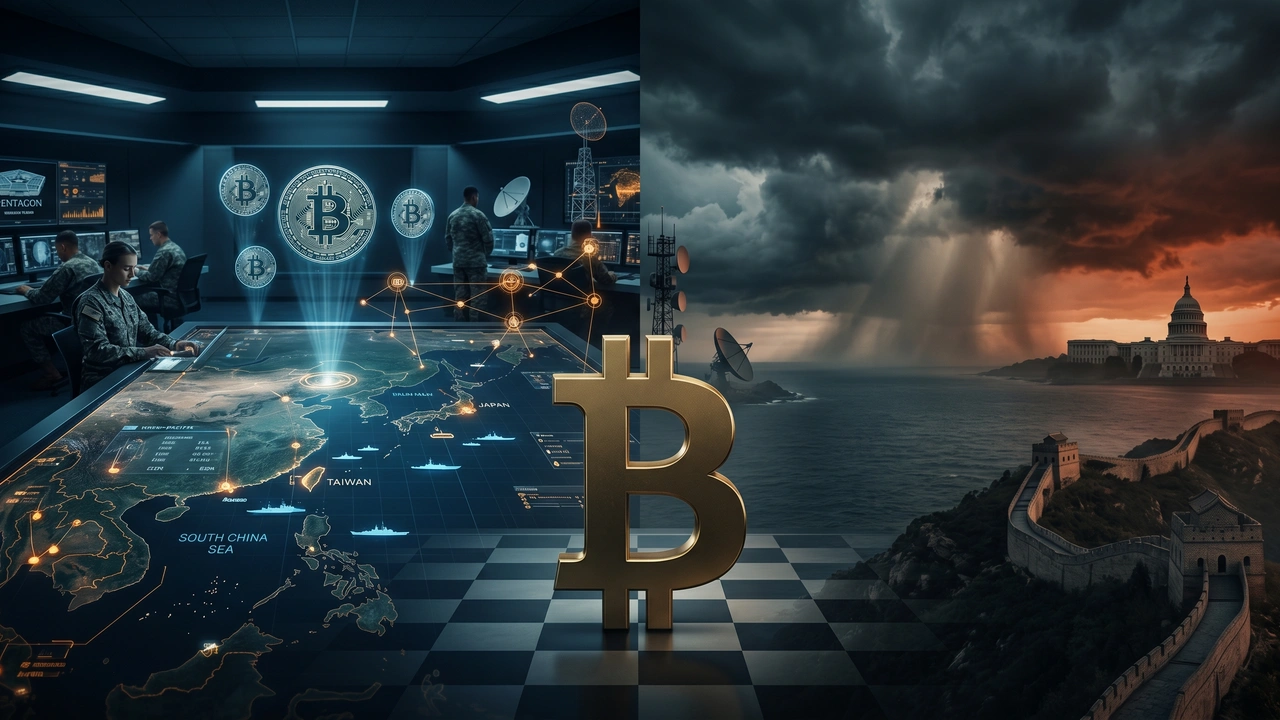
A four-star U.S. admiral's declaration that Bitcoin is a 'valuable computer science tool for power projection' marks a watershed moment — Bitcoin is no longer just a financial asset but an emerging instrument of national security strategy.
Key Takeaways
- A geopolitical pivot point: Admiral Paparo's Senate testimony marks the first time a sitting INDOPACOM commander has formally characterized Bitcoin as a tool of U.S. power projection and cybersecurity, elevating the asset from financial instrument to national security consideration.
- The Softwar thesis is going mainstream: Jason Lowery's controversial framework — treating Proof-of-Work as a mechanism for imposing real costs on digital adversaries — now appears to have genuine traction within senior U.S. military leadership, even if operational specifics remain undefined.
- U.S.-China Bitcoin rivalry is accelerating: The 127,000 BTC seizure linked to a Chinese national, combined with reports of Chinese researchers recommending a sovereign BTC reserve, signals that both superpowers are beginning to treat Bitcoin accumulation and mining capacity as geopolitically significant assets.
- The "Mined in America Act" matters strategically: If the Softwar doctrine gains further traction, domestic mining infrastructure and supply-chain independence from Chinese ASIC manufacturers will become explicit national security priorities — with significant policy and market implications for the mining sector.
- Bitcoin's neutrality faces its most serious test: State-level adoption of Bitcoin as a deterrence instrument creates an inherent conflict with the network's foundational properties of censorship resistance and decentralization — a tension that holders, developers, and policymakers must grapple with openly rather than ignore.
Bitcoin as a Weapon: How the Pentagon Is Rethinking Satoshi's Network
When a sitting four-star admiral commanding the most strategically consequential military theater on Earth tells the U.S. Senate that Bitcoin is a tool of power projection, the world should pay attention. This is no longer the fringe territory of crypto-libertarians or speculative investors. Bitcoin has entered the formal lexicon of American geopolitical strategy — and the implications for the network, its holders, and global power dynamics are profound.
The convergence of military doctrine, legislative action, and intensifying U.S.-China rivalry has produced a moment where Satoshi Nakamoto's decentralized protocol is being seriously evaluated not just as money, but as infrastructure for 21st-century deterrence. Understanding what this means — and what it risks — requires cutting through both the hype and the skepticism.
The Facts
At a Senate Armed Services Committee hearing focused on U.S. Indo-Pacific Command (INDOPACOM) strategy, Admiral Samuel Paparo, the four-star commander responsible for American military posture across the Pacific, made a statement that reverberated through both defense and crypto circles [2]. Asked by Republican Senator Tommy Tuberville about Bitcoin's potential role in strengthening U.S. resilience and deterrence against China, Paparo described Bitcoin as "a valuable computer science tool as power projection" and stated that it is "a reality, a peer-to-peer, zero trust transfer of value that supports interests of the United States of America" [2].
Paparo specifically highlighted Bitcoin's Proof-of-Work mechanism as a key factor, arguing that it imposes real-world costs on any attempt to compromise or manipulate the network [1]. "Independently of its economic function, it has very important applications in the field of cybersecurity," he told senators [1]. The admiral stopped short of detailing specific operational use cases, but the directional signal was unmistakable: the U.S. military views Bitcoin's architecture as strategically relevant.
The hearing took place against a charged backdrop. It was the first INDOPACOM strategy session following the United States' largest-ever Bitcoin seizure — more than 127,000 BTC confiscated in October 2025, linked to the Prince Holding Group and alleged Chinese national Chen Zhi [2]. The seizure triggered diplomatic friction, with a Chinese government agency accusing the U.S. of hacking and questioning the legality of the confiscation. Meanwhile, Chinese financial researchers have reportedly begun recommending that Beijing establish its own national Bitcoin reserve [2], suggesting the asset is being assessed for strategic value on both sides of the Pacific.
Admiral Paparo's testimony directly echoes the "Softwar" thesis advanced by Jason P. Lowery, a U.S. Space Force officer who published a doctoral-level analysis in 2023 arguing that Bitcoin's Proof-of-Work represents the first form of physical power projection in cyberspace [2]. Lowery's framework treats the digital domain as a new battlefield and PoW energy expenditure as a cost-imposition mechanism analogous to conventional military deterrence. Senator Cynthia Lummis responded to the hearing by renewing calls for rapid implementation of the strategic Bitcoin reserve — a policy already initiated by executive order under President Trump [2]. Dennis Porter of the Satoshi Action Fund went further, framing the reserve as "ammunition" for a deterrence weapon and arguing that the "Mined in America Act" — a bill promoting domestic mining using U.S.-allied hardware — is essential to prevent dependence on Chinese-manufactured ASIC miners [2].
Analysis & Context
Paparo's testimony represents something genuinely new: the formal integration of Bitcoin into the strategic calculus of a major military power. To appreciate the significance, consider the trajectory. In 2017, most U.S. government commentary on Bitcoin centered on illicit finance and regulatory risk. By 2021, El Salvador's adoption as legal tender reframed the conversation toward monetary sovereignty. Now, in 2026, a INDOPACOM commander is citing Proof-of-Work as a cybersecurity and power-projection asset before the Senate Armed Services Committee. The Overton window has shifted dramatically.
The Softwar framework, however controversial, provides the intellectual scaffolding for this shift. Lowery's core argument — that imposing physical costs through energy expenditure can deter digital adversaries much as nuclear arsenals deter conventional ones — is theoretically coherent, even if its practical implementation remains vague. The fact that Paparo invoked these ideas without being able to cite concrete applications suggests the doctrine is still in formation. What matters is that it is now being formed at the highest levels of the U.S. military establishment. Historically, technologies that enter military doctrine — from GPS to the internet itself — tend to receive sustained government investment and strategic prioritization, regardless of their origins in civilian or decentralized contexts. Bitcoin may be entering a similar trajectory.
The tension embedded in this development, however, is real and should not be dismissed. Bitcoin's value proposition rests fundamentally on its neutrality — its resistance to censorship, its indifference to national borders, and its decentralized governance. Critics including privacy advocates warn that state-level mining operations or attempts to use hash rate as a geopolitical lever could introduce pressure toward block censorship, creating divergent versions of the blockchain or excluding certain transactions on political grounds [2]. This is not a hypothetical concern: if the U.S. government begins mining Bitcoin at scale to "ensure transactions always go through," as Lowery suggests, the implicit corollary is that someone else's transactions might not. That tension between Bitcoin as neutral money and Bitcoin as American strategic infrastructure is the defining fault line of this debate — and it will intensify as the policy agenda advances.
Sources
AI-Assisted Content
This article was created with AI assistance. All facts are sourced from verified news outlets.