Bitcoin as Escape Route: Iranian Crypto Outflows Explode Following Airstrikes
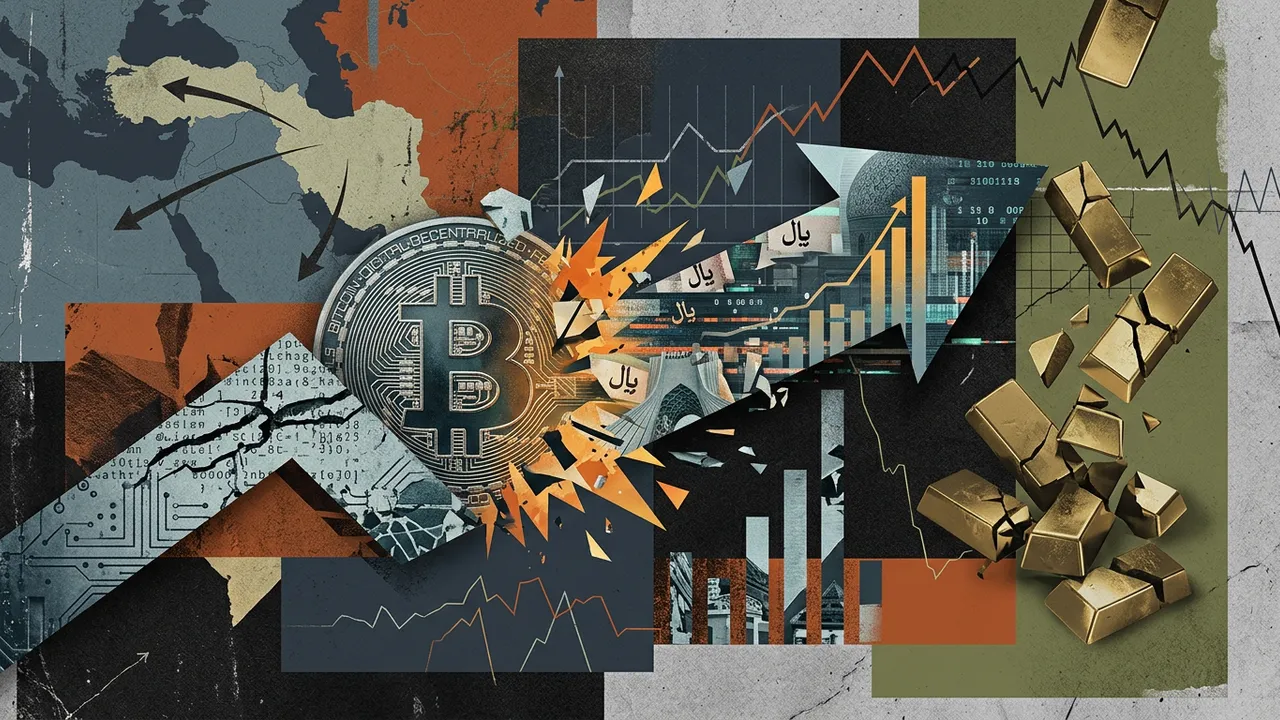
Following US-Israeli attacks on Tehran, crypto outflows from Iranian exchanges surged by 700 percent. The events demonstrate Bitcoin's role as a capital flight instrument in geopolitical crises – while traditional stores of value like gold falter.
Bitcoin as Escape Route: Iranian Crypto Outflows Explode Following Airstrikes
While geopolitical tensions traditionally strengthen gold as a safe haven, a new pattern is emerging in Iran: Bitcoin and other cryptocurrencies are becoming the preferred instrument for capital flight. Recent events provide unprecedented insight into the role of cryptocurrencies as flight currencies in times of crisis – challenging established assumptions about safe havens.
The data speaks clearly: While gold dropped six percent during current tensions, Bitcoin maintained surprising stability with a decline of merely three percent. This relative strength could signal a paradigm shift in global capital flight.
The Facts
Following US-Israeli airstrikes on Tehran on February 28, 2026, which targeted nuclear facilities and missile sites among other locations, crypto outflows from Iranian exchanges increased dramatically. Nobitex, the largest Iranian crypto exchange with over 11 million users, recorded a 700 percent surge in outflows to nearly 3 million US dollars within minutes of the first attacks [1][3].
Blockchain analytics firms identified three main movements: Between February 28 and March 2, approximately 10.3 million US dollars in cryptocurrencies flowed out from Iranian exchanges [3]. Blockchain analytics firm Chainalysis documented that Iranian citizens increasingly transferred funds from centralized exchanges to private wallets to gain control over their assets. Tom Robinson, CEO of Elliptic, explained: "The increase in crypto asset outflows last Saturday could represent capital flight from Iran. Initial tracking of recent outflows from Nobitex suggests that the funds are being sent to foreign crypto exchanges" [1].
The pattern resembles earlier events: During anti-regime protests in January 2026, Bitcoin withdrawals from Iranian exchanges already surged before the government imposed internet blackouts [3]. After internet connectivity was restored, outflows increased again – a cycle that repeated itself following the airstrikes.
The Iranian state itself is increasingly using cryptocurrencies to circumvent sanctions. Elliptic reported in January that Iran's central bank had acquired approximately 507 million USDT to support the collapsing rial [1]. US Senator Richard Blumenthal initiated an investigation against the exchange Binance due to its alleged role in circumventing Iran sanctions [1]. Chainalysis estimates the Iranian crypto ecosystem at 7.8 billion US dollars, with Nobitex alone processing transactions worth 7.2 billion US dollars in 2025 [3].
While Bitcoin fell back to 66,000 US dollars after a brief excursion above 70,000 US dollars, the cryptocurrency showed remarkable resilience compared to traditional assets [2]. Gold fell by six percent, silver by eleven percent within two days, while Bitcoin lost only three percent [2]. The S&P 500 and Nasdaq Composite each recorded declines of approximately two percent following the closure of the Strait of Hormuz [2].
Analysis & Context
The Iranian events provide some of the clearest evidence of Bitcoin's function as digital flight capital in geopolitical crises. Unlike gold, which must be physically transported, or fiat currencies, which are subject to the international banking system, cryptocurrencies enable cross-border asset transfers outside state control. For Iranians under sanctions and facing a collapsing rial, this is not a theoretical function but an existential necessity.
Historically, parallels can be drawn to earlier crises: Venezuela during hyperinflation, Cyprus during the 2013 banking crisis, or capital controls in Greece in 2015. In all cases, citizens sought ways to protect their wealth from state seizure. The difference: Back then, Bitcoin was still a niche product. Today, Nobitex alone has 11 million users – a considerable penetration in a country with 89 million inhabitants.
Bitcoin's relative stability compared to gold during this crisis could mark an important turning point. Trader Michaël van de Poppe is already speculating about a possible capital rotation from gold to Bitcoin [2]. While gold was "absolutely crushed" in this crisis, as Nik Bhatia of The Bitcoin Layer noted, Bitcoin held the psychologically important 66,000-dollar mark [2]. This suggests that institutional and private investors increasingly view Bitcoin as a legitimate store of value in geopolitical crises.
Several implications emerge for medium-term market development: First, Bitcoin's demonstrated utility as flight capital could accelerate adoption in additional crisis regions. Second, regulatory pressure is likely to increase on exchanges that facilitate transfers from sanctioned countries. Third, it becomes apparent that Bitcoin no longer necessarily correlates with risk assets in crisis situations, but is increasingly developing its own characteristics.
The fact that Bitcoin remained relatively stable despite rising oil prices and falling stock markets refutes the thesis that Bitcoin behaves exclusively like a technology asset. The reality is more complex: Bitcoin functions as a risk asset, store of value, or flight capital depending on context – a flexibility that traditional asset classes do not offer.
Conclusion
-
The 700 percent increase in Iranian crypto outflows following the airstrikes demonstrates Bitcoin's practical function as digital flight capital beyond theoretical discussions – for millions of people, this is already reality
-
Bitcoin's relative stability during the crisis (minus three percent versus gold minus six percent) could signal a paradigm shift in which digital assets are increasingly accepted as stores of value in geopolitical crises
-
The dual-use problem will intensify: While Bitcoin provides Iranian citizens with legitimate protection against asset devaluation, state actors also use cryptocurrencies to circumvent sanctions – a dilemma that will shape regulatory debates
-
Investors should observe Bitcoin's decoupling from traditional risk assets: The cryptocurrency is increasingly developing its own market dynamics that can be fully explained by neither pure risk assets nor classic safe havens
-
The Iranian events provide a foretaste of future crises: In an increasingly multipolar world with fragmented financial systems, Bitcoin as a neutral, censorship-resistant network could systematically gain importance
Sources
AI-Assisted Content
This article was created with AI assistance. All facts are sourced from verified news outlets.