Bitcoin as Geopolitical Weapon: The Hormuz Toll Story Changes Everything
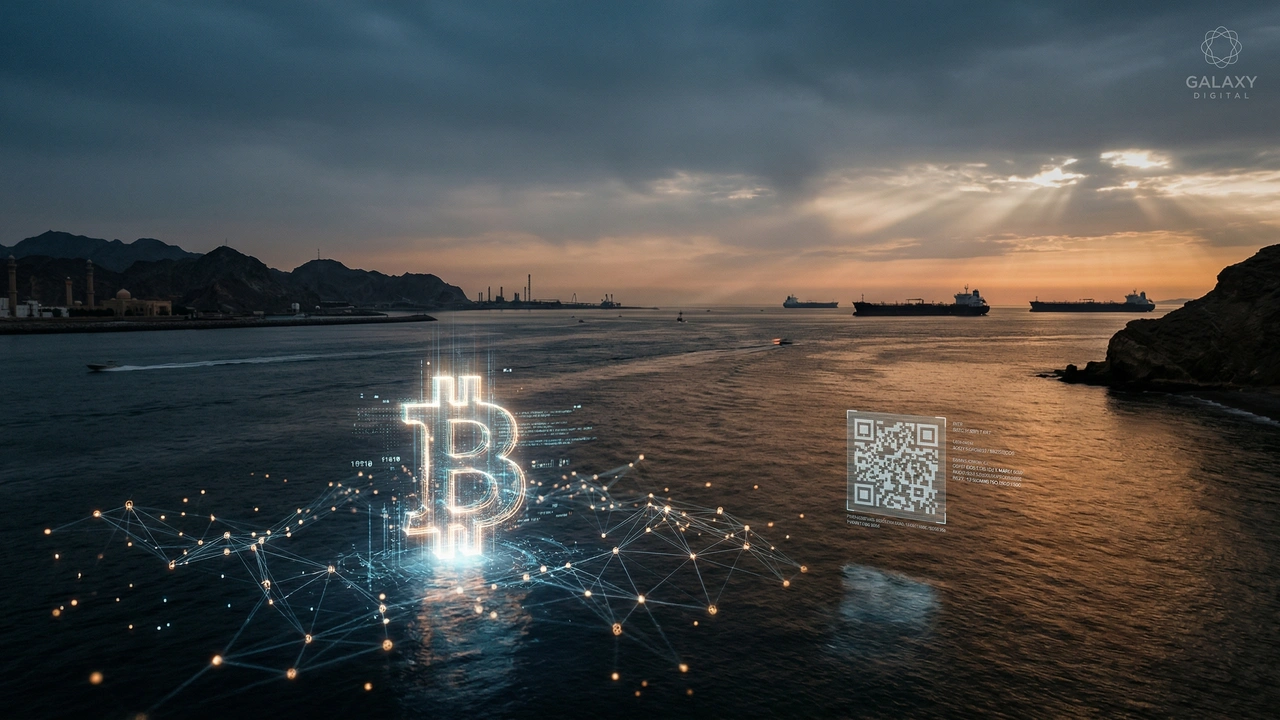
Reports that Iran may be accepting Bitcoin for oil tanker passage through the Strait of Hormuz have ignited serious debate about Bitcoin's role as a censorship-resistant settlement layer — and Galaxy Digital is now investigating the on-chain evidence.
Key Takeaways
- The Hormuz report — true or not — is accelerating a critical conversation: Bitcoin's censorship-resistance is no longer just a talking point; it is being evaluated at the level of sovereign commerce and international trade infrastructure.
- Stablecoins have a structural disqualifying flaw for sanctioned actors: Built-in blacklist functions in USDT and USDC, reinforced by US regulatory frameworks like GENIUS, make them unusable for any party under American financial pressure — a gap Bitcoin uniquely fills.
- Galaxy Digital's on-chain investigation matters: The methodology of matching ship movements with blockchain data sets a precedent for verifying real-world Bitcoin adoption through transparent, auditable evidence — watch for their findings closely.
- The Lightning Network is not yet the answer for large institutional settlements: At transaction sizes of $200,000–$2 million, on-chain Bitcoin remains the only credible mechanism; Lightning's capacity ceiling is a key infrastructure limitation to monitor.
- Iran's use case is defensive, not predatory: The distinction between Bitcoin as a commercial survival tool (Iran) versus an offensive theft mechanism (North Korea) is analytically important and shapes how regulators and investors should interpret nation-state Bitcoin adoption going forward.
Bitcoin as Geopolitical Weapon: The Hormuz Toll Story Changes Everything
A single report about oil tankers paying Bitcoin tolls in one of the world's most strategically sensitive waterways has crystallized something Bitcoin advocates have argued for years: that BTC's most profound use case may not be speculative investment, but rather permissionless commerce in a fractured geopolitical world. Whether or not every detail of the Hormuz story holds up to scrutiny, the debate it has triggered reveals just how seriously the market is beginning to treat Bitcoin's structural advantages over every other form of digital money.
The story is still developing — and contested. But the underlying question it raises is not going away: when two parties who cannot trust each other, cannot use the same banks, and cannot rely on neutral intermediaries need to transact, what do they use? Increasingly, the answer being proposed is Bitcoin.
The Facts
The controversy began with a Financial Times report claiming that the Iranian government was exploring Bitcoin as a payment mechanism for tolls levied on oil tankers crossing the Strait of Hormuz — a chokepoint through which approximately 20% of the world's oil supply passes [2]. A spokesperson for Iran's Oil, Gas and Petrochemical Products Exporters' Union was cited as saying that vessels would have only a "few seconds" to complete their BTC payment upon requesting passage [2].
The report triggered immediate analysis from across the crypto industry. Alex Thorn, Head of Firmwide Research at Galaxy Digital, weighed in with a nuanced take that both validated the broader narrative and challenged specific technical claims [1]. Thorn acknowledged that the story, if confirmed, would represent a significant real-world demonstration of Bitcoin's censorship-resistance — particularly its immunity to the kind of asset freezing that can be applied to stablecoins or traditional payment rails [1]. He framed the development as potentially "another feather in Bitcoin's cap" and a signal that BTC is increasingly assuming the role of digital gold in international commerce [1].
However, Thorn pushed back firmly on the "few seconds" framing. The claim implies Lightning Network usage, the layer-2 protocol capable of near-instant Bitcoin settlement [2]. But Thorn noted that the largest known Lightning transaction on record stands at approximately $1 million — and Hormuz transit tolls for oil tankers are estimated to range between $200,000 and $2 million per vessel [2]. For transactions at the upper end of that range, Lightning remains an impractical mechanism. Thorn's more plausible scenario: Iranian authorities provide ships with a wallet address or QR code, and payment is made directly to that address on-chain, with speed being largely irrelevant to the transaction's censorship-resistance properties [1][2].
Complicating the picture further, Thorn noted that conflicting reports have emerged suggesting that the tolls may actually be denominated in stablecoins or Chinese yuan rather than Bitcoin [2]. Galaxy Research has announced it will attempt to verify the claims independently by cross-referencing ship movements through the Strait of Hormuz with Bitcoin blockchain data to identify suspicious transaction patterns [1].
BTC advocate Justin Bechler offered a sharp rebuttal to any stablecoin alternative. He pointed out that both USDT and USDC carry blacklist functions built into their smart contracts, allowing issuers to freeze funds at any flagged address — a vulnerability Iran, operating under heavy US sanctions, could not afford to ignore [2]. The recently proposed GENIUS stablecoin regulatory framework in the United States reinforces this compliance architecture [2]. Bitcoin, by contrast, has no issuer, no compliance officer, and no freeze function — making it structurally unique as a sanctions-resistant settlement asset [2].
Analysis & Context
What makes the Hormuz story so significant — regardless of whether every detail is accurate — is what it represents as a geopolitical signal. For years, Bitcoin's censorship-resistance has been discussed in largely theoretical terms, or in the context of individual financial freedom. The possibility of a nation-state deploying Bitcoin specifically to route around the US dollar's weaponization through sanctions marks a qualitative shift in that narrative. This is not retail adoption. This is sovereign-level Bitcoin usage driven by structural necessity.
Thorn's distinction between Iran's use case and North Korea's is worth underscoring [1]. North Korea's cryptocurrency activity is predominantly offensive — hacking exchanges, stealing assets, laundering proceeds. Iran's alleged approach, by contrast, is defensive and transactional: using a permissionless network to keep commerce flowing despite being cut off from the SWIFT system and dollar-denominated trade. This is precisely the "Bitcoin is for enemies" thesis in practice — a network that does not ask for permission, does not check identity, and cannot be pressured by a Treasury Department. That thesis has never had a more concrete potential illustration than an oil tanker paying its way through a geopolitical chokepoint in satoshis.
Historically, monetary innovation has accelerated during periods of geopolitical stress. The Eurodollar market emerged in part because of Cold War-era restrictions on dollar flows. Gold's role as a neutral reserve asset was reinforced every time political tensions made fiat currencies unreliable. Bitcoin is now being stress-tested in that same historical role — not as a speculative asset, but as neutral infrastructure. If Galaxy's on-chain investigation confirms even partial BTC usage in Hormuz tolls, it will be a landmark data point: the first documented, large-scale, state-level use of Bitcoin as a geopolitical settlement tool. Markets should treat that seriously.
Sources
AI-Assisted Content
This article was created with AI assistance. All facts are sourced from verified news outlets.