Bitcoin at $74K: ETF Momentum Meets the Powell Test
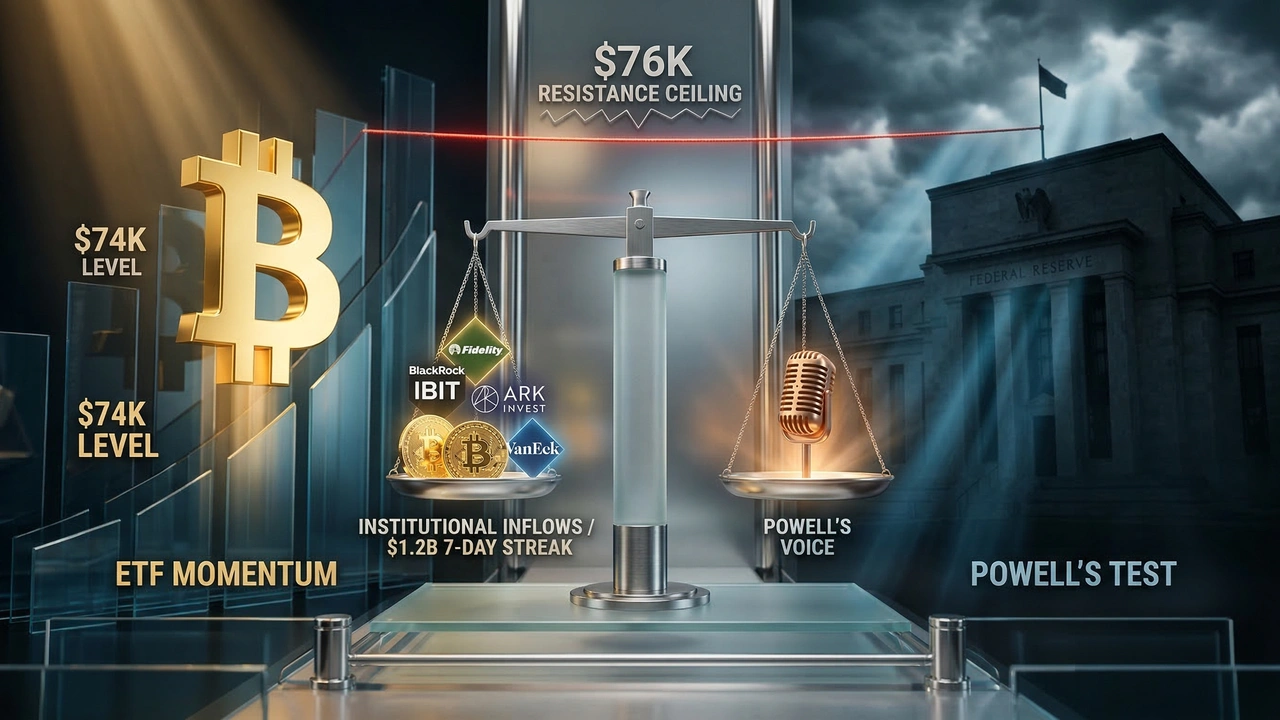
Seven consecutive days of Bitcoin ETF inflows totaling $1.2 billion signal returning institutional appetite, but the real question is whether Powell's tone can unlock the next leg higher — or send BTC back toward $65,000.
Key Takeaways
- Powell's tone, not the rate decision itself, is the real market mover: With a rate hold fully priced in at near-100% probability, Bitcoin's next directional move hinges entirely on whether Powell sounds hawkish or dovish at his press conference [1].
- Seven days of ETF inflows are encouraging but below prior cycle intensity: The $1.2 billion seven-day streak is the longest since October 2025, yet it pales against the $6 billion generated during a comparable nine-day run last October — suggesting cautious, not exuberant, institutional re-engagement [2].
- Bitcoin's year-to-date ETF balance remains slightly negative: Despite the positive recent streak, cumulative 2025 outflows still exceed inflows by roughly $100 million, meaning the structural recovery in ETF demand has not yet fully reversed the damage from earlier in the year [2].
- The $76,000 level is the line in the sand: A confirmed break and hold above $76,000 opens the path toward the 200-day SMA at $87,411; a rejection risks a slide back to the $65,000–$72,000 range, with $60,000 as the worst-case scenario if that band gives way [1].
- Broad crypto ETF demand is returning simultaneously: Ethereum, Solana, and XRP ETFs all posted positive inflow days alongside Bitcoin, suggesting this is a macro-driven rotation back into digital assets rather than Bitcoin-specific buying — a broader signal of improving risk appetite [2].
Bitcoin at $74K: ETF Momentum Meets the Powell Test — A Fragile Recovery at a Critical Crossroads
Bitcoin is trading at a price that looks constructive on the surface — recovering from February lows, holding above key moving averages, and attracting steady institutional money through spot ETFs. But beneath that relative calm lies a market wound tight with tension. The Federal Reserve's rate decision and, more critically, Jerome Powell's tone at his press conference represent a binary fork in the road: either the rally gets its green light, or a retreat toward $60,000 becomes increasingly plausible. The convergence of macro uncertainty and nascent ETF momentum makes this one of the most consequential moments for Bitcoin in months.
What makes the current setup particularly fascinating is the interplay between two distinct forces — macro policy signals from Washington and the steady, grinding return of institutional capital through ETF products. Neither story alone tells the full picture. Together, they define where Bitcoin goes next.
The Facts
Bitcoin was trading around $74,000 on Wednesday, sitting approximately 2.6% below the six-week high of $76,000 it briefly touched on Tuesday [1]. The price action has been constructive since breaking out of its prior range on Friday, but bulls have so far failed to decisively clear the $76,000 resistance level — a ceiling that has capped every rally attempt with disciplined precision [1].
The Federal Open Market Committee (FOMC) meeting on March 17-18 concluded with a rate decision that markets had already fully anticipated: interest rates remain unchanged in the 3.5%–3.75% range. Polymarket bettors assigned a 100% probability to this outcome, and futures traders priced in a 98.9% chance of no change [1]. With the decision itself stripped of surprise value, the real volatility catalyst is Powell's language at his subsequent press conference. As veteran trader Matthew Dixon noted, "The rate decision is fully priced in so low surprise risk" — the "real volatility catalyst is Powell's tone" [1]. A hawkish lean could weigh on risk assets; a softer, more accommodative tone could be the spark that breaks Bitcoin above $76,000.
On the ETF front, the data paints an encouraging — though nuanced — picture. Spot Bitcoin ETFs recorded their seventh consecutive day of net inflows on March 17, bringing in $199 million on that day alone [1]. Across the full seven-day streak, total net inflows reached approximately $1.2 billion, representing the longest positive run for these products since October 2025 [2]. BlackRock's IBIT led the charge with $169 million in single-day inflows on Tuesday, while Fidelity's FBTC contributed an additional $24 million. Products from Ark Invest and VanEck also posted positive figures [2].
However, the broader year-to-date picture remains sobering. Since January 1, Bitcoin ETFs have accumulated roughly $1.8 billion in outflows against $1.7 billion in inflows, leaving the net balance still slightly negative for 2025 [2]. The enthusiasm of the current streak is real, but it exists against a backdrop of months of capital retreat. Ethereum ETFs also showed signs of life, registering approximately $140 million in inflows — their best single-day figure since March 4 — while Solana products attracted $17.8 million and XRP spot ETFs returned to positive territory with nearly $5 million after suffering close to $60 million in outflows over the preceding days [2].
Analysis & Context
The ETF inflow streak deserves measured optimism rather than outright celebration. A $1.2 billion seven-day run sounds impressive, but context is everything: the comparable nine-day streak in October 2025 generated roughly $6 billion in inflows — five times the current pace [2]. This signals that institutional buyers are returning, but with considerably more caution than they showed during the peak of post-ETF-launch enthusiasm. The market is healing, not surging. This distinction matters enormously for anyone trying to gauge whether we are at the beginning of a new leg up or merely a relief rally within a broader corrective phase.
Historically, Bitcoin has demonstrated a pattern of front-running macro catalysts with optimism, only to sell off on the actual event — what traders call "buy the rumor, sell the news." The data point that crypto trader BitcoinHyper raised — that BTC has moved lower following each of the last six FOMC meetings — is worth taking seriously [1]. That said, there is a credible counterargument: if Powell strikes a dovish or even neutral tone, the unwinding of defensive hedges could generate a sharp move higher. Crypto analyst Sykodelic's thesis that both equities and Bitcoin could "juice" following the meeting reflects a legitimate scenario, particularly if Powell uses what may be his final FOMC press conference to frame the economic outlook favorably [1]. Legacy-conscious central bankers have historically preferred to leave on a constructive note.
The technical picture sets up cleanly. Bitcoin needs to flip $76,000 from resistance to support to have any credible path toward $80,000 and beyond. Above that zone, the 200-day simple moving average at $87,411 represents the next major target [1]. On the downside, a failure to hold the $72,000–$65,000 support band — where the 200-week exponential moving average sits — opens the door to a retest of the $60,000–$62,500 region, which would effectively wipe out all gains since early February [1]. The market is at maximum tension: both outcomes are plausible, and the margin between them is thinner than it has been in weeks.
Sources
AI-Assisted Content
This article was created with AI assistance. All facts are sourced from verified news outlets.