Bitcoin at a Crossroads: $66K Hope Meets $24K Worst-Case Warning
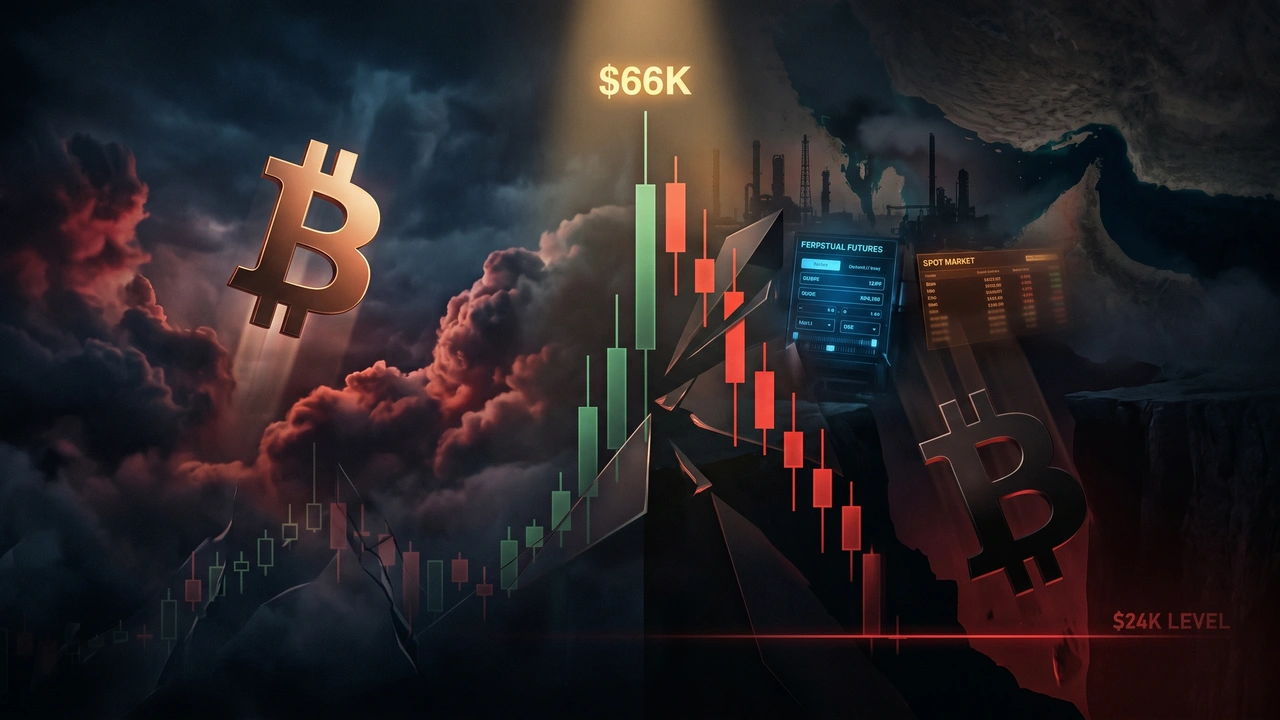
Bitcoin clawed back toward $64,000 against a backdrop of renewed US-Iran tensions and persistent institutional selling pressure, while a separate technical analysis raises the alarm about a potential 60%-plus collapse if equity markets crack hard.
Key Takeaways
- Bitcoin's weekend rally to nearly $64,500 was driven primarily by derivatives activity, with spot sellers on Binance consistently pushing back against the move - a structural weakness that undermines confidence in the recovery's durability.
- The six-consecutive-Monday peak pattern flagged by trader Killa adds a short-term timing risk to any bullish position heading into the weekly open.
- Institutional sentiment remains a critical missing ingredient: negative Coinbase premium readings throughout 2026 and nearly $4.7 billion in ETF outflows since May confirm that large professional investors are in risk-reduction mode, not accumulation mode.
- A severe US equity market drawdown of 50% or more could pull Bitcoin toward the $23,980 level identified by analyst Jesse Olson, a scenario that prominent macro voices including Jeremy Grantham, Michael Burry, and Gary Shilling consider increasingly plausible.
- Until spot demand recovers and institutional flows turn positive, every Bitcoin rally should be evaluated against the possibility that it is a derivatives artifact rather than a genuine change in underlying demand.
Bitcoin at a Crossroads: $66K Hope Meets $24K Worst-Case Warning
Bitcoin is caught between two competing narratives right now, and the distance between them is breathtaking. On one hand, bulls are fighting to consolidate a recovery above $64,000 even as geopolitical flashpoints reignite and sophisticated sellers push back. On the other, a growing chorus of macro-aware analysts is sketching out a scenario where BTC doesn't stop falling until it prints a number that starts with a two. The gap between optimism and catastrophe has rarely felt this wide.
What makes the current moment particularly instructive is that both storylines are running simultaneously, and they share a common thread: big money is not yet convinced. Until that changes, every bounce carries an asterisk.
The Facts
Bitcoin briefly reached a local peak of $64,522 on Bitstamp over the weekend before sellers clawed back roughly half a percent of those gains, leaving the pair still nursing most of its weekly advance [1]. The recovery came despite a fresh escalation in the US-Iran standoff, with Tehran once again shutting the Strait of Hormuz oil corridor and throwing the existing ceasefire agreement into serious question [1]. Israeli military operations in Lebanon were the proximate trigger, prompting Iran to threaten a full unraveling of the fragile truce. President Donald Trump pushed back sharply on Truth Social, warning Iran to rein in its proxy forces or face harder consequences [1].
For crypto traders watching macro risks pile up in real time, the price action felt off. Trader Lennaert Snyder captured the mood on X, calling Bitcoin's climb amid escalating geopolitical stress "suspicious" [1]. Even so, Snyder saw a plausible path toward $66,000 as part of the current leg higher, describing the week ahead as potentially interesting for the asset [1]. A note of caution came from trader Killa, who pointed out that over the previous six weeks, every single Monday had functioned as a local peak before price retreated [1]. With US futures markets about to open, that historical pattern gave short-term bulls reason to tread carefully.
Beneath the headline price, the mechanics of the move raised further red flags. Commentator Exitpump analyzed Binance order book data and concluded that the rally was being driven almost entirely by perpetual futures rather than genuine spot demand [1]. Spot market participants on Binance were consistently selling into the strength, a dynamic that Cointelegraph had flagged earlier in the week as an aggressive, sustained headwind for bullish momentum [1]. Derivatives-driven rallies without spot confirmation have a historical tendency to unwind sharply.
The bearish case gets considerably darker when zooming out to a macro stress scenario. Technical analyst Jesse Olson published a two-week BTC chart over the weekend anchoring a proprietary volume-weighted average price line from the 2022 bear market trough [2]. That long-term support projection converges around $23,980 - a level Olson frames as a realistic destination if US equities suffer a drawdown exceeding 50% [2]. The warning arrives with credible macro company: GMO's co-founder Jeremy Grantham has characterized the current AI-driven market surge as a full-blown speculative bubble, while Michael Burry has drawn parallels to the terminal phase of the late-1990s technology mania [2]. Economist Gary Shilling, meanwhile, has put the odds of a US recession arriving before year-end at near-certainty, with stocks potentially shedding between 20% and 30% in the process [2].
Institutional behavior is already beginning to reflect that caution. The Coinbase Premium Index - a gauge that measures BTC's price differential between Coinbase and Binance - has spent most of 2026 in negative territory, signaling that large US-based buyers are pulling back rather than accumulating [2]. Spot Bitcoin ETFs have compounded the picture: since May, American funds have recorded net outflows totaling $4.68 billion, according to SoSoValue data [2]. On-chain analyst Darkfost, affiliated with CryptoQuant, summarized the institutional mindset bluntly: "They operate under permanent risk management logic, they're not looking to buy a potential bottom, they're looking for confirmation" [2]. That confirmation has not arrived.
Analysis & Context
The pairing of these two stories is not coincidental - it maps onto a familiar Bitcoin archetype: the false dawn that precedes a deeper reset. The 2019 recovery to $14,000 is the textbook reference point. Bitcoin surged on retail enthusiasm and derivatives activity while institutional capital sat on the sidelines, and the structure eventually gave way to a prolonged grind lower before the genuine bull cycle launched from a healthier base. The current setup - derivatives-led upside, negative Coinbase premium, consistent ETF outflows - rhymes uncomfortably with that pattern.
The more important disambiguation here is that $64,000 is not a safe harbor just because it sounds high in absolute terms. Relative to the macro risks being priced into other asset classes, Bitcoin's resilience could reflect illiquidity and short-squeeze dynamics rather than genuine conviction buying. When equity volatility spikes in earnest, forced deleveraging across asset classes tends to treat Bitcoin as a high-beta risk asset first and a store of value second - at least in the short run. That sequencing is precisely what makes Olson's $23,980 scenario worth taking seriously as a tail risk, even if most bulls would dismiss it as extreme. Markets have a way of finding those tail risks when macro conditions deteriorate fast enough.
Sources
AI-Assisted Content
This article was created with AI assistance. All facts are sourced from verified news outlets.