Bitcoin Banking and Payments Face Regulatory Crossroads as Charter Politics and Tax Policy Collide
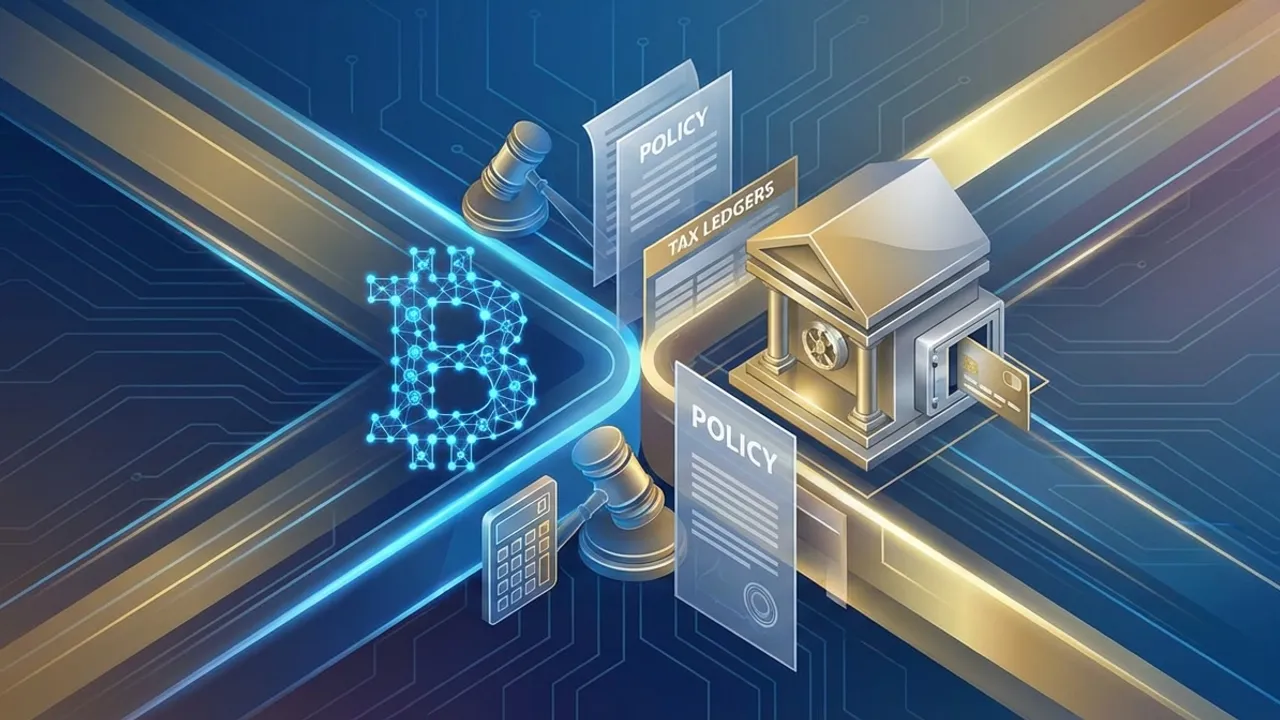
While crypto firms pursue national bank charters amid political controversy, tax policy remains the most significant barrier to Bitcoin's adoption as everyday money—a structural impediment that scaling technology alone cannot solve.
Key Takeaways
• Tax policy, not technology, is now the primary barrier to Bitcoin payments—solving this requires legislative action rather than technical innovation, making political engagement critical for Bitcoin's payment use case
• The OCC's commitment to evaluating crypto banking charters on merit regardless of political pressure represents a significant test of regulatory independence that will set precedent for how politicized the chartering process becomes
• Proposed legislation that grants tax exemptions exclusively to stablecoins while excluding Bitcoin would fundamentally reshape the competitive landscape through regulatory preference rather than market forces
• The convergence of institutional banking pathways and payment-focused tax reform represents a critical juncture where Bitcoin could either achieve functional money status or become permanently relegated to a digital commodity role
• Bitcoin advocates and industry participants must engage with tax policy debates as vigorously as they pursue banking charters, since technical scaling solutions are meaningless without supportive regulatory frameworks
Bitcoin's Regulatory Battle Plays Out on Two Critical Fronts
The path toward Bitcoin's integration into mainstream finance is being shaped by two simultaneous regulatory developments that will determine whether digital assets remain speculative instruments or evolve into functional money. On one front, crypto-native firms are navigating the politically charged process of obtaining banking charters, with World Liberty Financial's application becoming a lightning rod for concerns about political influence. On another, the U.S. tax code continues to create fundamental obstacles to Bitcoin's use as a payment method—a barrier that industry insiders now identify as more significant than any technical limitation.
These parallel developments reveal a critical tension: even as regulatory doors open for crypto firms to operate as banks, the tax treatment of Bitcoin transactions ensures that digital assets remain impractical for everyday commerce. The resolution of both issues will fundamentally reshape Bitcoin's role in the financial system.
The Facts
The Office of the Comptroller of the Currency has confirmed it will continue reviewing World Liberty Financial's application for a national bank charter despite strong objections from Senator Elizabeth Warren, who urged the regulator to halt the process due to the company's reported ties to President Donald Trump and his family [1]. OCC Comptroller Jonathan Gould stated the agency is legally required to evaluate all charter applications under existing regulatory standards regardless of political pressure, emphasizing that the chartering process must remain "apolitical and nonpartisan" [1].
Warren rejected this explanation, calling the review a "sham" and accusing Gould of refusing to delay the process until Trump and his family divest from the company [1]. The dispute comes as multiple crypto-focused firms seek national bank charters, with Paxos applying for a license in mid-2025 and Ripple receiving conditional approval in December [1]. Recent OCC policy changes now allow banks to facilitate crypto trading for customers and custody digital assets including Bitcoin, Ethereum, and XRP [1].
Meanwhile, tax policy has emerged as the primary obstacle preventing Bitcoin from functioning as a payment method. Pierre Rochard, a board member for Bitcoin treasury company Strive, explained the problem through a sports metaphor: "the best athlete can win against the worst athlete 100% of the time, if the best athlete plays. It drops to 0% if he doesn't play and lets the weak athlete win" [2]. His point: Bitcoin's technical capabilities are irrelevant if tax rules prevent its use.
The core issue is the absence of a de minimis tax exemption for small Bitcoin transactions, meaning every BTC transfer for payment is subject to capital gains taxation [2]. In December 2025, the Bitcoin Policy Institute highlighted this problem as a critical barrier to Bitcoin's use as a medium of exchange [2]. Wyoming Senator Cynthia Lummis introduced legislation in July 2025 proposing a de minimis exemption for digital asset transactions of $300 or less, with a $5,000 annual limit, and provisions to defer income from staking and mining until assets are sold [2].
Controversy erupted when lawmakers considered limiting de minimis exemptions exclusively to overcollateralized dollar-pegged stablecoins, sparking backlash from the Bitcoin community [2]. Jack Dorsey, whose payments company Square integrated Bitcoin payments into its point-of-sale systems in October, called for tax exemptions on small BTC transactions, stating "We want BTC to be everyday money ASAP" [2]. Bitcoin advocate Marty Bent called the proposed stablecoin-only exemption "nonsensical" [2].
Analysis & Context
These developments illustrate a fundamental contradiction in U.S. crypto policy: regulators are opening doors for institutional participation while maintaining tax structures that prevent practical usage. The banking charter debate represents the culmination of a multi-year shift in regulatory posture, where crypto firms transition from operating in legal gray zones to seeking full integration with traditional finance. This institutional acceptance carries profound implications for Bitcoin's legitimacy and accessibility, even as political controversies surrounding specific applications threaten to politicize what should be neutral regulatory processes.
The tax policy issue cuts deeper. Bitcoin was designed as peer-to-peer electronic cash, yet current U.S. tax treatment effectively mandates that users track the cost basis of every fraction of a bitcoin and calculate capital gains on every transaction—from buying coffee to paying for services. This creates an accounting nightmare that renders Bitcoin impractical for daily commerce regardless of transaction speed or network fees. The irony is stark: Lightning Network and other scaling solutions have largely solved Bitcoin's technical payment limitations, yet regulatory frameworks have nullified these advances.
The stablecoin favoritism in proposed legislation reveals a critical policy divide. By potentially granting tax advantages exclusively to dollar-pegged tokens while denying them to Bitcoin, lawmakers would be picking winners in the digital asset space based on monetary properties rather than neutral principles. This approach would cement stablecoins as payment mechanisms while relegating Bitcoin to a store-of-value role—not through market forces, but through regulatory design. Historically, when governments create preferential tax treatment for specific monetary instruments, those advantages often become self-fulfilling prophecies that shape adoption patterns for decades. If Bitcoin remains taxable on every transaction while stablecoins receive exemptions, the market structure of digital payments will reflect that regulatory choice rather than the organic preferences of users and merchants.
The banking charter pathway, meanwhile, offers Bitcoin companies a double-edged sword: legitimacy and regulatory clarity in exchange for comprehensive oversight and operational restrictions. Previous cycles have shown that institutional infrastructure—custody solutions, regulated exchanges, banking partnerships—creates the foundation for broader adoption, even if that adoption happens gradually. The question is whether politically contentious applications like World Liberty Financial's will poison the well for subsequent applicants or whether the OCC can maintain the neutral stance Gould has articulated.
Sources
AI-Assisted Content
This article was created with AI assistance. All facts are sourced from verified news outlets.