Bitcoin Charges Toward $74K as Short Squeeze and Geopolitics Collide
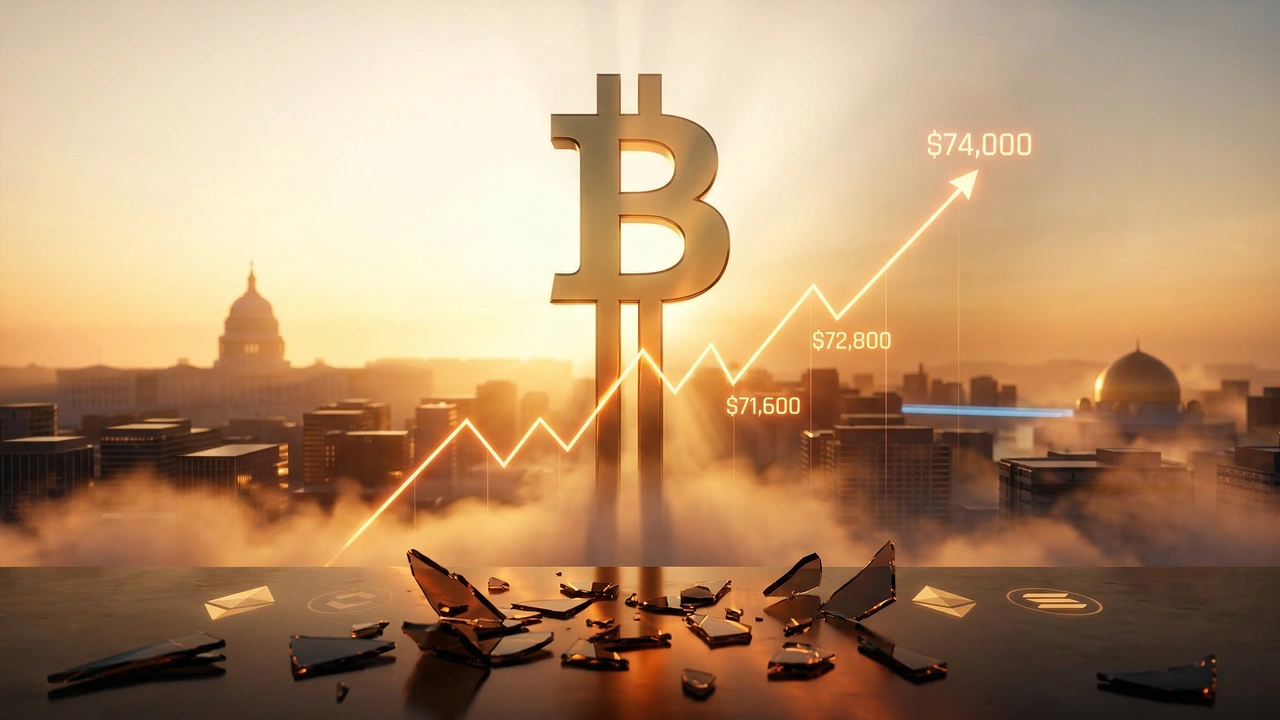
Bitcoin surged nearly 10% week-over-week to challenge the $74,000 level, driven by a massive short squeeze and easing tensions in the Middle East — but a critical Fed decision now looms as the defining catalyst for the next directional move.
Key Takeaways
- Short squeeze, not just sentiment, drove the rally: With $284.9 million in short liquidations in 24 hours, a significant portion of Bitcoin's move toward $74,000 was mechanically forced — but this also cleared a bearish overhang that had been suppressing prices [2].
- The Fed decision on Wednesday is the week's decisive catalyst: Powell's language on forward guidance and potential QE measures matters far more than the widely-expected rate hold; a dovish tilt could extend the rally, while a hawkish or neutral tone may trigger profit-taking [1].
- Geopolitical de-escalation is a tailwind, not a resolved risk: The softening around the Strait of Hormuz is encouraging, but the situation remains fluid — any reversal could quickly flip the market narrative back to risk-off [2].
- PPI data on Wednesday sets the stage before Powell speaks: A third consecutive month of above-forecast producer prices would complicate the Fed's path toward easing and could weigh on Bitcoin and altcoins heading into the rate announcement [1].
- Quadruple witching expiry on Friday warrants caution on volatility: Historically, this event amplifies price swings across financial markets — Bitcoin investors should expect elevated intraday noise and avoid over-interpreting short-term moves as trend confirmation [1].
Bitcoin's Defiant Rally: When Fear Becomes Fuel
In a week defined by geopolitical anxiety, equity weakness, and commodity selloffs, Bitcoin did what it does best — confound the consensus. While traditional safe-haven assets like gold and silver retreated alongside U.S. stock markets, the world's leading cryptocurrency staged a powerful countertrend rally, leaving bearish traders nursing significant losses. The move is more than just a price spike; it signals a maturing market dynamic where Bitcoin increasingly decouples from risk-off sentiment and trades on its own internal mechanics.
The coming week, however, will test the durability of that strength. A packed macroeconomic calendar — headlined by the Federal Reserve's rate decision — means the next 72 hours could either validate this rally as the beginning of a new leg higher or expose it as a technically-driven sugar rush without fundamental backing.
The Facts
Bitcoin closed the previous trading week up approximately 6%, reaching $71,600, with Ethereum, Solana, and BNB each gaining roughly 8% in the same period — a broadly bullish performance that defied the negative backdrop of ongoing Middle East conflict and pressure on U.S. equity markets [1]. The momentum carried into the new week, with Bitcoin pushing toward the $74,000 mark, representing a gain of more than 3% in a single 24-hour window and nearly 10% above the prior week's levels [2].
A key mechanical driver behind the surge was a significant short squeeze. According to data from CoinGlass, approximately $344 million worth of leveraged positions were liquidated within a 24-hour window, with an overwhelming $284.9 million of that total coming from short positions. Bitcoin and Ethereum were identified as the most heavily affected assets in the liquidation cascade [2]. The memecoin PEPE stood out as the session's top performer, posting a gain of around 19% [2].
On the geopolitical front, the tone around the U.S.-Iran conflict appeared to soften meaningfully. U.S. President Donald Trump indicated that Washington was in communication with Tehran, and while Iranian officials pushed back on the characterization, the market interpreted the signals as an opening toward de-escalation [2]. Iran's Foreign Minister Abbas Araghchi further reduced tension by clarifying that the Strait of Hormuz closure now applied only to vessels from "enemy" nations — a notable step back from a blanket blockade — and two liquefied natural gas tankers passed through the strait for the first time since hostilities began [2]. Traditional markets responded positively: S&P 500 futures gained 0.5%, the U.S. Dollar Index eased 0.3%, and the MSCI global equity benchmark stabilized [2].
Looking ahead, the week's most consequential event is Wednesday's Federal Reserve rate announcement at 7:00 PM CET, followed by Fed Chair Jerome Powell's press conference at 7:30 PM CET [1]. Fewer than 1% of market participants currently expect a rate cut; the real focus is on Powell's forward guidance, particularly any commentary around quantitative easing measures and the Fed's posture given tariff-related economic headwinds [1]. Wednesday also brings U.S. Producer Price Index data for February, with analysts forecasting a month-on-month increase of 0.3% — a figure that, if exceeded, could reignite inflation concerns and pressure risk assets [1]. Thursday features the Bank of Japan's rate decision, where an unchanged rate of 0.75% is expected, though hawkish language could trigger JPY/USD volatility with knock-on effects for global markets [1].
Analysis & Context
The short squeeze dynamic that propelled Bitcoin toward $74,000 is a well-documented phenomenon in crypto markets, and its recurrence here carries an important implication: the market had accumulated a substantial overhang of bearish bets that was fundamentally inconsistent with underlying demand. When geopolitical fears began to moderate — even slightly — that imbalance resolved violently to the upside. This is not a new pattern. Bitcoin witnessed identical mechanics during the early 2024 ETF-driven rally and again during the post-halving consolidation period, where excessive short positioning repeatedly became the catalyst for sharp upside moves rather than a genuine directional signal of weakness.
What distinguishes this rally from purely mechanical bounces is the confluence of factors supporting it. The partial de-escalation in the Strait of Hormuz matters because elevated oil prices have been a primary obstacle to Fed dovishness — if energy price pressure eases, the argument for maintaining restrictive monetary policy weakens. Bitcoin has historically been highly sensitive to shifts in Fed rhetoric; the 2023 pivot narrative alone drove a multi-month rally even before actual rate cuts materialized. If Powell strikes a more accommodative tone Wednesday — acknowledging tariff-related economic drag or signaling openness to balance sheet expansion — the crypto market's reaction could be outsized relative to traditional assets, precisely because it has already demonstrated its willingness to move aggressively on sentiment shifts.
The quadruple witching expiry at the end of the week adds another layer of complexity [1]. Options and futures expiries of this scale routinely amplify intraday volatility across asset classes. For Bitcoin, which trades 24/7 and increasingly interacts with the derivatives ecosystem, this could mean sharp but short-lived swings in either direction regardless of the fundamental news flow. Investors should contextualize any extreme single-day moves within this technical backdrop rather than reading them as definitive trend signals.
Sources
- [1]btc-echo.de
- [2]btc-echo.de
AI-Assisted Content
This article was created with AI assistance. All facts are sourced from verified news outlets.