Bitcoin Cracks $73K: ETF Exodus, Geopolitics, and a Mysterious $8.5M Burn
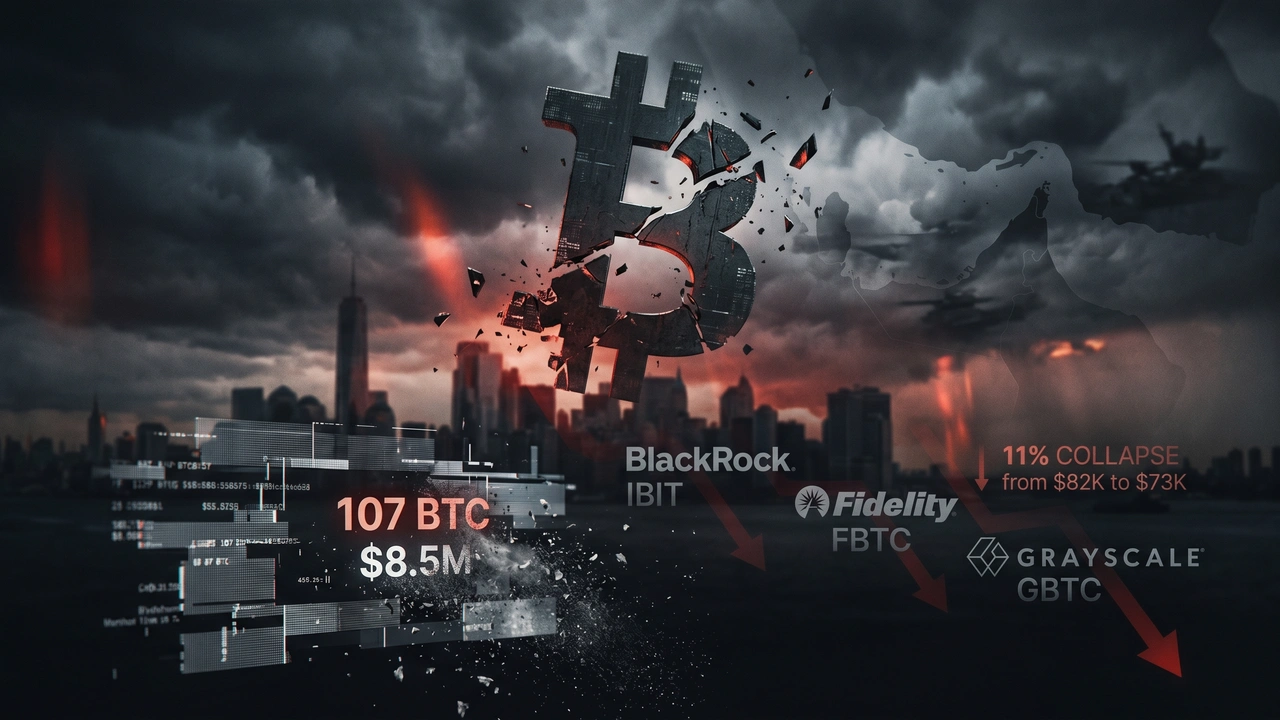
Bitcoin shed more than 5% in five days as record-scale ETF redemptions collided with fresh Middle East tensions, while a bizarre 107-BTC destruction event added a layer of intrigue to an already turbulent market.
Key Takeaways
- The ETF redemption wave is real but context matters: Wednesday's $733 million combined outflow was historically large, yet IBIT's lifetime inflow base of $64 billion means the structural bull case remains intact if the macro backdrop stabilizes.
- The dark-pool block trade and net ETF redemptions arriving simultaneously signal that institutional players were reducing bitcoin exposure through multiple channels at once - a more coordinated retreat than a single outlier event.
- Bitcoin's new ETF-driven market structure creates a reflexive feedback loop where redemptions force spot sales, which depress prices and can trigger further redemptions - a dynamic absent in previous cycles that amplifies short-term drawdowns.
- JPMorgan's framing of the selloff as investors pre-pricing a geopolitical resolution suggests this may be a sentiment-driven dip rather than a structural exit, but that thesis depends entirely on whether Middle East tensions actually de-escalate.
- The unexplained 107-BTC burn highlights a growing operational risk: as AI agents and complex institutional workflows become more deeply embedded in bitcoin custody, the probability of irreversible errors - not just hacks - increases in ways the industry has not fully priced in.
Bitcoin Cracks $73K: ETF Exodus, Geopolitics, and a Mysterious $8.5M Burn
Bitcoin's May correction has deepened into something that demands serious attention. What began as a routine pullback from early-month highs has evolved into a multi-vector pressure event - institutional capital fleeing through the ETF channel, a geopolitical shock reigniting safe-haven anxiety, and an unexplained destruction of roughly $8.5 million worth of bitcoin that has the industry's sharpest minds offering competing theories. Taken together, these developments reveal the fragility beneath bitcoin's 2025 bull run and raise pointed questions about who is selling, why, and what comes next.
The Facts
The price deterioration has been swift and broad. Bitcoin dropped from above $82,000 in early May to beneath $73,000 within roughly two weeks, a decline exceeding 11% from peak to trough [2]. The most acute leg lower came during Asian trading hours on Thursday, when the coin fell to approximately $72,978, pressured in part by fresh American airstrikes against an Iranian military installation near the Strait of Hormuz - a development that jolted risk markets globally [2].
The ETF complex bore the clearest fingerprints of institutional retreat. BlackRock's IBIT fund saw approximately $528 million drain out in a single Wednesday session - its second-largest one-day outflow since launching in January 2024, missing the all-time record by a relatively thin margin [2]. Across all U.S. spot bitcoin ETFs, combined daily outflows hit $733 million that same day, the heaviest collective bleeding since late January [2]. Fidelity's FBTC lost roughly $60 million, Grayscale's GBTC shed about $105 million, and only Morgan Stanley's MSBT managed positive flows, absorbing a modest $4.3 million [2]. Yet perspective is warranted: IBIT still carries more than $64 billion in lifetime net inflows and sits in the top 2% of all ETFs by cumulative flows, making Wednesday's draw less than 1% of that accumulated base [2].
The day before those redemptions crystallized, a single institutional player quietly sold $1.29 billion worth of IBIT shares through a dark-pool block trade - a privately negotiated transaction designed to move large size without broadcasting intent to the open market [2]. Bloomberg's senior ETF analyst Eric Balchunas flagged the 29.2-million-share transaction, which helped push total bitcoin ETF trading volume on Tuesday to $4.4 billion, the highest since mid-April [2]. Importantly, a dark-pool transfer is not automatically a net outflow - buyers absorb the other side - but IBIT still posted $192 million in net redemptions that day, suggesting the institutional pressure was arriving through multiple channels simultaneously [2].
Meanwhile, a separate mystery unfolded on-chain. Roughly 107 BTC - worth approximately $8.5 million at the time - was sent to a provably unspendable address, permanently removing it from circulation [1]. Galaxy Research floated several explanations: deliberate tax-loss harvesting, destruction of coins linked to illicit origins, or a mistaken transfer by an AI agent operating without proper oversight [1]. Bloomberg's Balchunas raised the possibility of a rogue AI acting autonomously, alongside kidnapping or tax-related motives [1]. Coinbase's head of product business operations, Conor Grogan, offered perhaps the most grounded take, suggesting it was "most likely an exchange that messed up their cold storage transfers" [1].
Analysis & Context
The confluence of these events fits a recognizable pattern in bitcoin's market history: macro shock + institutional positioning shift = amplified drawdown. What makes this episode distinct from simpler corrections is the feedback loop the ETF structure creates. When large holders redeem shares, fund issuers must liquidate underlying bitcoin to settle those exits, which pushes spot prices lower, which in turn can trigger margin calls or risk-limit breaches at other institutions, generating further redemptions. This reflexive dynamic was largely absent in previous cycles and represents a structural evolution in how bitcoin corrections can transmit and accelerate in the current regime.
Historically, bitcoin has endured multiple episodes where geopolitical shocks served as the initial catalyst for selling that then took on its own momentum. The key analytical distinction is between a sentiment-driven dip - where capital returns once the scare fades - and a structural rotation, where the money leaving is redeploying into a different asset class for fundamental reasons. JPMorgan's observation that both bitcoin and gold ETFs are seeing simultaneous outflows, which the bank attributes to investors front-running a potential U.S.-Iran diplomatic resolution, leans toward the former interpretation [2]. If that read is correct, the current selloff may be more about repositioning than disillusionment.
The debasement-trade thesis deserves scrutiny here. Bitcoin's bull case in 2024 and early 2025 was partially built on the narrative that institutional money was treating it as a hedge against dollar erosion - the same role gold has historically played during periods of fiscal stress. JPMorgan's cooling assessment of that narrative is not a death knell for bitcoin, but it does suggest that the marginal institutional buyer who entered on macro-hedge grounds may be quicker to exit than the conviction holder who owns bitcoin as a long-term monetary asset [2]. Distinguishing between these two buyer cohorts matters enormously when interpreting ETF flow data.
On the mysterious burn: while $8.5 million is a negligible fraction of bitcoin's multi-trillion-dollar market cap, the event carries symbolic weight disproportionate to its size. The most instructive detail is how cleanly it exposes the risks of AI-assisted custody and trading operations. Whether the coins were destroyed by a mistaken AI agent, a human error in cold storage migration, or a deliberate act of financial hygiene, the incident underlines that as bitcoin becomes embedded in complex institutional workflows, the surface area for irreversible mistakes grows. Unlike a hacked exchange, where funds can sometimes be traced and occasionally recovered, a burn to an unspendable address is absolute. The industry's inability to definitively explain what happened is itself a data point about transparency gaps in institutional bitcoin operations.
Sources
AI-Assisted Content
This article was created with AI assistance. All facts are sourced from verified news outlets.