Bitcoin Decouples from Software Stocks as Inflation Reshapes Markets
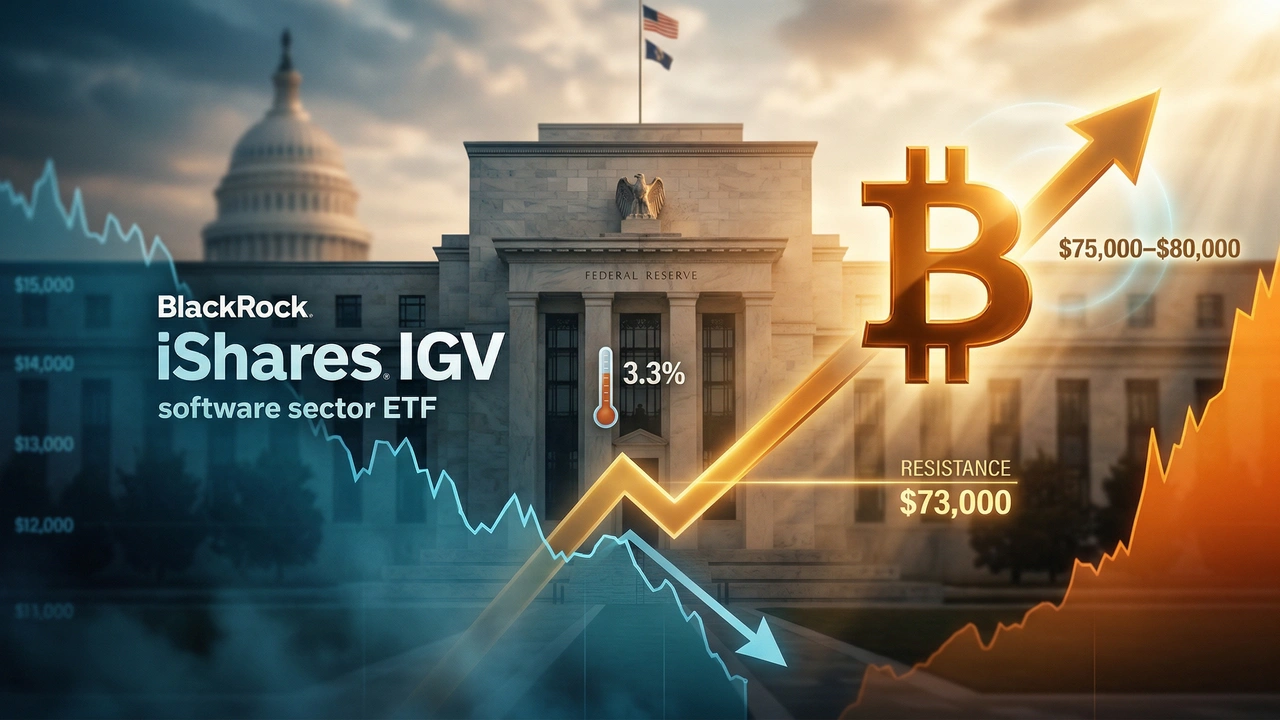
With U.S. CPI running at 3.3% annually and rate cuts effectively off the table, Bitcoin is staging a notable break from its months-long correlation with software equities — a shift that could redefine how markets classify the asset.
Key Takeaways
- Inflation remains the dominant macro constraint: At 3.3% YoY with energy-driven upside pressure, CPI data keeps the Fed on hold and rate cut odds at zero — a headwind for all risk assets, but one Bitcoin appears to be absorbing better than expected [1].
- The software stock correlation may be breaking down: Bitcoin's 8% weekly gain against IGV's 7% decline represents one of the sharpest divergences in recent memory, potentially signaling a market reassessment of how Bitcoin should be classified [2].
- The fundamental case for decoupling is strong: Unlike software firms, Bitcoin faces no AI disruption risk — and may actually benefit from AI adoption as autonomous agents require permissionless digital currency [2].
- Bitcoin as a leading macro indicator: Historical patterns from 2022 and the current cycle suggest Bitcoin peaks and corrects ahead of equity markets, making it a more accurate barometer of global liquidity than a simple tech-stock proxy [2].
- Watch the $73,000–$75,000 zone: This is the critical technical level identified by analysts; a clean break opens the path toward $80,000 and potentially beyond, especially if favorable regulatory developments materialize [1].
Bitcoin's Defining Moment: Breaking Free From the Software Stock Shadow
For much of the past year, Bitcoin traded like a leveraged bet on enterprise software — rising and falling in near-lockstep with names like Salesforce, Adobe, and Microsoft. That narrative is now being challenged in real time. As U.S. inflation data continues to pressure the Federal Reserve into keeping rates elevated, Bitcoin is quietly doing something remarkable: outperforming while the software sector crumbles. This isn't just a price story. It may be a fundamental reclassification in progress.
The confluence of sticky inflation, zero probability of near-term rate cuts, and a fracturing correlation with tech equities is forcing analysts to ask a question that once seemed premature: Is Bitcoin finally beginning to trade on its own terms?
The Facts
The U.S. Bureau of Labor Statistics released its Consumer Price Index report for March, showing headline inflation rose 0.9% month-over-month and 3.3% year-over-year [1]. While the figure came in marginally below analyst forecasts, it remains well above the Federal Reserve's 2% target — the threshold that would give policymakers the confidence to begin easing monetary conditions. A major driver of the March print was an energy price surge tied to the ongoing Iran conflict, with the energy index climbing nearly 11% and gasoline prices spiking 21.2% [1].
Markets responded swiftly to the data. According to CME Group's FedWatch tool, traders are pricing in a 0% probability of a rate cut at the April FOMC meeting, with a 98.4% chance that rates remain unchanged [1]. Rate cut odds increase only marginally across the remainder of the year, and some FOMC members have reportedly declined to rule out rate hikes entirely, given the inflationary pressures stemming from the war [1]. In this environment, risk assets typically struggle — yet Bitcoin rose more than 1.5% on the day of the CPI release, briefly touching the $73,000 level [1].
Meanwhile, a separate but deeply connected development has been unfolding in the relationship between Bitcoin and software equities. Bitcoin had maintained an unusually tight correlation with BlackRock's iShares Expanded Tech-Software Sector ETF (ticker: IGV) since at least spring 2024, with both assets reaching cycle highs in early October before entering sharp corrections [2]. This week, however, that correlation appears to have broken down decisively. While IGV fell roughly 7% and dropped to its lowest level since late 2023, the Bitcoin spot ETF IBIT gained more than 8% over the same period [2]. Bitcoin is currently trading approximately 20% above its February low of $60,000, while IGV has continued to make new multi-year lows [2].
Analyst Matt Mena of 21Shares framed Bitcoin's current technical position optimistically, identifying the $73,000–$75,000 zone as the next major resistance target and suggesting a successful break could set up a test of $80,000 [1]. He further noted that passage of the Clarity Act could catalyze a move toward $100,000 and a total crypto market cap of $3–$3.2 trillion by end of Q2 [1].
Analysis & Context
The correlation between Bitcoin and software stocks was never fundamentally justified — and that incongruence is precisely what makes its breakdown so significant. Software companies like Microsoft, Adobe, and ServiceNow have been under pressure due to fears of AI-driven disruption to their business models [2]. Those fears are entirely inapplicable to Bitcoin. A decentralized monetary network with a fixed supply of 21 million coins cannot be undercut by a competing AI product. If anything, the rise of autonomous AI agents — which require a native, permissionless digital currency to transact — arguably strengthens Bitcoin's long-term demand thesis [2].
The correlation existed primarily because of macro liquidity dynamics and algorithmic trading patterns. When central banks tightened aggressively after 2022, risk assets across the board sold off together, and Bitcoin was lumped in with high-multiple tech stocks. Algorithms identified the statistical relationship and began trading it, creating a self-reinforcing feedback loop. This is a well-documented phenomenon in financial markets: correlations forged in liquidity crises tend to persist even after the underlying rationale has faded. Bitcoin's history actually supports a more nuanced reading — in both 2022 and the more recent cycle, BTC peaked and entered correction territory before the broader equity market followed, suggesting it functions less as a correlated risk asset and more as a leading indicator of liquidity conditions [2].
The current macro backdrop adds another layer of complexity. With inflation above target and rate cuts effectively frozen, the traditional playbook would suggest headwinds for Bitcoin. Yet Bitcoin is rising. This mirrors patterns seen during periods of currency stress and geopolitical uncertainty, where hard-capped assets have historically attracted capital seeking shelter from monetary debasement. Gold has notably failed to show the same relative strength during the current Iran conflict that Bitcoin has demonstrated [2] — a detail that deserves far more attention than it has received. If Bitcoin is absorbing safe-haven flows that bypassed traditional crisis hedges, the implications for its long-term positioning are substantial. Respected analysts like Luke Gromen, who were initially skeptical of attributing Bitcoin's resilience to fundamentals rather than the software stock correlation, are beginning to reconsider their interpretation as the divergence becomes harder to dismiss [2].
Sources
AI-Assisted Content
This article was created with AI assistance. All facts are sourced from verified news outlets.