Bitcoin DeFi's Reality Check - And Why Quantum Risk Adds Urgency
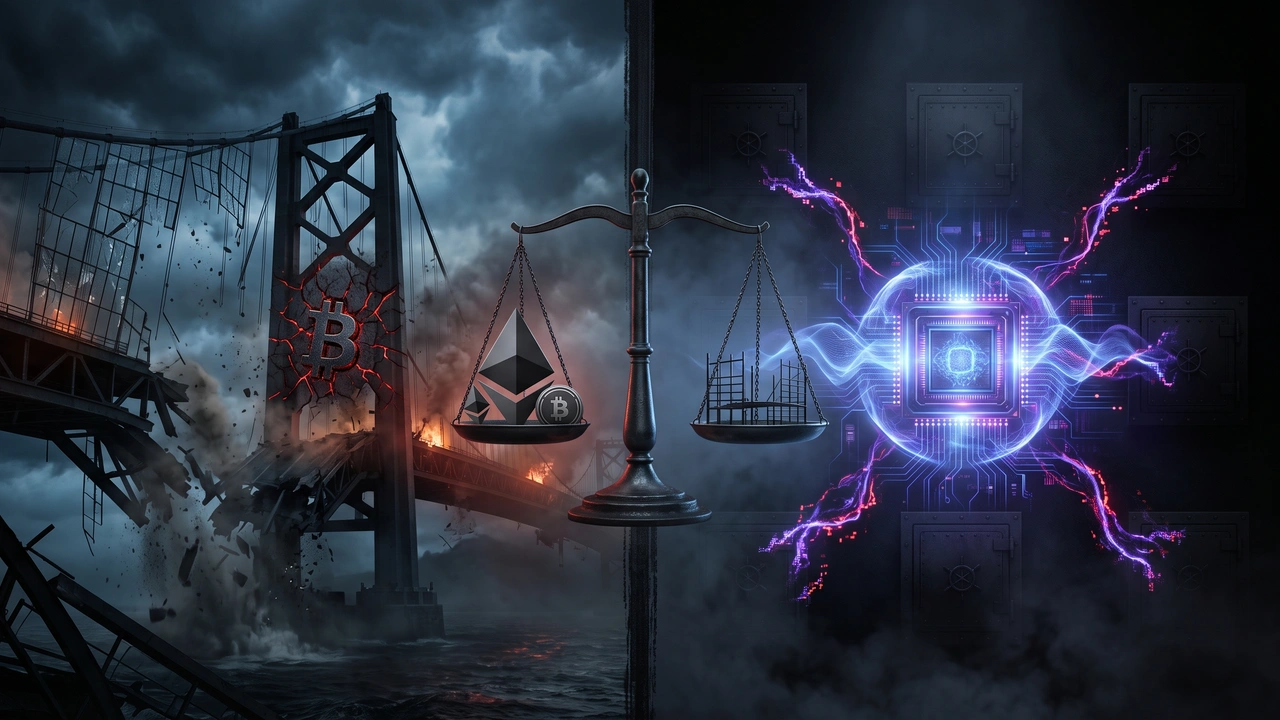
The shutdown of Botanix exposes a structural mismatch at the heart of Bitcoin DeFi, while Binance's founder reignites a long-dormant debate about whether quantum computing could one day threaten Bitcoin's oldest wallets.
Key Takeaways
- Wrapped BTC on Ethereum dominates Bitcoin DeFi not because of superior security or alignment, but because liquidity depth, established applications and user familiarity create switching costs that technical advantages alone cannot overcome.
- Roughly $20 billion in tokenized BTC - under 2% of total supply - is active in DeFi, and a large majority of that lives on Ethereum and its ecosystem, not on Bitcoin-native chains.
- Bitcoin-native DeFi still has a viable path, but it runs through institutional trust infrastructure - legal frameworks, risk controls and compliance scaffolding - rather than through replicated EVM primitives.
- Satoshi's early wallets and other legacy addresses with exposed public keys represent a real, if distant, quantum vulnerability; the debate about how to handle them is a governance challenge Bitcoin cannot defer indefinitely.
- The Botanix closure should be read as a data point about one specific architectural approach, not as proof that Bitcoin-secured financial infrastructure is inherently unworkable.
Bitcoin DeFi's Reality Check - And Why Quantum Risk Adds Urgency
Two separate but thematically linked developments are forcing the Bitcoin community to confront uncomfortable questions about its future. One is a postmortem from a failed Bitcoin-native DeFi experiment that reveals how stubbornly users cling to Ethereum's gravity. The other is a renewed warning from Binance's founder that dormant wallets - including those attributed to Satoshi Nakamoto - could become targets once quantum hardware matures. Together, they paint a picture of a network whose greatest strengths may, paradoxically, be the source of its greatest vulnerabilities.
The Facts
Botanix, a Bitcoin-aligned EVM sidechain, recently wound down operations - and the post-mortem from co-founder Willem Schroé is worth reading carefully. Despite offering what Schroé characterized as competitive pricing and a tighter security model than conventional wrapped-BTC bridges, his platform could not dislodge users from their comfort zones. [1] The culprit, in his assessment, was Ethereum's compounding advantages: decades of infrastructure accumulation, deep liquidity pools, established app ecosystems and the regulatory familiarity that institutional and retail participants have built around it. [1] Wrapped BTC on Ethereum, he concluded, is simply good enough for most people - and good enough beats better architecture every time.
The aggregate data backs that conclusion up bluntly. A May 2026 analysis estimated that approximately $20 billion worth of BTC - under 2% of total supply - is actively circulating on EVM networks in tokenized form. [1] The overwhelming majority of that sits not on Bitcoin-native chains but on Ethereum and its layer-2 networks, alongside Polygon, Solana and BNB Smart Chain. [1] Meanwhile, a survey of 730 Bitcoin holders conducted by GoMining in October 2025 found that 77% had never touched a BTCFi platform at all, and only 3% had incorporated such tools into a broader Bitcoin strategy. [1] Even accounting for the fact that survey respondents skew toward engaged users, those figures reveal that Bitcoin-native DeFi is still a niche activity rather than a mainstream behavior.
Industry practitioners reinforce this picture. Justin d'Anethan, who leads research at Arctic Digital, a crypto-focused private markets advisory firm, told Cointelegraph that yield and liquidity conditions on Ethereum and Solana simply outperform Bitcoin-native alternatives at this stage. [1] For clients asking how to put their Bitcoin to work, the realistic options remain centralized lending desks, basis-trade structures or institutional credit pools - not Bitcoin L2 bridging. [1] Dr. Dragosch, analyzing the Botanix closure, argued that capital with genuine yield ambitions has already migrated toward wrapped-BTC products on proven, liquid networks rather than moving into purpose-built Bitcoin execution layers. [1] His view: the architecture and the user base are fundamentally misaligned, because Bitcoin's foundational culture is anchored in store-of-value conservatism, not on-chain productivity.
Not everyone accepts the fatalist reading. Diego Gutierrez Zaldivar, CEO of RootstockLabs, rejects the notion that there is no genuine demand for Bitcoin-backed lending and yield products. [1] In his framing, the real bottleneck is institutional trust infrastructure - the legal, operational and risk-management scaffolding that large capital allocators require before committing. [1] He noted that Rootstock now processes more than 40% of all Bitcoin DeFi activity by volume, including real-world asset settlements and institutional vaults, and that fund-level inflows of hundreds or even thousands of BTC at a time have begun appearing - flows that were essentially unheard of two or three years ago. [1] Orkun Mahir Kilič of Chainway Labs, the team behind the zero-knowledge Bitcoin rollup Citrea, takes a similar contrarian stance. He argues that Botanix's failure was a verdict on copy-paste EVM cloning as a strategy, not a verdict on Bitcoin DeFi as a concept. [1] His pointed observation: "People don't price counterparty risk until something breaks." [1]
On an entirely different front, Binance founder Changpeng Zhao has reopened a debate that the Bitcoin development community has periodically revisited but never resolved. His concern centers on older Bitcoin addresses where the public key is already visible on-chain - a condition that makes them theoretically susceptible once quantum computers become capable of reverse-engineering private keys from public ones. [2] Zhao floated the idea of freezing the most exposed wallets, with Satoshi's holdings explicitly in scope, to prevent any future quantum attacker from injecting long-dormant coins into circulation. [2] He was careful to frame this as a conversation starter rather than a formal proposal. [2] Modern wallets are considered significantly more resistant to this threat, but the older address formats used extensively in Bitcoin's early years offer a much weaker posture against next-generation cryptographic attacks. [2] Some developers view the discussion as overdue; others warn that any protocol-level intervention to lock or freeze addresses cuts against Bitcoin's foundational principle of immutability and the absence of centralized control. [2]
Analysis & Context
The Botanix shutdown fits a recognizable pattern in crypto: the technically superior product losing to the entrenched one. This is not unique to Bitcoin. Ethereum itself survived competitive pressure from faster, cheaper chains for years not because of performance metrics but because of network effects and developer inertia. The lesson for BTCFi builders is not that demand is absent - Rootstock's institutional traction suggests otherwise - but that demand is not sufficient on its own. Liquidity, legal clarity and application density need to reach critical mass simultaneously. Bitcoin-native DeFi is still assembling those pieces, and the window to do so before wrapped-BTC products on Ethereum become the permanent default may be narrower than advocates appreciate.
The quantum threat discussion deserves a different kind of analysis, because it sits at the intersection of cryptographic timelines and Bitcoin governance - one of the most contentious arenas in the entire space. The meaningful risk is not imminent; credible estimates of quantum computers capable of breaking elliptic-curve cryptography remain in the range of at least a decade away, possibly considerably longer. But Bitcoin governance moves slowly by design, and any protocol upgrade to introduce quantum-resistant cryptography would require years of development, testing and consensus-building. Zhao's intervention, whatever one thinks of its specific suggestion, usefully highlights the gap between technical risk timelines and governance timelines. The community cannot afford to treat this as a problem to solve when it arrives.
Sources
AI-Assisted Content
This article was created with AI assistance. All facts are sourced from verified news outlets.