Bitcoin Enters the Workplace: From Employee Bonuses to Mining at Scale
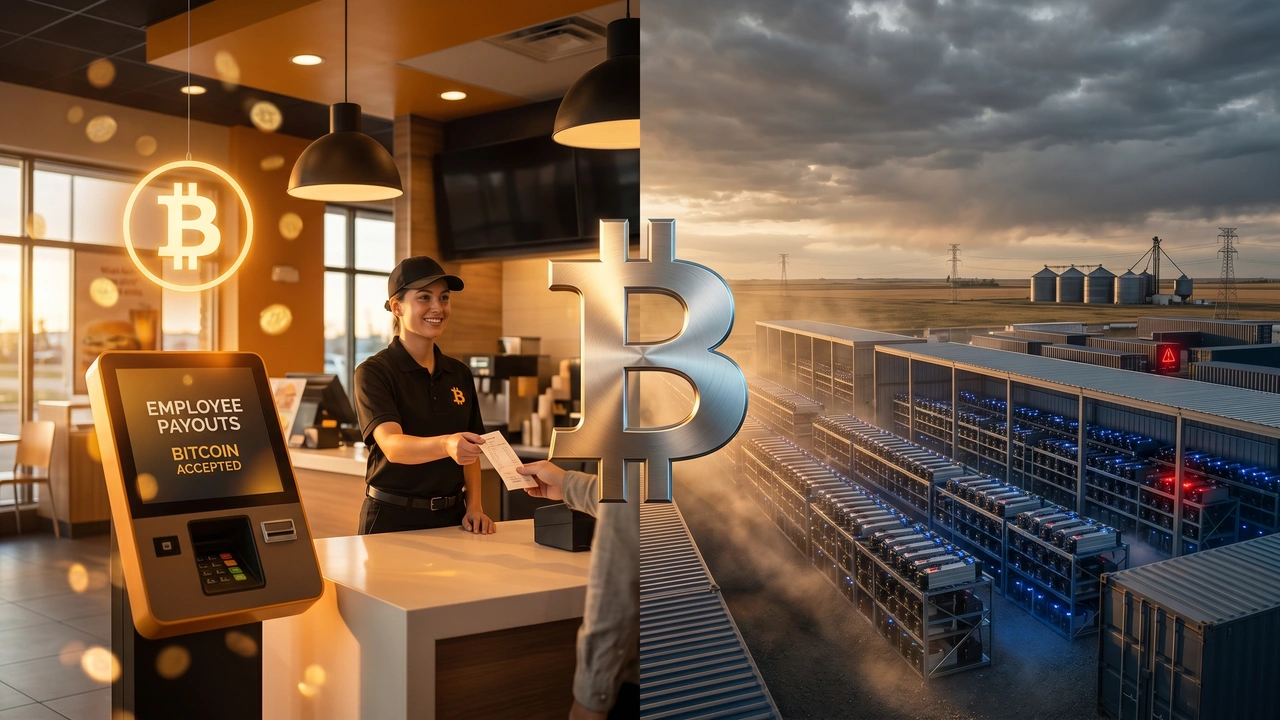
Two converging developments reveal how Bitcoin is embedding itself deeper into corporate infrastructure — both as an employee benefit tool and as an industrial-scale mining operation navigating a brutal post-halving environment.
Key Takeaways
- Fold's Bitcoin Bonus Program is the most significant attempt yet to bring bitcoin compensation to non-executive, hourly workers at scale, with Steak 'n Shake's 10,000+ person workforce serving as the critical proof-of-concept [1].
- The compliance-friendly design — Fold handles custody, conversion, and vesting while employers interact only in dollars — removes the primary barrier that has kept most HR departments away from bitcoin compensation programs [1].
- American Bitcoin's fleet expansion to 28.1 EH/s signals continued long-term conviction in mining economics, even as Q4 2025 losses of $59.5 million and record industry-wide BTC sales in Q1 2026 underscore the severity of the current mining downturn [2].
- The record 32,000 BTC sold by public miners in Q1 2026 — surpassing even the stress period of Q2 2022 — is a meaningful indicator of sector-wide financial pressure and warrants close monitoring by anyone tracking Bitcoin's supply dynamics [2].
- The convergence of consumer-facing Bitcoin compensation infrastructure (Fold) and industrial hash rate expansion (ABTC) illustrates that Bitcoin's corporate integration is deepening across multiple layers of the economy simultaneously, even in a challenging price environment.
Bitcoin Enters the Workplace: From Employee Bonuses to Mining at Scale
Bitcoin's corporate story is no longer just about treasury allocations and speculative balance sheets. Two distinct but thematically connected developments this week illustrate a maturing ecosystem where Bitcoin is being woven into the fabric of business operations — from the paycheck of a fast-food worker in Middle America to the hash rate of an 89,000-machine mining fleet in the Canadian prairies. Together, they paint a picture of an asset class that is simultaneously becoming infrastructure and grappling with the harsh economics of its own production.
The question is no longer whether Bitcoin belongs in enterprise settings. The question is how deeply it can penetrate — and whether the underlying economics support the ambition.
The Facts
Fold Holdings, listed on Nasdaq under the ticker FLD, has officially launched what it calls a Bitcoin Bonus Program through its new Fold Business platform, targeting employers who want to offer bitcoin-denominated compensation without overhauling existing payroll systems [1]. The mechanics are straightforward: companies designate a recurring dollar-denominated bonus aligned with their existing payroll cycles, and Fold handles the real-time conversion to bitcoin, custody, vesting administration, and delivery through its consumer app [1]. Employers never directly touch digital assets, which sidesteps compliance headaches that have historically deterred corporate adoption.
The flagship corporate partner is Steak 'n Shake, which is rolling out the program across a workforce of more than 10,000 hourly employees — a notably blue-collar demographic that represents an entirely new frontier for Bitcoin compensation [1]. Iowa-based bitcoin mining hosting firm Simple Mining is also participating, directing one percent of employee pay into bitcoin redeemable at year-end, explicitly framing it as a way to align staff incentives with the asset their clients depend on [1]. Fold frames the Bitcoin Bonus Program not just as a perk but as a retention tool, with vesting schedules that can be tied to tenure or performance milestones [1]. The company, with a market cap of approximately $73 million as of early Thursday trading near the mid-$1 range, views workplace bitcoin benefits as a key growth channel beyond its existing consumer products [1].
On the industrial side of the Bitcoin economy, American Bitcoin (ABTC) — a publicly traded mining company co-founded by Eric and Donald Trump Jr. — announced the successful energization of 11,298 new ASIC mining rigs at its Drumheller facility in Alberta, Canada [2]. The expansion brings the company's total fleet to approximately 89,242 machines generating 28.1 exahashes per second at an average efficiency of 16 joules per terahash [2]. Shares of ABTC jumped roughly 11.7% on the announcement, reaching approximately $1.38 [2]. The news, however, comes against a sobering financial backdrop: ABTC reported a $59.5 million loss in Q4 2025, driven largely by a $227.1 million decline in the fair value of its bitcoin holdings as BTC prices fell more than 50% to around $60,000 [2]. The company noted it was still able to mine bitcoin at a 53% discount to spot prices, a metric it highlighted as evidence of operational resilience [2]. Across the broader public mining sector, companies including MARA, CleanSpark, Riot, Cango, Core Scientific, and Bitdeer collectively sold approximately 32,000 BTC in Q1 2026 — surpassing the previous record of 20,000 BTC sold during Q2 2022 [2].
Analysis & Context
Fold's Bitcoin Bonus Program represents something genuinely novel in the history of Bitcoin adoption: a structured, compliance-friendly on-ramp that targets wage earners rather than investors. Every prior wave of corporate Bitcoin integration has come from the top down — treasury departments, CFOs, institutional asset managers. This is the first serious infrastructure play aimed at the bottom of the org chart. The inclusion of Steak 'n Shake is particularly significant. Hourly workers are not the traditional Bitcoin demographic, and if Fold can make the experience frictionless enough that a line cook in Ohio is accumulating satoshis through their employer, it represents a genuine expansion of the addressable market. The vesting mechanism is also clever: it transforms bitcoin from a speculative instrument into something behaviorally closer to a 401(k) match, which is a psychological reframing that could have long-term implications for how ordinary Americans relate to the asset. This echoes the early days of equity compensation at tech firms, which gradually normalized stock ownership among non-executive employees over decades.
The American Bitcoin story is a stark reminder that the industrial side of Bitcoin's ecosystem is operating under significant duress. The April 2024 halving cut block rewards in half, and the subsequent bear market has compressed margins across the entire mining sector. The fact that public miners collectively sold a record 32,000 BTC in a single quarter signals balance sheet stress — these are not voluntary sales driven by profit-taking but forced liquidations to cover operational costs [2]. ABTC's ability to mine at a 53% discount to spot is a genuine competitive advantage, but it offers cold comfort when the fair value of your holdings is swinging by hundreds of millions of dollars [2]. The expansion of its fleet to 28.1 EH/s is a long-term bet that prices will recover and that hash rate dominance today translates to profitability tomorrow — a wager that has historically proven correct across multiple cycles, but one that demands deep capital reserves to survive the troughs. The political profile of ABTC's founders adds an additional layer of scrutiny to every operational decision the company makes, but the underlying business logic is the same as any other industrial miner: survive the bear, accumulate hash rate, harvest the bull.
What connects these two stories is the theme of institutionalization under pressure. Fold is building the rails for Bitcoin to flow through corporate America's compensation infrastructure. ABTC is betting that industrial-scale mining remains viable through the cycle. Both are making long-duration bets on Bitcoin's continued relevance — one at the level of the individual worker, the other at the level of the network itself.
Sources
AI-Assisted Content
This article was created with AI assistance. All facts are sourced from verified news outlets.