Bitcoin Faces Identity Crisis as Inflation Cools to Multi-Year Lows
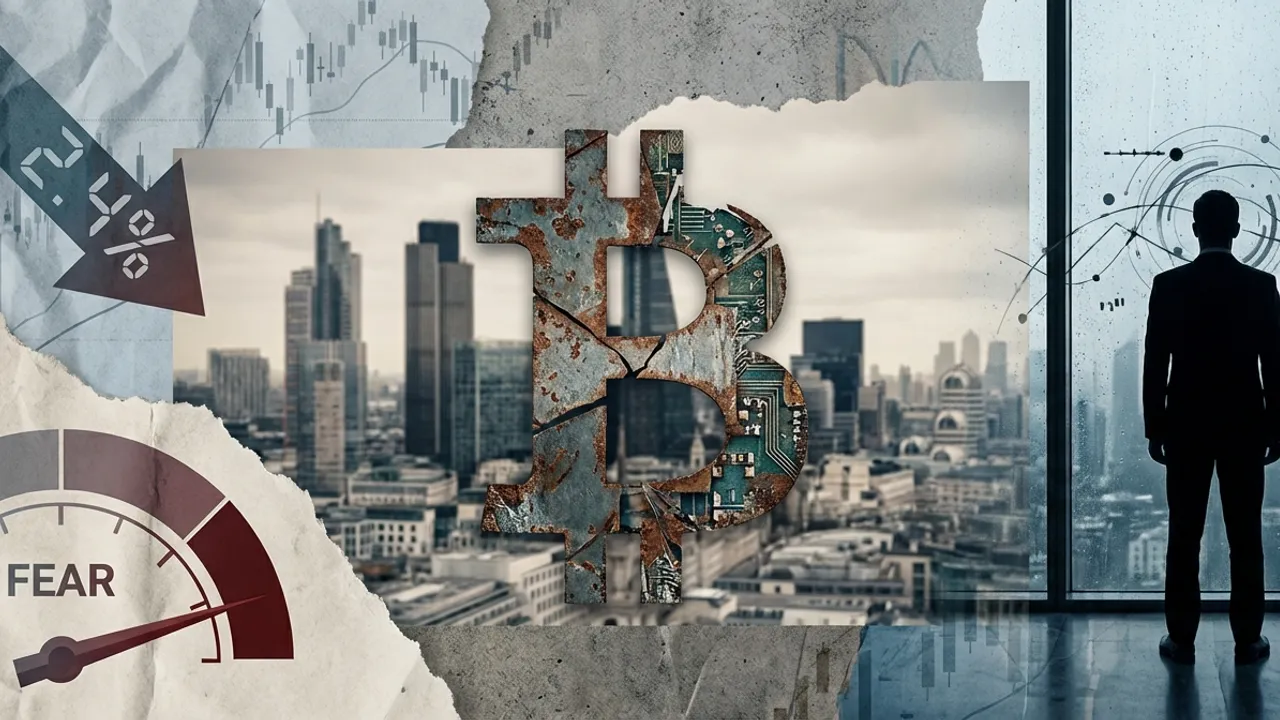
As US inflation drops to 2.4%, Bitcoin investors confront a fundamental question about the asset's value proposition beyond its traditional role as an inflation hedge, while market sentiment plunges to extreme fear levels.
Key Takeaways
• Bitcoin faces a narrative challenge as US inflation cools to 2.4%, forcing investors to reconsider the asset's value proposition beyond simple inflation hedging in the near term
• Market sentiment has collapsed to extreme fear levels (9 out of 100) not seen since June 2022, potentially signaling capitulation but offering no guarantees of an immediate reversal
• The "monetary slingshot" theory suggests current deflationary pressures may ultimately trigger renewed money printing, but the timing and magnitude of such intervention remains highly uncertain
• Bitcoin's 47% decline from all-time highs and failure to decisively reclaim $70,000 despite positive inflation data indicates the market remains fragile and conviction among holders is being tested
• Long-term Bitcoin investors must develop conviction based on the asset's fundamental properties—scarcity, decentralization, and censorship resistance—rather than relying solely on macroeconomic crisis as the primary investment thesis
Bitcoin Faces Identity Crisis as Inflation Cools to Multi-Year Lows
Bitcoin's recent price recovery following better-than-expected inflation data masks a deeper challenge facing the cryptocurrency community: what happens to Bitcoin's investment thesis when inflation isn't a pressing concern? As US consumer prices recorded their slowest growth since 2021, the crypto market rallied nearly 5% on average, yet Bitcoin remains trapped 47% below its October 2025 all-time high [2]. The modest bounce has done little to alleviate the profound fear gripping investors, with sentiment indicators flashing warning signals not seen since the depths of the 2022 bear market.
The paradox is striking. Bitcoin received the inflation data it theoretically wanted—evidence of cooling price pressures—yet the asset's response has been tepid at best, raising fundamental questions about its identity in a lower-inflation environment.
The Facts
US Consumer Price Index data released this week showed inflation falling to 2.4% in January from 2.7% in December, marking the lowest level since May 2021 [2]. Core inflation, which excludes volatile food and energy prices, came in at 2.5%—below economist expectations of 2.5% headline inflation and representing the lowest reading since March 2021 [2].
Bitcoin responded with a modest rally, approaching but failing to reclaim the psychologically important $70,000 level after trading as low as $68,850 [1][2]. The broader cryptocurrency market showed stronger gains, with Ethereum climbing 6% and altcoin Bittensor surging approximately 32% [2]. However, Bitcoin has lost 28.62% over the past 30 days [1].
Market sentiment has deteriorated dramatically, with the Crypto Fear & Greed Index posting an "Extreme Fear" score of 9—a reading not witnessed since June 2022, during the previous bear market's most severe phase [1]. The index suggests capitulation-level fear among investors despite the price recovery.
Bitcoin entrepreneur Anthony Pompliano framed the cooling inflation data as a test for Bitcoin holders. "I think the challenge for Bitcoin investors, can you hold an asset when there is not high inflation in your face on a day-to-day basis?" Pompliano asked during a Fox Business interview [1]. He emphasized that Bitcoin's fundamental value proposition remains intact: "Can you still believe in what Bitcoin's value proposition is, which is that it's a finite-supply asset. If they print money, Bitcoin is going higher" [1].
Traditional financial institutions are taking a more cautious stance. British banking giant Standard Chartered slashed its Bitcoin price target for year-end 2026 from $150,000 to $100,000, while warning of potential declines toward $50,000 [2]. US equity markets reflected broader uncertainty, with the Nasdaq posting its fifth consecutive weekly loss and the S&P 500 recording its weakest week of the year [2].
Pompliano outlined what he calls a "monetary slingshot" scenario, where deflationary forces in the near term will prompt central bank intervention. "We're going to get deflationary-type forces in the short term, people are going to ask to print money and to drop interest rates," he explained [1]. The US dollar index has already weakened 2.32% over the past month, trading at $96.88 [1].
Analysis & Context
This moment represents a critical juncture for Bitcoin's narrative evolution. For years, the cryptocurrency has been marketed primarily as "digital gold"—a hedge against monetary debasement and inflation. That story resonated powerfully during 2021-2022 when inflation surged above 9% and central banks printed trillions in pandemic stimulus. Now, with inflation normalizing and the immediate crisis passing, Bitcoin must prove it offers value beyond crisis insurance.
Pompliano's "monetary slingshot" theory deserves serious consideration. Historically, central banks have demonstrated a strong bias toward monetary expansion during economic stress. The pattern has repeated consistently: economic weakness emerges, authorities respond with rate cuts and quantitative easing, asset prices eventually inflate. If this cycle plays out again, Bitcoin holders who maintained conviction through the low-inflation period would be positioned for the subsequent debasement phase. However, the timing remains highly uncertain, and markets can remain irrational—or simply range-bound—far longer than investors expect.
The extreme fear reading is particularly noteworthy from a contrarian perspective. Previous instances of single-digit fear scores have often coincided with local price bottoms, though they can persist for extended periods during genuine bear markets. The 2022 comparison is instructive: June of that year marked the capitulation low around $17,500, but the subsequent recovery took many months to develop. Current price action around $69,000-$70,000 suggests Bitcoin is testing a critical support zone that could determine whether this represents a healthy correction within a bull market or something more severe.
What's increasingly clear is that Bitcoin's investment case must mature beyond simple inflation hedging. The asset's properties—censorship resistance, global accessibility, programmatic scarcity, and settlement finality—offer value regardless of the inflation rate. The current environment is forcing a necessary evolution in how both retail and institutional investors conceptualize Bitcoin's role in portfolios.
Sources
AI-Assisted Content
This article was created with AI assistance. All facts are sourced from verified news outlets.