Bitcoin Goes Mainstream: Block and Big Tech Rebuild the Payment Stack
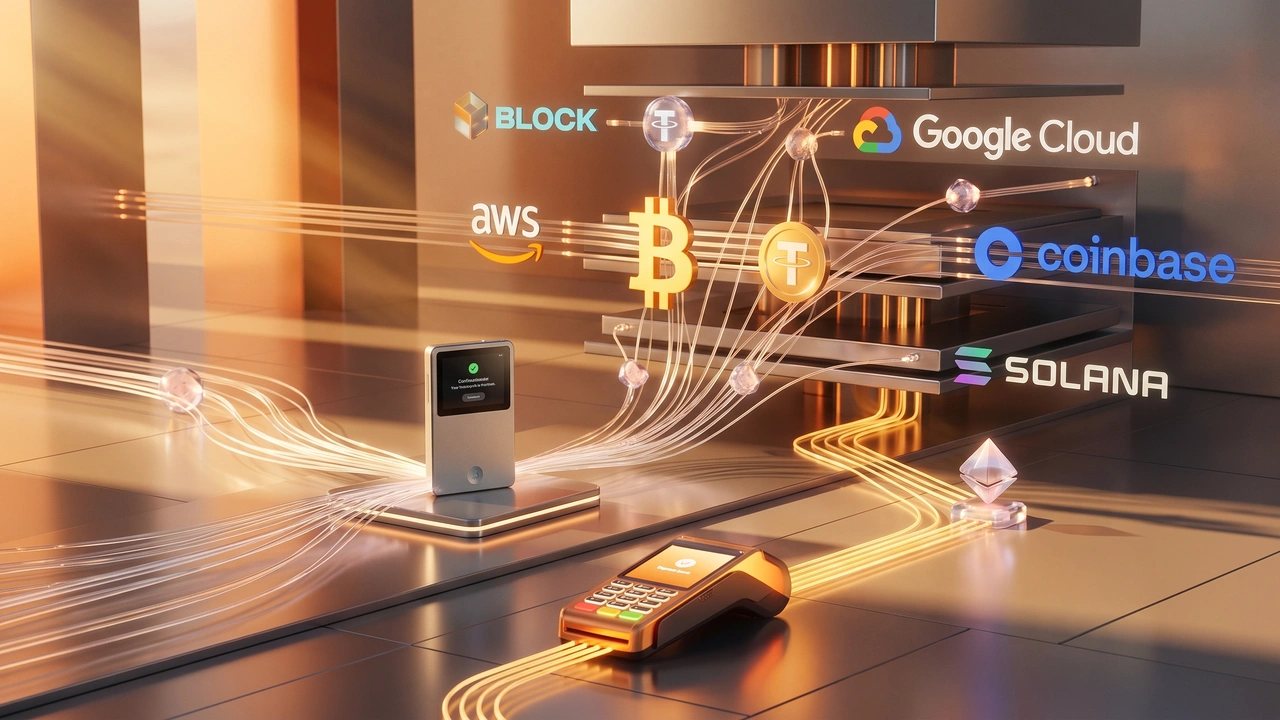
Block is aggressively expanding Bitcoin's role in everyday commerce while AWS and Google Cloud are quietly wiring stablecoins into AI infrastructure - together, these moves signal that crypto is becoming foundational plumbing for the digital economy.
Key Takeaways
- Block's simultaneous launch of proof-of-reserves, higher withdrawal limits, automatic Bitcoin conversion, and merchant rewards represents the most coherent attempt yet by a major payments company to make Bitcoin a genuine everyday currency rather than a speculative asset.
- The fivefold increase in Cash App withdrawal limits to $10,000 daily and $25,000 weekly is a meaningful practical improvement for users who want to treat Bitcoin as a liquid spending tool.
- AWS and Google Cloud integrating stablecoin payment layers for AI agents is not a crypto story - it is an infrastructure story, and its implications for normalizing crypto rails across the tech industry are significant and durable.
- The x402 protocol, now being standardized through the Linux Foundation, could become as foundational to machine-to-machine payments as HTTP is to web browsing - worth monitoring closely as it matures.
- Block's decision to expand Bitcoin offerings while simultaneously cutting 40% of its workforce signals that Dorsey views Bitcoin infrastructure as a core strategic priority, not a peripheral product line - and companies that treat Bitcoin this seriously tend to build the adoption flywheels that drive the next wave of mainstream usage.
Bitcoin Goes Mainstream: Block and Big Tech Rebuild the Payment Stack
Something significant is happening beneath the surface of the crypto market. While price action dominates headlines, two parallel developments reveal a deeper shift: the companies building tomorrow's digital infrastructure are choosing crypto rails - not as a speculative bet, but as practical plumbing. Block is embedding Bitcoin deeper into everyday commerce, while Amazon Web Services and Google Cloud are wiring stablecoins into the payment layer of AI systems. Taken together, these moves represent a maturation of crypto from asset class to infrastructure standard.
This is not hype. This is architecture. And once infrastructure is built, it tends to stay.
The Facts
Block - the payments company led by Jack Dorsey - has rolled out a cluster of Bitcoin-focused product updates that collectively push the currency further into mainstream financial life. In late April, Block launched a proof-of-reserves system covering both its corporate Bitcoin treasury and user balances on Cash App and Square, giving customers a concrete way to verify their holdings independently [1]. The move is a direct response to the trust deficit that has plagued the broader crypto industry since a series of high-profile collapses in recent years.
Alongside that transparency push, Block unveiled a new version of its Bitkey hardware wallet, this time equipped with a touchscreen for transaction verification [1]. Cash App also received a notable new feature: eligible users can now set payments to automatically convert into Bitcoin upon receipt [1]. For merchants using Square, Block introduced a 5% Bitcoin cash-back rewards program, while simultaneously raising daily withdrawal limits from $2,000 to $10,000 and weekly limits to $25,000 - a fivefold increase that removes a significant friction point for users treating Bitcoin as a genuine spending currency [1].
The backdrop to these product launches is a company undergoing significant internal restructuring. Block reported a 57.2% year-on-year increase in operational expenses to $3.08 billion in Q1, and in late February Dorsey announced roughly 4,000 job cuts - approximately 40% of the workforce - framing the move as part of a push toward greater operational efficiency through increased reliance on AI [1]. The simultaneous expansion of Bitcoin product offerings while cutting costs suggests Block is doubling down on what it considers its core identity.
On a separate but thematically connected front, AWS and Google Cloud have both made moves to integrate stablecoin payments into their AI infrastructure. AWS unveiled a payment system for AI agents - developed in partnership with Coinbase and Stripe - that allows software agents to pay for APIs, digital content, and compute services autonomously during live workflows [2]. Users can connect wallets and set per-session spending limits. Almost simultaneously, the Solana Foundation and Google Cloud announced Pay.sh, a service enabling AI agents to pay for on-demand APIs using USDC on Solana, with the agent's wallet serving as both identity and payment instrument [2]. The underlying protocol powering much of this is x402, an open payment standard developed by Coinbase for automated stablecoin transactions over HTTP - now being formalized through a dedicated x402 Foundation under the Linux Foundation [2].
Analysis & Context
What Block is doing with Bitcoin mirrors what PayPal did with online payments in the early 2000s - removing friction at every touchpoint until using the currency feels unremarkable. The combination of automatic Bitcoin conversion on incoming payments, higher withdrawal limits, hardware wallet improvements, and merchant rewards creates a reinforcing ecosystem. Each feature reduces the cost of choosing Bitcoin over legacy alternatives. Historically, payment network adoption follows a tipping point model: once enough merchants and consumers are onboarded to the same rails, switching costs for everyone else rise. Block is clearly trying to manufacture that tipping point for Bitcoin payments, and the proof-of-reserves launch adds the institutional-grade transparency needed to bring more cautious users on board.
The AI-infrastructure story is equally important, even if it feels more abstract. For years, one of the genuine technical limitations of autonomous software agents has been their inability to independently pay for services mid-task. Traditional payment rails require human authorization loops, credit agreements, or subscription models - none of which work cleanly for software executing decisions in real time. Stablecoins, particularly USDC on fast and low-cost chains like Solana, solve this elegantly. When AWS and Google Cloud - two of the most conservative and compliance-driven infrastructure companies on the planet - both move to integrate stablecoin payment layers in the same week, it is a strong signal that this is no longer experimental. It is becoming standard. Bitcoin itself is not the primary currency in these AI payment systems, but the broader normalization of crypto as infrastructure directly benefits Bitcoin's long-term legitimacy and adoption curve.
The pattern here is consistent with how major technological shifts tend to unfold. The internet did not become ubiquitous when consumers decided to adopt it - it became ubiquitous when the companies building the infrastructure assumed it would be there. Block, AWS, Google Cloud, Coinbase, and Stripe are all, in different ways, making that assumption about crypto rails right now. That is a qualitative shift in the maturity of this industry, and it deserves to be treated as such.
Sources
AI-Assisted Content
This article was created with AI assistance. All facts are sourced from verified news outlets.