Bitcoin Goes Mainstream: Schwab, Steak 'n Shake Signal a New Era
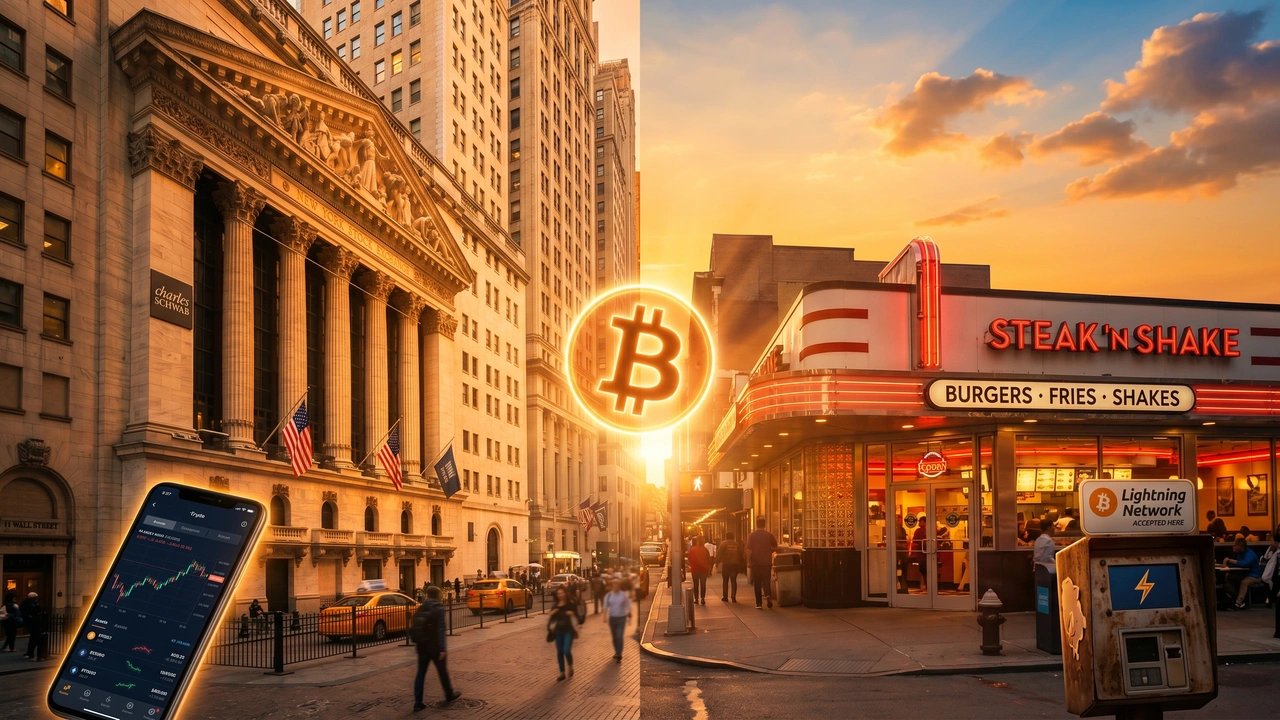
From Wall Street's largest brokerages to fast-food counters, Bitcoin integration is accelerating across both institutional and retail layers of the economy — and the implications run deeper than most realize.
Key Takeaways
- Schwab's spot Bitcoin offering represents a structural demand unlock: Millions of retail investors who previously accessed Bitcoin only through ETFs or external exchanges can now hold it directly within existing brokerage accounts, lowering friction and potentially broadening the long-term holder base.
- Regulated custody infrastructure is becoming the competitive moat: Schwab's use of Paxos under OCC oversight signals that federally regulated trust structures are now the industry standard for institutional Bitcoin services — a sign of the asset's deepening integration into the regulated financial system.
- Steak 'n Shake's closed-loop Bitcoin economy is a replicable business model: The combination of Lightning payment savings, treasury accumulation, and employee incentives creates a self-reinforcing flywheel that any high-volume consumer business could theoretically adopt, with no ideological motivation required.
- Top-down and bottom-up adoption are converging: The simultaneous movement of a major brokerage and a consumer fast-food chain into Bitcoin infrastructure suggests adoption is no longer driven by a single demographic or use case — it is becoming systemic across income levels and business types.
- The symbolic details matter: Steak 'n Shake paying workers 21 cents per hour in Bitcoin and timing its milkshake launch to Bitcoin Conference 2026 reflects a cultural fluency that deepens brand loyalty among a growing Bitcoin-native consumer base — a soft power asset that is difficult for competitors to replicate quickly.
Bitcoin's Two-Front Advance: Wall Street and Main Street Are Moving Simultaneously
Something notable is happening in Bitcoin adoption, and it isn't arriving from a single direction. Within the same news cycle, Charles Schwab — one of America's most powerful retail brokerages — has announced direct spot Bitcoin trading for its millions of clients, while Steak 'n Shake, a beloved American fast-food chain, is deepening a Bitcoin strategy that now touches its payments infrastructure, corporate treasury, and employee compensation. These two developments may seem worlds apart, but together they tell a single, coherent story: Bitcoin is being woven into the fabric of everyday American economic life, from the top down and the bottom up, simultaneously.
This dual-front advance matters because it closes the gap between Bitcoin as a financial instrument and Bitcoin as a functional currency. When a $9 trillion asset manager opens spot trading to retail investors at the same moment a burger chain pays its hourly workers in satoshis, the narrative of Bitcoin as a fringe asset becomes increasingly difficult to sustain.
The Facts
Charles Schwab confirmed plans to launch Schwab Crypto™, a dedicated platform enabling retail clients to buy and sell Bitcoin and ethereum directly through their existing Schwab accounts [1]. The rollout will occur in phases over the coming weeks and will integrate across Schwab.com, the Schwab Mobile App, and the firm's thinkorswim® trading suite [1]. Custody of digital assets will be held through Charles Schwab Premier Bank, SSB, while blockchain infrastructure provider Paxos — regulated by the Office of the Comptroller of the Currency — will handle sub-custody and trade execution [1].
Schwab's pricing is positioned aggressively at 75 basis points per trade, placing it at the low end of the brokerage industry and well below many standalone crypto exchanges [1]. The firm's Head of Retail Investing, Jonathan Craig, framed the launch in client-centric terms: "Clients want to conduct more of their financial lives at Schwab," noting that the new offering allows digital asset trading alongside traditional holdings such as stocks, ETFs, and mutual funds [1]. Schwab already commands significant indirect exposure to crypto markets — its clients own approximately 20 percent of all spot crypto exchange-traded products — but the new service extends that reach into direct ownership [1].
On the consumer side of the economy, Steak 'n Shake has made a series of escalating Bitcoin commitments. The chain, which began accepting Bitcoin payments via the Lightning Network across 393 U.S. locations in May 2025, reports that payment processing fees have dropped by roughly 50 percent compared to traditional card networks since integrating Speed's Lightning wallet [2]. All Bitcoin received from customers is directed into the company's Strategic Bitcoin Reserve, which has now grown to at least $20 million following a new $10 million addition [2]. The company launched the reserve formally with an initial $10 million purchase in January, and management characterizes the model as self-sustaining: higher Bitcoin-driven sales expand the reserve, which in turn funds store upgrades and menu improvements [2].
Steak 'n Shake has also introduced a worker incentive program paying hourly employees a Bitcoin bonus of 21 cents per hour, funded from its Bitcoin-focused reserve — a figure that carries obvious symbolic weight for those familiar with Bitcoin's fixed supply [2]. The chain is further leveraging its Bitcoin identity with the unveiling of a themed "Bitcoin Milkshake" timed to debut around Bitcoin Conference 2026 on April 27, targeting both conference attendees and existing Bitcoin-paying customers [2].
Analysis & Context
Schwab's entry into spot Bitcoin trading is not merely a product launch — it is a legitimacy event. Schwab manages trillions in client assets and has built its brand on conservative, long-term investing principles. When a firm of that institutional character decides that direct Bitcoin custody is a service its clients need, it sends a signal that reverberates across the entire financial advisory industry. Rivals, including Fidelity, have already moved in this direction, but Schwab's scale — and the explicit integration of Bitcoin trading into existing brokerage workflows — raises the bar. Critically, Schwab's infrastructure choice of Paxos, a federally regulated trust, reflects a post-ETF regulatory environment in which compliance-first custody is the baseline expectation, not a differentiator. This architecture mirrors the approach that enabled the 2024 Bitcoin ETF approvals to succeed and suggests Schwab has built for regulatory durability, not just speed to market.
Historically, each wave of institutional on-ramping has been followed by a period of sustained demand growth rather than immediate price spikes. The launch of Bitcoin futures on the CME in December 2017 opened institutional hedging but also preceded a brutal bear market — a reminder that infrastructure alone does not guarantee price performance. The more instructive comparison may be the January 2024 spot ETF approvals, which unlocked billions in new demand from wealth management channels and demonstrated that making Bitcoin easier to hold within regulated frameworks expands the total addressable buyer pool in measurable ways. Schwab's move arguably does the same for the brokerage segment, particularly for clients who previously accessed crypto only through ETF wrappers and can now hold the underlying asset directly.
Steak 'n Shake's story is analytically distinct but complementary. What the chain is building is a closed-loop Bitcoin economy at the corporate level: customers spend Bitcoin, the company retains it, employees receive it, and the treasury grows. This model is more ambitious than simply adding a payment option. It resembles, in miniature, the corporate treasury strategy pioneered by MicroStrategy, but applied operationally rather than purely financially. The 50 percent reduction in payment processing costs is a concrete, bottom-line justification that requires no ideological commitment to Bitcoin — it is simply better unit economics. If that cost advantage holds and scales, it provides a replicable template for other consumer-facing businesses, particularly those with high transaction volumes and thin margins.
Sources
AI-Assisted Content
This article was created with AI assistance. All facts are sourced from verified news outlets.