Bitcoin Holds the Line While Altcoins Struggle to Keep Up
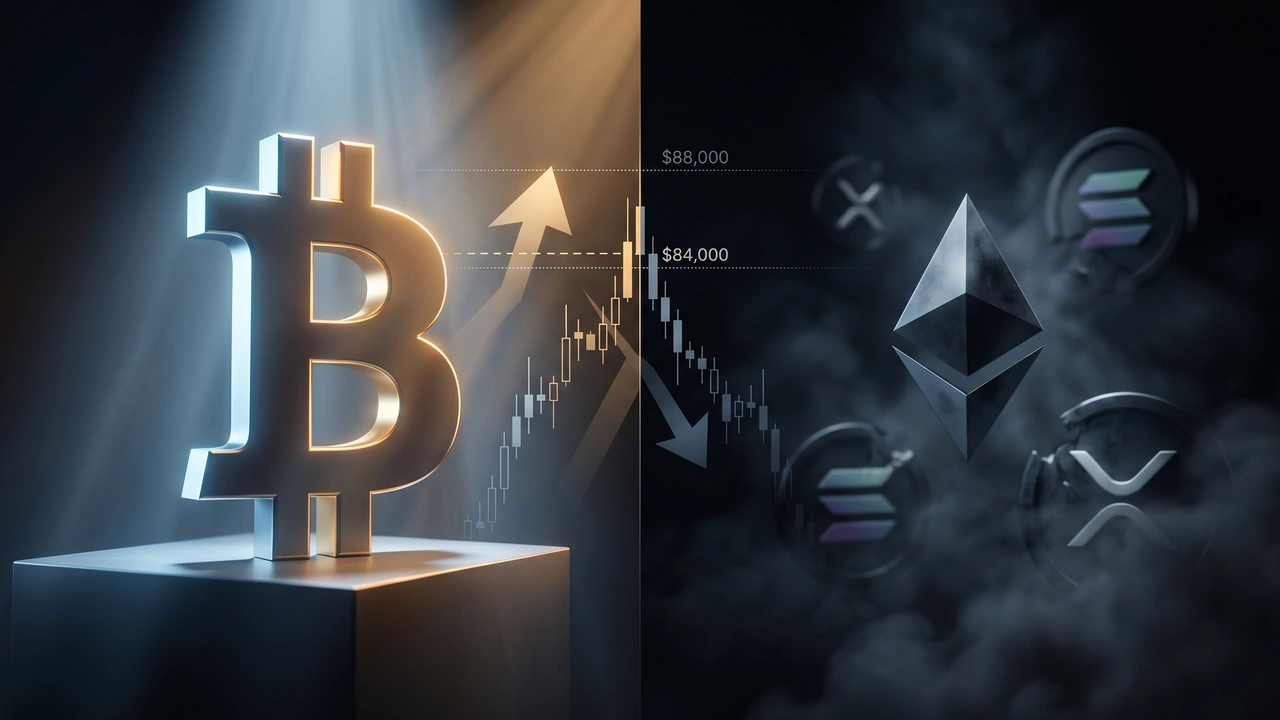
Bitcoin continues attracting buyers on dips while altcoins face mounting selling pressure, and analysts remain sharply divided on whether the market has truly bottomed or whether deeper pain lies ahead.
Key Takeaways
- Bitcoin is showing relative strength by attracting buyers on dips, but it must reclaim and hold above $88,880 to confirm a meaningful bottom - anything below that level keeps the bear case alive.
- Altcoin weakness is a warning signal, not background noise - when altcoins fail to participate in Bitcoin recoveries, it historically indicates that broad risk appetite has not returned to the market.
- ETF inflows were net positive for the week at over $1 billion, but Thursday's $277.5 million outflow reveals that institutional players are not uniformly bullish and are trimming exposure near resistance.
- Onchain profit-taking by short-term holders has reached its highest level since December 2024, and history shows these spikes tend to precede local price tops or prolonged sideways consolidation rather than sustained rallies.
- Analyst opinion remains sharply divided between a recovery scenario and a deeper bear market extending into 2026 - position sizing and risk management matter more than directional conviction in this environment.
Bitcoin Holds the Line While Altcoins Struggle to Keep Up
Bitcoin is doing something it rarely does cleanly: holding its ground while the rest of the market loses theirs. As altcoins bleed and sentiment wavers, BTC has continued to attract buyers at lower levels, suggesting a degree of conviction among core holders that simply isn't visible elsewhere in the market right now. But conviction alone doesn't confirm a bottom - and that distinction matters enormously for anyone trying to read where this market is headed.
The divergence between Bitcoin's relative stability and the weakness spreading across altcoins is not a minor footnote. It is the defining market dynamic of this moment, and understanding it requires looking beyond the price ticker at the structural forces pulling in opposite directions.
The Facts
Bitcoin pulled back to near $79,000 before buyers stepped in and pushed the price back toward $80,000, but the broader picture remains complicated [1]. The $84,000 level has emerged as a fierce battleground, with bears successfully repelling a rally attempt from $82,850 earlier in the week. CryptoQuant analyst IT Tech has identified $88,880 as the key threshold BTC must reclaim and hold above for a credible bottom confirmation, noting that the $85,000 to $88,000 range is likely to see persistent selling from holders looking to exit at breakeven [1].
Not everyone shares that cautious read. John Bollinger, creator of the widely used Bollinger Bands indicator, stated on social media that his trend model had turned positive for Bitcoin, and that he had taken a position based on that signal [1]. His assessment adds a notable counterweight to the more bearish onchain readings circulating this week.
On the ETF front, the picture is mixed. Bitcoin ETF inflows surged past $1 billion across four positive days this week before an outflow of $268.5 million arrived on Friday, with Thursday specifically seeing $277.5 million leave - the first net outflow in May [1][2]. That outflow reading suggests that some institutional participants are choosing to lock in gains near overhead resistance rather than hold through potential volatility.
Onchain data adds another layer of complexity. The Short-Term Holder Spent Output Profit Ratio (STH-SOPR) has climbed above 1, signaling that short-term Bitcoin holders are actively realizing profits [2]. CryptoQuant data shows holders are booking more than 20,000 BTC in net profits on a 30-day rolling basis - the first positive reading of that kind since late December 2024, following months of heavy net losses that reached as deep as 398,000 BTC during February and March [2]. One analyst noted that demand has not kept pace with this profit-taking, and framed the current environment as still fitting the definition of a bear market [2].
Altcoins are struggling across the board. Ether closed below its 20-day EMA, XRP is locked in equilibrium near its moving averages with no clear directional edge, Solana is facing resistance at $90.73, and Dogecoin dropped sharply from the $0.12 level [1]. The common thread running through each chart is the same: buyers have retreated, and sellers are defending overhead levels with conviction.
Analysis & Context
The pattern playing out right now - Bitcoin resilience paired with altcoin weakness - is one of the more reliable signatures of a market still in recovery mode rather than one entering a confirmed new bull leg. Historically, genuine bull market expansions tend to see capital rotate from Bitcoin into altcoins as risk appetite rises. When altcoins underperform during Bitcoin's own attempted recoveries, it typically signals that broader market confidence is still fragile. Speculators who would normally chase altcoin beta are either sitting on losses from earlier positions or simply not willing to extend risk until Bitcoin proves it can hold meaningful support levels.
The $88,880 threshold flagged by CryptoQuant carries real analytical weight here. It isn't an arbitrary round number - it represents the level at which short-term holder breakeven pressure is expected to dissipate, allowing a cleaner path higher. Until BTC clears that zone and holds it on a closing basis, the market will likely continue to see rallies sold into rather than bought through. The ETF outflow on Thursday reinforces that thesis - sophisticated capital is not blindly accumulating at current levels.
The longer-term analyst forecasts introduce genuine uncertainty worth taking seriously. Michael Terpin's projection of a potential $57,000 bottom in October 2026, based on historical cycle timing relative to the cycle top, is not fringe commentary - it reflects a legitimate reading of Bitcoin's four-year cycle behavior [2]. Meanwhile, the realized profit spike is historically associated with local tops or extended sideways action, not the beginning of sustained moves higher. For investors, the message is clear: the easy part of the April recovery may already be priced in, and the next leg - in either direction - will require a cleaner catalyst.
Sources
AI-Assisted Content
This article was created with AI assistance. All facts are sourced from verified news outlets.