Bitcoin in a Vise: How ETFs and Bank Blockchains Threaten Decentralization
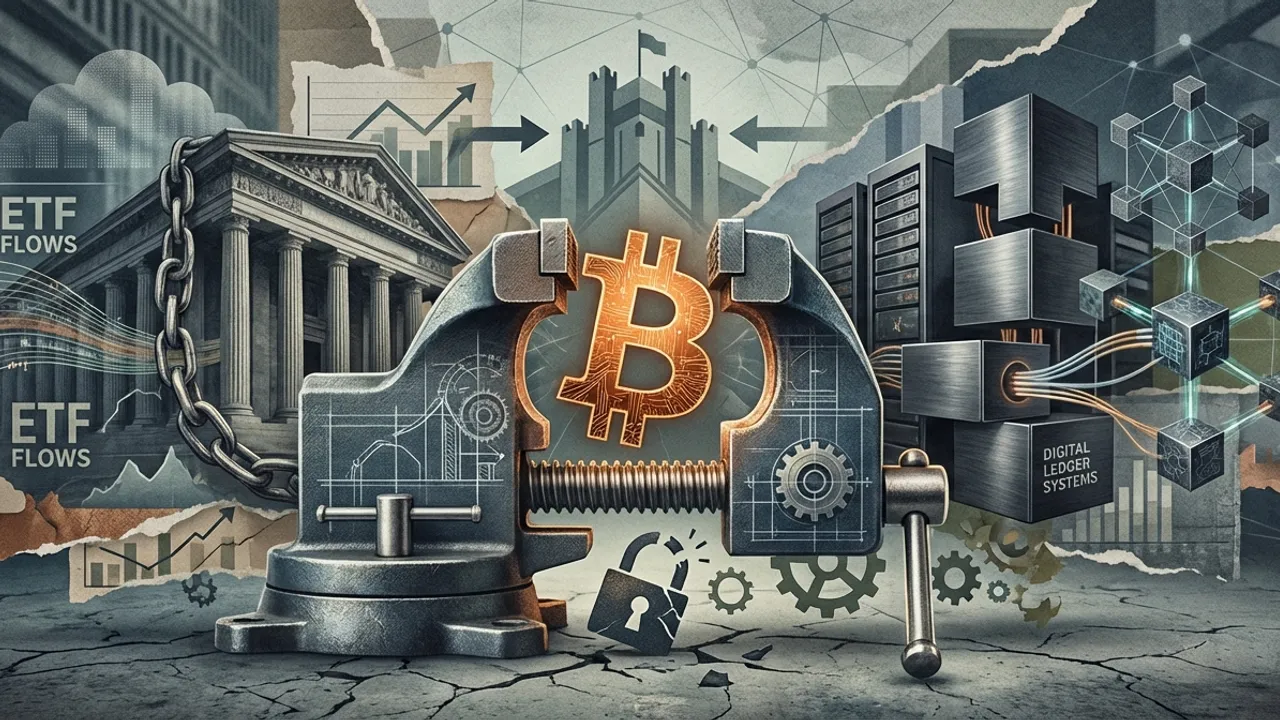
As Bitcoin ETFs collect billions and major banks develop their own blockchain platforms, control over digital assets is shifting back to central institutions. A development that stands in direct opposition to the original promise of self-sovereignty.
Bitcoin in a Vise: How ETFs and Bank Blockchains Threaten Decentralization
Two seemingly independent developments currently illustrate a fundamental conflict in the crypto market: While Bitcoin ETFs attract billions in institutional capital and concentrate custody of large holdings with a few central actors, traditional major banks like Barclays are working on their own blockchain platforms for payments and deposits. Both trends follow a common logic – the reintegration of decentralized technology into centralized financial structures. Bitcoin's original vision as a self-sovereign, censorship-resistant monetary system threatens to become a footnote.
The irony is hard to miss: Bitcoin emerged as a decentralized answer to a financial system based on trust in intermediaries. Now these very intermediaries are returning – except this time they're using blockchain technology to cement their position.
The Facts
Bitcoin ETFs have experienced unprecedented growth since their introduction, attracting billions of US dollars in capital [1]. These products allow investors to participate in Bitcoin's price development without holding the cryptocurrency themselves. Instead, a regulated third party assumes custody of the underlying coins [1]. Investors merely own fund shares, not the associated private keys – which effectively means they have no real control over the Bitcoin holdings [1].
This development stands in fundamental opposition to Bitcoin's original promise: self-determination through direct custody on a hardware wallet with one's own private key, without a central authority able to approve transactions or freeze balances [1]. In the Bitcoin network, miners and nodes worldwide independently verify only whether protocol rules are followed – not the purpose or motivation of a transfer [1].
In parallel, British banking giant Barclays has begun examining the development of its own blockchain platform for core banking functions such as payments and deposits at the end of February 2026, according to a Bloomberg report [2]. The bank has already sent request-for-information inquiries to several technology providers to explore options for infrastructure that could also support stablecoins and tokenized deposits [2]. A selection of potential partners is expected in April 2026 [2].
The report cites as motivation the increasing pressure from stablecoins like Tether's USDT and Circle's USDC, which promise fast, cheap, and round-the-clock settlement, thereby challenging traditional payment rails and banks' deposit business [2]. Barclays is not alone in this initiative: Competitors like JPMorgan and HSBC are already testing tokenized deposit and settlement solutions [2]. Even Meta is reportedly working again on stablecoin payments and testing corresponding integrations [2].
Barclays' reversal is particularly noteworthy: At the end of 2025, bank analysts had published a pessimistic crypto report stating that Bitcoin and Ethereum lacked price catalysts [2]. Now the same institution is working on integrating blockchain technology into its core infrastructure.
Analysis & Context
The two developments – Bitcoin ETFs and bank blockchains – are two sides of the same coin: the recentralization of decentralized technology. While Bitcoin was conceived as a trustless system that functions without intermediaries, both ETFs and bank blockchains create new layers of trust and control instances.
With ETFs, actual control over large Bitcoin holdings lies with a few regulated custodians. From a technical perspective, this may not affect the Bitcoin network – the blockchain processes transactions regardless of who holds the private keys. But it fundamentally shifts the power distribution around the asset. When institutional investors primarily invest in Bitcoin through ETFs, a parallel structure grows in which Bitcoin exists as an asset but is used without the decentralized properties that make it valuable.
Bank blockchains go even further: They adapt the technology but retain central control. A Barclays blockchain for payments and deposits may be technologically more efficient than legacy systems, but in its essence remains a centralized system with a single point of failure and the possibility of censorship. The difference from Bitcoin could hardly be greater.
Historically, a recurring pattern emerges: Disruptive technologies are first fought by established actors, then co-opted, and finally integrated into existing power structures. The Internet itself underwent a similar development – from a decentralized network to an infrastructure dominated by a few tech giants. The question is whether Bitcoin can escape this fate or whether we are witnessing the beginning of a similar centralization.
For Bitcoin investors, this presents a dilemma: ETFs lower the barrier to entry and bring capital into the market, which can positively affect the price. At the same time, they undermine the core principles that could make Bitcoin valuable in the long term. Those who view Bitcoin exclusively as a speculative object may ignore this. However, those who have invested in the vision of a censorship-resistant, self-sovereign monetary system should critically observe this development.
Conclusion
• Bitcoin ETFs and bank blockchains follow a common logic: They adapt decentralized technology but retain central control – thereby undermining the core promise of self-sovereignty and censorship resistance
• The concentration of large Bitcoin holdings with a few institutional custodians through ETFs creates new power structures that contradict the decentralized nature of the network – even though the blockchain itself remains unchanged
• Major banks like Barclays are responding to pressure from stablecoins with their own blockchain platforms, which may be technologically modern but retain the centralized weaknesses of traditional financial systems
• Investors face a choice: Bitcoin as a purely price-driven investment via ETF or as a self-custodied asset with real control – a decision that determines which version of Bitcoin will prevail in the long term
• The development is reminiscent of the Internet's centralization by tech giants – whether Bitcoin follows this pattern or can preserve its decentralized nature will be decided in the coming years
Sources
- [1]btc-echo.de
- [2]btc-echo.de
AI-Assisted Content
This article was created with AI assistance. All facts are sourced from verified news outlets.