Bitcoin in Business and Education: New Pathways to Adoption
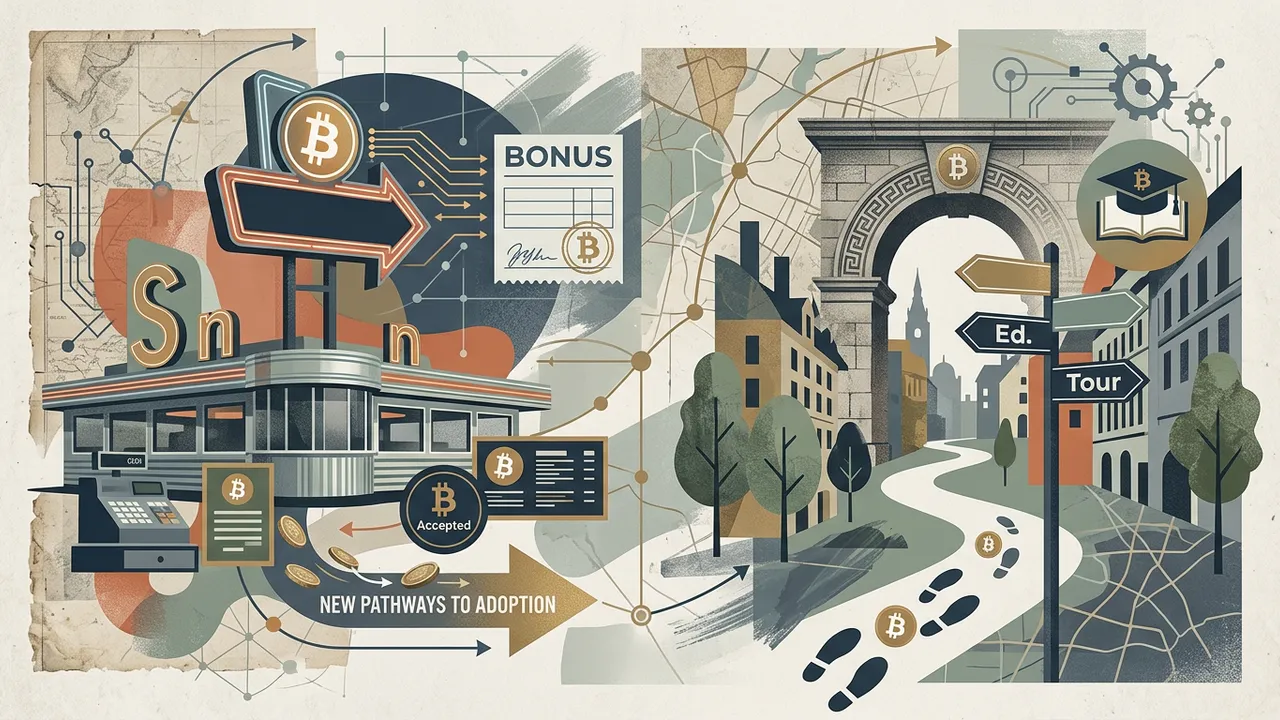
While Steak 'n Shake becomes the first fast-food chain to pay Bitcoin bonuses to employees, Europe's first Bitcoin educational walking tour launches this summer. Two different approaches demonstrating how Bitcoin is increasingly being integrated into everyday life and society.
Bitcoin Leaves the Niche: From Payroll to Educational Walking Tours
Bitcoin is increasingly evolving from a pure investment vehicle to a firmly integrated component of everyday business processes and educational offerings. Two recent developments impressively illustrate this transformation: A U.S. fast-food chain is systematically paying its employees Bitcoin bonuses for the first time, while in Europe an innovative educational walking tour makes Bitcoin history physically tangible. Both approaches show that Bitcoin has long since grown beyond the classic trader and investment scene.
These developments mark an important milestone in Bitcoin adoption: It's no longer just about whether companies add Bitcoin to their treasury or accept it as a means of payment, but how Bitcoin is integrated into fundamental processes like employee compensation and knowledge transfer.
The Facts
The U.S. fast-food chain Steak 'n Shake introduced a remarkable compensation model on March 1, 2026: All hourly employees receive a Bitcoin bonus of 21 U.S. cents per hour worked in addition to their regular salary [1]. The symbolic number references the maximum Bitcoin supply of just under 21 million units. The company communicates the goal of being a "Maximum-Wage Employer" – an employer that pays the best wages in their respective communities to attract the best employees [1].
However, the accumulated Bitcoin is not immediately available: Employees must be employed with the company for at least two years before they can access their accumulated Bitcoin bonuses [1]. This vesting model clearly serves employee retention. In addition to the Bitcoin bonus, Steak 'n Shake deposits $1,000 into so-called "Trump Accounts" for employees' children – special retirement and investment accounts designed as long-term savings solutions [1].
For Steak 'n Shake, this is not the first step toward Bitcoin: The company had already introduced Bitcoin as a payment method in 2025 and has since regularly reported increasing sales in its locations [1]. The Bitcoin received via payments flows into the company's own Bitcoin reserve, which the company has actively increased by a million-dollar amount [1]. In January 2026, Steak 'n Shake announced it had increased its Bitcoin commitment by a nominal value of $10 million [1].
Parallel to this corporate integration, a completely different approach to Bitcoin education launches in summer 2026: "BitcoinWalk 2026" invites participants to Europe's first Bitcoin educational walking tour from June 19 to July 3, 2026 [2]. The route covers 15 days and 201 kilometers from Cologne Cathedral to the Belgian university city of Leuven – on foot along historic pilgrimage routes such as the Rhenish Way of St. James and the Via Mosana [2].
The conceptual framework is designed as a time journey: Each of the 15 stages is dedicated to a historical Bitcoin topic, chronologically backward through time. The range of topics spans from current aspects like wallets and self-custody to defining events like Mt. Gox, the Blocksize War, and the Halving, all the way back to Satoshi Nakamoto and the Cypherpunks of the 1980s [2]. The community provides accompanying free, bilingual educational manuals, supplemented by a detailed hiking plan with stage overview, accommodation information, and an interactive map [2].
With an average of 13.4 kilometers per day, the route is deliberately designed to be beginner-friendly [2]. In contrast to classic Bitcoin conferences, there is deliberately "no stage, no panels, no screen program" [2]. The focus is on personal encounters and continuous dialogue over several days. Another component is the integration of Mental Health Awareness, which commemorates several programmers and activists from the free software and cryptography community who died by suicide, including Len Sassaman and Aaron Swartz [2].
Analysis & Context
Both developments represent a fundamental shift in Bitcoin adoption: integration into everyday business and educational processes. While Bitcoin has long been primarily perceived as a speculative object or treasury asset, these examples show how the technology is increasingly being embedded in social and business structures.
The Steak 'n Shake model is particularly noteworthy because it systematically integrates Bitcoin into the compensation structure of a major employer for the first time. Even though 21 cents per hour is a modest amount – for a 40-hour work week, that's about $8.40 per week or around $437 per year – the real significance lies in its signal effect. Thousands of employees are brought into contact with Bitcoin, not as an abstract investment opportunity, but as a real part of their compensation. The two-year vesting period also promotes long-term savings thinking and could sensitize employees to Bitcoin-typical topics like self-custody and wallet management.
Historically, this step is reminiscent of early corporate pioneers who offered Bitcoin payments for salaries – though usually on a voluntary basis or for individuals. The fact that an entire employee group now automatically receives Bitcoin represents a new quality. The vesting model is familiar from the tech industry and should demonstrably reduce employee turnover. At the same time, the company benefits from positive publicity in the Bitcoin community, as shown by increased sales.
BitcoinWalk, on the other hand, addresses an often underestimated deficit: sound Bitcoin education beyond price speculation. The format combines physical experience with intellectual engagement and creates a unique learning environment through the multi-day shared walk. The chronologically backward approach is didactically clever: Participants begin with familiar topics like wallets and Lightning Network and work their way forward to the philosophical and technical fundamentals. The integration of Mental Health Awareness also gives the event a depth that goes beyond pure technology transfer and illuminates the human side of Bitcoin development.
Common to both initiatives is the bottom-up approach: They don't rely on top-down regulation or institutional adoption, but on direct integration of people in their respective life contexts – whether at the workplace or in adult education. This could contribute more sustainably to Bitcoin adoption in the medium term than short-term price developments.
Conclusion
• The integration of Bitcoin into employee compensation marks a paradigm shift: Bitcoin evolves from a pure treasury asset to an operational component of personnel strategy, thereby reaching people outside the classic crypto target group
• Steak 'n Shake's vesting model could set a precedent and inspire other employers to launch similar programs – especially in industries with high employee turnover
• BitcoinWalk demonstrates that Bitcoin education also works outside digital conferences and online courses – physical, multi-day engagement could foster deeper understanding than classic event formats
• Both developments show: Sustainable Bitcoin adoption emerges through practical integration into everyday life and education, not through price speculation or short-term marketing campaigns
• The combination of entrepreneurial innovation (Steak 'n Shake) and community-driven educational work (BitcoinWalk) illustrates the diversity of the Bitcoin movement and its increasing social anchoring
Sources
AI-Assisted Content
This article was created with AI assistance. All facts are sourced from verified news outlets.