Bitcoin Meets Political Power: Regulation, Influence & Control
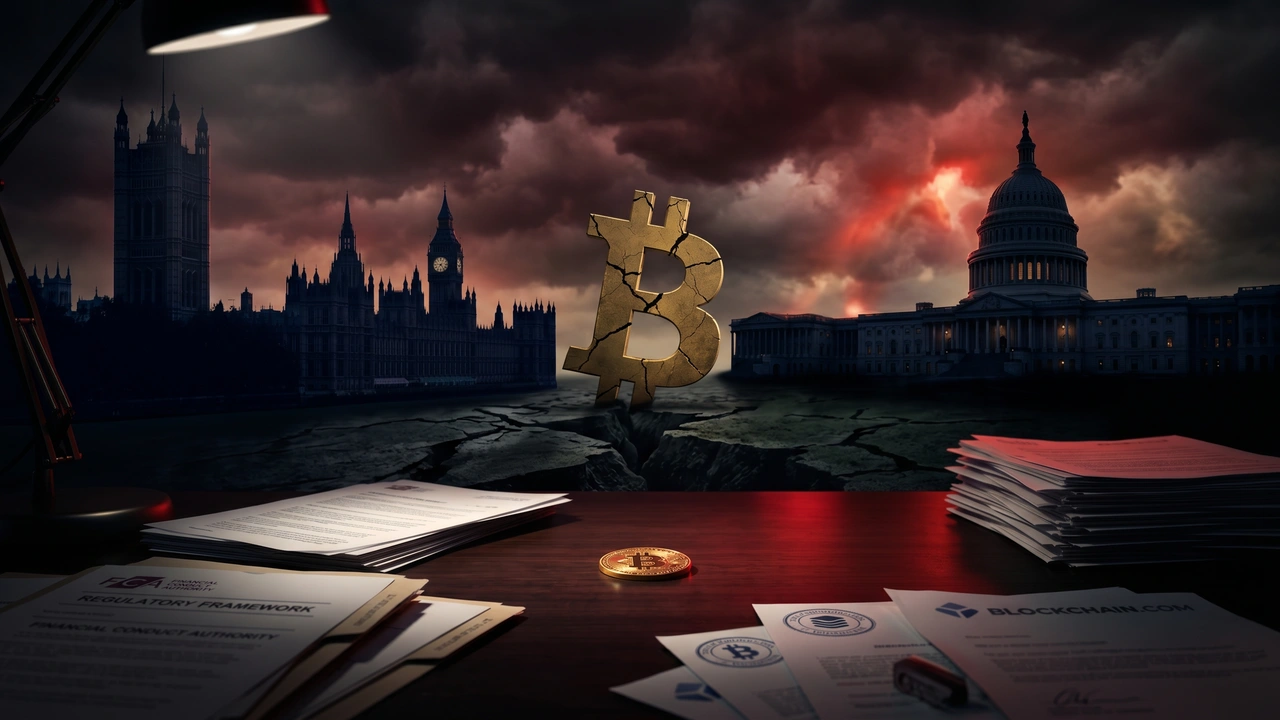
From Westminster to Washington, politicians and regulators are scrambling to define Bitcoin's role in the financial system — and the battles over stablecoins and political promotion reveal just how high the stakes have become.
Key Takeaways
- The FCA's review of Nigel Farage's Stack BTC involvement could establish a significant precedent for how regulators treat crypto promotion by investor-politicians, with implications for similar dual-role figures globally.
- The £9 million crypto donation to Reform UK illustrates how digital asset wealth is beginning to reshape political financing, raising legitimate questions about the independence of policy advocacy from financial self-interest.
- The White House-ABA stablecoin dispute reveals a genuine policy fault line: the systemic risk calculus changes dramatically if the stablecoin market reaches the $1–2 trillion range projected by banking economists.
- The GENIUS Act's yield prohibition, and the unresolved question of third-party pass-through arrangements like Coinbase's USDC rewards, mean that current stablecoin regulation remains incomplete and subject to near-term revision.
- For Bitcoin specifically, these regulatory battles are clarifying: the more Bitcoin and stablecoin infrastructure become entangled with mainstream political and financial institutions, the more the regulatory environment — not technology — becomes the primary variable determining adoption speed.
When Bitcoin Enters the Political Arena, the Rules of the Game Change
Bitcoin has long existed in tension with established power structures, but two developments on opposite sides of the Atlantic illustrate a new phase in that relationship. In the United Kingdom, a sitting member of parliament is under regulatory scrutiny for his financial ties to a Bitcoin treasury firm. In the United States, the banking lobby and the White House are trading blows over stablecoin policy, with trillions of dollars and the future of community banking hanging in the balance. Together, these episodes reveal a singular truth: Bitcoin and its derivatives are no longer a niche curiosity that regulators can afford to ignore. They are pressure points in a much larger contest over money, power, and political legitimacy.
The convergence of these two stories is not coincidental. It reflects a maturing ecosystem in which Bitcoin has become attractive enough to draw in politicians, financiers, and institutional actors — and controversial enough to trigger serious institutional pushback. How regulators respond in the coming months will shape the environment for Bitcoin adoption for years to come.
The Facts
In the UK, Liberal Democrat deputy leader Daisy Cooper has formally requested that the Financial Conduct Authority investigate Nigel Farage over his involvement with Stack BTC, a London-listed Bitcoin treasury company [1]. The trigger was a promotional video in which Stack BTC claimed that Farage executed a £2 million Bitcoin purchase on the firm's behalf, describing it as a "landmark moment" in British politics and identifying Farage as the first sitting MP and UK party leader to publicly acquire Bitcoin [1].
The controversy deepened when it emerged that Farage had separately invested £215,000 in Stack BTC through his media vehicle Thorn In The Side Ltd, acquiring approximately a 6.3% stake as part of a £260,000 fundraising round [1]. That round also included participation from Blockchain.com and was structured at 5 pence per share, with a planned listing on the Aquis Growth Market [1]. Cooper's letter to FCA chief Nikhil Rathi argued that Farage's dual status as investor and public promoter could expose retail investors to harm and potentially constitute market abuse or improper influence [1]. The FCA confirmed it had received the request and would review it [1].
Further amplifying the political dimension, Cooper pointed to a £9 million donation to Farage's Reform UK party from crypto investor Christopher Harborne — the same individual who also backs Stack BTC — describing it as an unprecedented entanglement of political financing and digital asset interests [1]. Farage has publicly championed a Bank of England Bitcoin reserve and pro-crypto legislation, and his party accepts Bitcoin donations through payment firm Radom [1].
Across the Atlantic, a different but equally consequential battle is unfolding. The White House Council of Economic Advisers released a 21-page analysis on April 8 tied to the 2025 GENIUS Act, which prohibits payment stablecoin issuers from paying yield to holders [2]. The CEA's modelling found that banning yield would increase bank lending by only approximately $2.1 billion — roughly 0.02% of a $12 trillion loan book — while costing consumers around $800 million in foregone returns, producing a cost-benefit ratio of 6.6 in which lost yield outweighs gains [2]. The American Bankers Association responded sharply, accusing the CEA of asking "the wrong question" by focusing on the effects of a prohibition rather than the systemic risks of allowing yield-bearing stablecoins to grow toward a $1–2 trillion market [2]. The ABA warned that at that scale, yield-paying tokens backed by Treasuries could accelerate deposit flight from community banks, force higher-cost wholesale borrowing, and ultimately constrain local lending to households, farmers, and small businesses [2].
Analysis & Context
The Farage affair is, at its core, a test case for how democracies handle the collision of political influence and emerging asset classes. Bitcoin has historically thrived in environments where institutional trust is low, and politicians who champion it can generate significant retail interest. That dynamic creates an obvious conflict-of-interest risk when those same politicians hold financial stakes in companies that benefit from that interest. The FCA's response will set a precedent: if it finds no grounds for action, it signals that crypto promotion by investor-politicians occupies a regulatory grey zone. If it acts, it will likely accelerate the development of explicit rules governing public figures and digital asset promotion — a development that could have chilling or clarifying effects depending on how those rules are written. The broader point is that Bitcoin's growing mainstream legitimacy is attracting exactly the kind of political entanglement that demands clearer guardrails.
On the stablecoin front, the ABA-White House debate exposes a fundamental tension in the architecture of money. The CEA's "reshuffling" argument — that stablecoin reserves flowing into Treasuries and money markets largely preserve aggregate banking system liquidity — is technically coherent at today's market size but becomes progressively less reassuring as the stablecoin sector scales [2]. The ABA's warning about community bank vulnerability echoes concerns that were raised during the debate over central bank digital currencies: that disintermediation of local deposit-taking institutions could hollow out relationship lending in ways that aggregate statistics simply don't capture [2]. For Bitcoin holders, the stablecoin debate is directly relevant because stablecoins function as on- and off-ramps for the entire digital asset ecosystem. Regulatory decisions about yield, reserve requirements, and third-party distribution — such as the Coinbase USDC rewards model that currently exploits a gap in the GENIUS Act's language — will materially affect liquidity, adoption curves, and the competitive dynamics between Bitcoin and dollar-denominated instruments [2]. Historically, periods of intense regulatory uncertainty have created short-term volatility but have also, in every major jurisdiction that eventually developed clear frameworks, been followed by accelerated institutional participation.
What unites both stories is a recognition that Bitcoin and its ecosystem have become too large and too politically significant to remain in a regulatory no-man's-land. The question is no longer whether rules will be written, but who writes them and in whose interest.
Sources
AI-Assisted Content
This article was created with AI assistance. All facts are sourced from verified news outlets.