Bitcoin Miners Abandon Treasury Playbook Amid Margin Squeeze
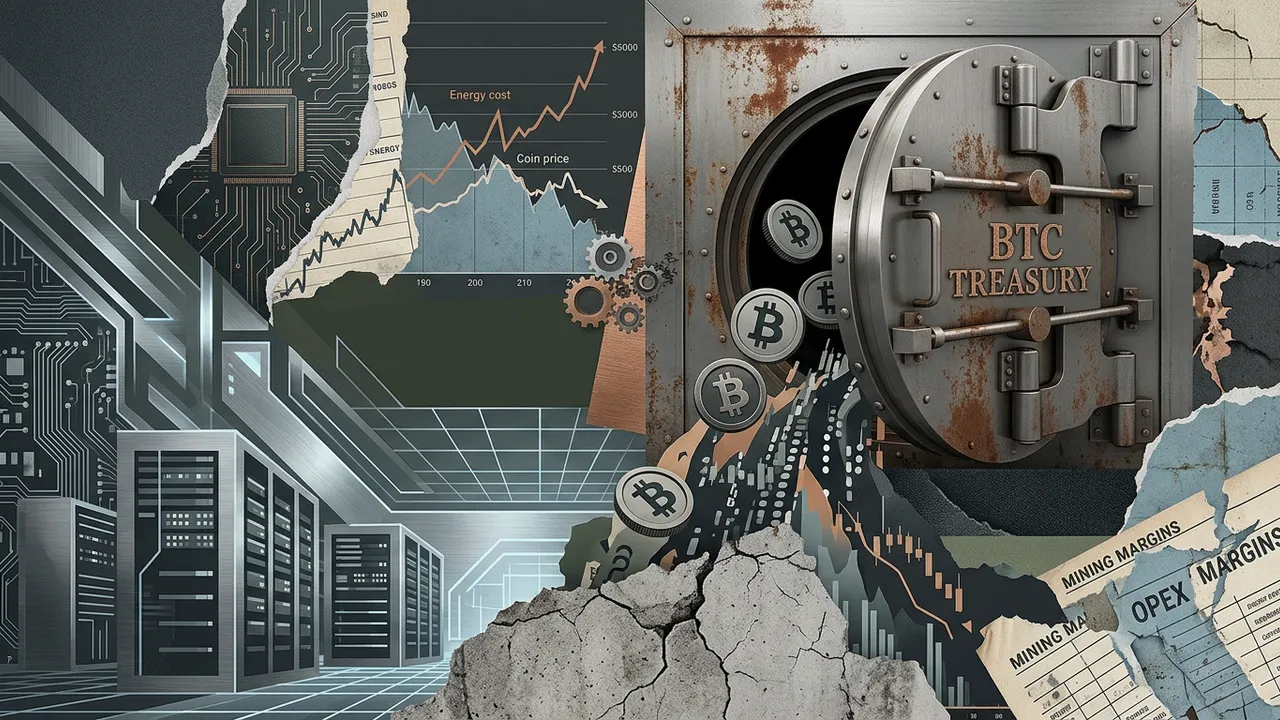
Public bitcoin miners have sold over 15,000 BTC since October, marking a dramatic reversal from the accumulation strategy that defined 2024-2025 as deteriorating economics force strategic pivots toward AI and infrastructure.
Key Takeaways
• The bitcoin miner treasury model that dominated 2024-2025 is collapsing under margin pressure, with public miners selling over 15,000 BTC since October—a strategic reversal that signals genuine economic strain rather than opportunistic profit-taking.
• The industry's pivot toward AI and high-performance computing infrastructure reveals an implicit admission that pure-play bitcoin mining cannot support the capital structures public miners built during the bull market, potentially reshaping the competitive landscape permanently.
• American Bitcoin's counter-trend accumulation of 6,500+ BTC stands in stark contrast to industry-wide liquidation, raising questions about whether this reflects superior economics or simply different risk tolerance from a politically-connected operation with high-profile backers.
• Historical miner capitulation events have marked market turning points, though the current dynamic differs—today's sales appear strategically proactive rather than crisis-driven, with companies deleveraging before rather than during acute distress.
• A mining industry with fewer overleveraged public companies and more distributed hashrate could paradoxically strengthen Bitcoin's security model by reducing the percentage controlled by entities facing quarterly earnings pressure and debt obligations.
Bitcoin Miners Face a Strategic Crossroads as Treasury Model Crumbles
The bitcoin mining industry is experiencing its most significant strategic pivot in years, as companies that spent the past two years accumulating BTC on their balance sheets now find themselves forced to liquidate holdings amid what industry observers describe as the harshest margin environment on record. This shift represents more than tactical repositioning—it signals a fundamental reassessment of the miner treasury model that became gospel during the bull market.
While one Trump-backed mining operation doubles down on accumulation, the broader industry tells a starkly different story of financial strain and strategic retreat that could reshape the competitive landscape for years to come.
The Facts
Publicly listed bitcoin miners have sold more than 15,000 BTC since October, according to TheEnergyMag's Miner Weekly newsletter, marking a dramatic reversal from the treasury accumulation strategy that dominated the 2024-2025 market cycle [2]. The selloff accelerated following October's market peak and subsequent flash crash that triggered widespread deleveraging across the sector.
Several major operations have led the retreat. Cango liquidated 4,451 BTC in February—approximately 60% of its total reserves—while Bitdeer sold its entire bitcoin treasury last month [2]. Core Scientific offloaded roughly 1,900 BTC for approximately $175 million in January, reducing holdings to under 1,000 BTC, and announced plans to sell an additional 2,500 BTC during the first quarter [2][3]. Riot Platforms conducted multiple December sales totaling 1,818 BTC worth $161.6 million as it pivoted toward monetizing power and data center infrastructure for AI workloads [3].
CleanSpark sold 553 of the 568 BTC it produced in February, generating $36.6 million in proceeds while maintaining 13,363 BTC in treasury [3]. The company also repaid its Bitcoin-backed credit line in full, citing efforts to reduce financial risk amid tightening margins [2]. On March 6, Core Scientific secured a $500 million credit facility from Morgan Stanley specifically to fund high-density computing infrastructure for AI and high-performance computing applications [3].
MARA Holdings, the second-largest public corporate Bitcoin holder with over 53,000 BTC, attracted scrutiny after updated regulatory filings indicated the company may both buy and sell Bitcoin to maintain "flexibility and optionality" [2]. Vice president Robert Samuels moved quickly to clarify that while the filing allows flexible sales, it doesn't signal majority liquidation of the treasury [2].
Swimming against this tide, American Bitcoin—backed by the Trump family—announced it has expanded its corporate treasury to more than 6,500 BTC, adding over 500 BTC during a 21-day period [1]. The accumulation came alongside the purchase of 11,298 new ASIC mining machines expected to boost the company's hashrate to approximately 28.1 EH/s [1]. President Matt Prusak emphasized that operational decisions focus on increasing balance sheet BTC, with the company reporting fourth-quarter 2025 mining margins of about 53% [1].
The divergence occurs against a backdrop of significant financial strain. American Bitcoin reported a fourth-quarter loss of roughly $59 million and full-year 2025 losses exceeding $150 million, though it generated over $185 million in revenue during its first year as a public company [1]. Co-founder Eric Trump publicly criticized major U.S. banks including JPMorgan Chase, Bank of America, and Wells Fargo for allegedly lobbying to block higher-yield crypto products and protect traditional banking from competition [1].
Analysis & Context
This divergence in miner behavior reveals a sector at an inflection point, forced to confront the sustainability of strategies built during radically different market conditions. The treasury accumulation model that emerged in 2024-2025 rested on three pillars: expectations of continued price appreciation, access to cheap capital, and healthy mining margins. All three have deteriorated simultaneously.
The timing of the selloff—beginning in October following the market peak—suggests miners recognized the changed environment before it became obvious to outside observers. What we're witnessing isn't panic liquidation but strategic repositioning by companies that can read their own economics. When miners who spent years preaching the gospel of "never sell" begin systematically unwinding positions, it indicates genuine structural pressure rather than opportunistic profit-taking.
Historically, miner capitulation has marked important market inflection points, though the current dynamic differs significantly. Previous capitulation events involved forced selling by overleveraged operations facing immediate bankruptcy. Today's sales appear more calculated—miners are proactively deleveraging, repaying credit lines, and redirecting capital toward AI and high-performance computing infrastructure that promises more stable revenue streams than volatile bitcoin mining margins.
American Bitcoin's counter-trend accumulation merits careful interpretation. The company's 53% mining margin—if sustainable—would indeed justify continued holding in ways that make less sense for competitors operating at breakeven or losses. However, the company's significant losses and the timing of its public emergence during peak market enthusiasm raise questions about whether its strategy reflects genuine operational advantage or represents a different risk appetite tied to its high-profile backers. The insider purchases following poor earnings could signal genuine conviction or represent optics management during a difficult market debut.
The pivot toward AI and HPC represents more than diversification—it's an implicit admission that pure-play bitcoin mining may not support the capital-intensive operations these public companies built. This shift could ultimately prove healthy for the network by reducing the percentage of hashrate controlled by entities facing quarterly earnings pressure and debt covenant requirements. A more distributed mining landscape with fewer leveraged public miners might paradoxically strengthen Bitcoin's security model.
Sources
AI-Assisted Content
This article was created with AI assistance. All facts are sourced from verified news outlets.