Bitcoin Miners at a Crossroads: Why Bitcoin and AI Are Not the Same
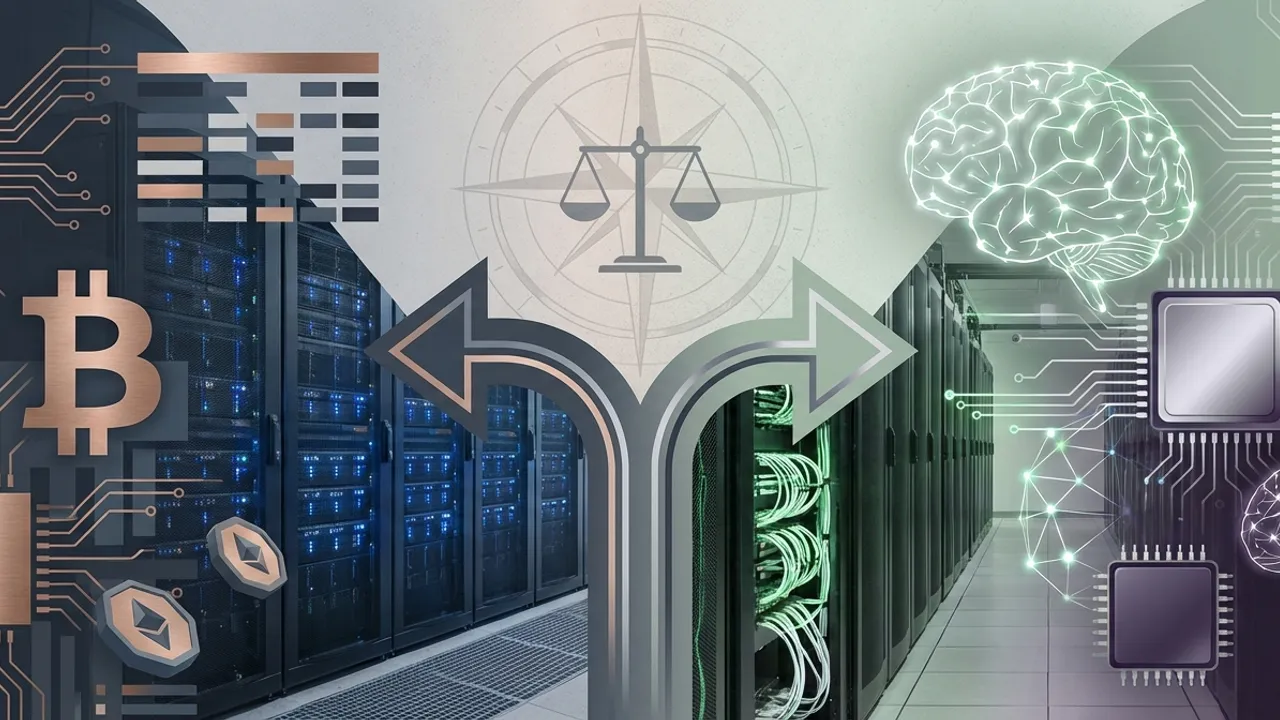
As mining companies increasingly diversify into AI infrastructure, a new research report highlights fundamental differences—with far-reaching consequences for regulation and network stability.
Mining Industry at a Crossroads: Between Technical Reality and Political Perception
As the mining industry expands its business models and invests in AI data centers under increasing margin pressure, a fundamental distinction is at risk: Bitcoin mining and AI infrastructure may both be energy-intensive, but their impacts on power grids could hardly be more different. This differentiation is becoming the decisive factor as regulatory authorities in North America decide on the future of energy-intensive data centers—and thus possibly on the future of the mining industry itself.
MARA Holdings' recent acquisition of Exaion perfectly illustrates the trend: mining companies are becoming hybrid infrastructure providers. At the same time, a new research report explains why precisely this convergence complicates public debate and makes differentiated consideration more urgent than ever.
The Facts
MARA Holdings has completed the acquisition of a 64 percent stake in French computing infrastructure operator Exaion after obtaining the necessary regulatory approvals [1]. French energy company EDF remains a minority shareholder and customer of the company. As part of the transaction, NJJ Capital, the investment vehicle of telecommunications entrepreneur Xavier Niel, is acquiring a 10 percent stake in MARA France [1].
This strategic move fits into a broader industry trend: mining companies are increasingly diversifying into AI and cloud computing infrastructure. After the 2024 halving, which cut block rewards in half, and rising network difficulty, many publicly traded miners are forced to develop hybrid business models [1]. Companies such as HIVE Digital Technologies, TeraWulf, Hut 8, IREN, and CleanSpark are converting mining facilities and energy capacities into AI data centers or expanding them [1]. In November, for example, CleanSpark announced plans to raise up to $1.28 billion through a convertible debt offering to expand both mining and data center operations [1].
At the same time, political pressure on both industries is growing. In August 2024, the International Monetary Fund called for stronger carbon pricing and additional levies on Bitcoin and AI [2]. In April 2025, the "Clean Cloud Act of 2025" was introduced to establish emission standards for data centers and mining facilities [2]. British Columbia announced it would exclude new mining projects from the power grid to reserve capacity for other industries—explicitly AI [2]. In New York State, a three-year construction moratorium on data centers over 20 megawatts is even being discussed [2].
Contrasting this is a new research report by crypto investment firm Paradigm titled "Green Mining, Stable Grids," authored by Justin Slaughter and Veronica Irwin [2]. The report argues that the frequent equation of Bitcoin mining and AI data centers is based on methodological errors. The authors emphasize that Bitcoin mining accounts for approximately 0.23 percent of global electricity consumption and about 0.08 percent of global CO₂ emissions [2]. However, the crucial factor is not the absolute amount but the type of energy consumption.
The report highlights that mining facilities function as "flexible load" that can dynamically respond to electricity prices and grid utilization [2]. Unlike AI data centers, which require continuous high performance, mining operations can quickly scale their capacity up and down. Many miners use power purchase agreements and demand-response programs to purchase energy cheaply during low grid utilization and sell electricity back during peak demand [2]. For example, Riot Platforms frequently pays a fixed electricity price in advance that is above the spot price and sells the already-paid-for energy back at higher prices during high demand [2].
In parallel, Bitcoin mining difficulty rose by approximately 15 percent to 144.4 trillion last Friday after previously falling by 11 percent—the sharpest decline since China's mining ban in 2021 [1]. The previous decline was due to severe winter storms in the United States that disrupted power grids and temporarily took many miners offline [1].
Analysis & Context
The seemingly contradictory developments—mining companies investing in AI infrastructure while a research report emphasizes their fundamental differences—reveal a deeper tension in the industry. The mining sector is experiencing an identity crisis triggered by economic pressure but with potentially far-reaching regulatory consequences.
The Paradigm report provides important arguments for differentiated regulation. The ability of mining facilities to function as flexible load is not a theoretical construct but is already being used in practice—as the Riot Platforms example shows. This flexibility makes mining operations a potentially stabilizing element in power grids with high shares of renewable energy, which naturally struggle with volatility in energy generation. AI data centers, on the other hand, require constant, high-quality power supply and cannot serve as buffers.
But reality is more complex than the analytical ideal: When MARA, CleanSpark, and other miners increasingly operate hybrid infrastructures, they dilute precisely the distinction that could protect them from blanket regulation. A data center that mines Bitcoin in the morning and processes AI workloads in the afternoon is neither purely flexible nor purely rigid. Regulators, who already have difficulty grasping technical nuances, could see this convergence as reason to treat both categories equally.
Historically, the mining industry follows a familiar pattern: After each halving, pressure increases on less efficient operators, who then seek alternative revenue sources. After the 2020 halving, it was expansion into North American markets following China's ban. Now it's diversification into AI infrastructure. The difference: Back then, geographic diversification strengthened network decentralization. Today, business diversification could weaken the regulatory position of the entire industry. The 15 percent difficulty increase also shows that competition in pure mining remains intense—despite all diversification efforts, fundamental network security remains robust.
Conclusion
• The mining industry faces a regulatory crossroads: While scientific evidence documents the differences from AI data centers, hybrid business models blur precisely these dividing lines in practice
• Bitcoin mining, as flexible, price-sensitive load, offers real advantages for grid stability and renewable energy integration—an argument that has barely been heard in political debates but could become decisive
• Diversification into AI infrastructure may stabilize margins in the short term but could jeopardize mining's special status in regulatory discussions in the long term
• Investors should watch how mining companies manage the balance between profitable diversification and maintaining their grid-beneficial characteristics—this balance will determine regulatory success or failure
• The robust difficulty adjustment despite winter storms and industry transformation demonstrates: The Bitcoin network itself remains largely unaffected by individual miners' business model experiments
Sources
AI-Assisted Content
This article was created with AI assistance. All facts are sourced from verified news outlets.