Bitcoin Miners Hit Record Selling Pressure in Q1 2026
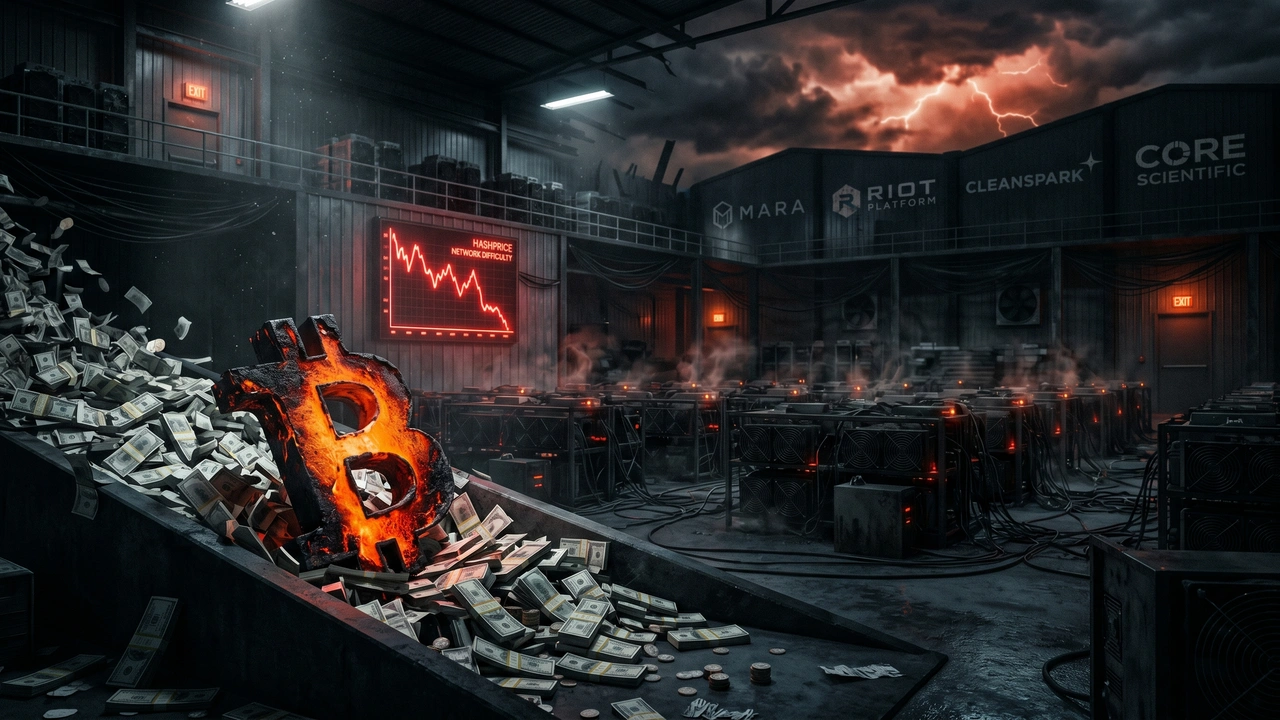
Publicly listed Bitcoin miners collectively offloaded more than 32,000 BTC in Q1 2026 — surpassing all of 2025's sales combined — as record-low hashprices and rising costs push roughly 20% of the industry into unprofitable territory.
Key Takeaways
- Record miner selling in Q1 2026 — over 32,000 BTC liquidated by major publicly listed miners — surpasses all of 2025 combined and sets a new all-time quarterly record, exceeding even the Terra-Luna crash-era selloff of Q2 2022 [1][2].
- The hashprice collapse to ~$33 PH/s/day has placed approximately 20% of the mining industry in unprofitable territory, with older hardware operations most exposed to forced liquidation [1][2].
- A strategic divide is forming: distressed miners are selling to survive, while better-capitalized operators like ABTC are actively accumulating, creating a bifurcation that will likely reshape industry concentration over the coming quarters [1].
- CoinShares warns of continued capitulation through H1 2026 unless Bitcoin's price recovers significantly — investors should monitor hashprice and miner reserve metrics as leading indicators of potential supply pressure [2].
- Historical context offers cautious optimism: past miner capitulation cycles have ultimately been cleansing events that strengthened network fundamentals, but the timeline to recovery depends heavily on Bitcoin price action and the pace at which inefficient capacity exits the network.
Bitcoin Mining's Breaking Point: Record Sales Signal an Industry Under Siege
Something significant is happening beneath the surface of the Bitcoin market. While price watchers focus on candles and order books, a structural shift is unfolding in the mining sector that carries real implications for Bitcoin's supply dynamics — and for the long-term health of the network. In Q1 2026, publicly listed miners didn't just sell a lot of Bitcoin. They sold more than they had in any single quarter in the industry's history, blowing past even the desperate liquidations of the Terra-Luna crash era. That's not a footnote. That's a signal.
The question isn't simply whether miners are struggling — it's what this unprecedented level of forced selling reveals about where the industry stands, who will survive, and what it means for Bitcoin's market structure in the months ahead.
The Facts
The numbers are stark. Major publicly traded Bitcoin mining companies — including MARA, Riot, CleanSpark, Core Scientific, Cango, and Bitdeer — collectively sold more than 32,000 BTC during the first quarter of 2026 [1][2]. To put that in perspective: those sales not only exceeded everything these companies sold throughout the entirety of 2025, but also surpassed the approximately 20,000 BTC that miners dumped onto the market during Q2 2022, when the collapse of the Terra-Luna ecosystem sent the crypto market into freefall [1][2]. According to TheMinerMag, Q1 2026 now stands as a new all-time record for Bitcoin miner sales in a single quarter [2].
The driving force behind this capitulation is the hashprice — the industry's benchmark metric for revenue per unit of computing power — which has collapsed to record lows of around $33 per petahash per second per day [1][2]. That figure sits below the estimated breakeven threshold of approximately $35 PH/s/day for many operations, particularly those running older mining hardware [2]. The consequence: roughly 20% of the entire mining industry is currently operating at a loss [1][2]. According to asset manager CoinShares, the pressure may not ease soon. "We expect further capitulation among higher-cost operators in H1 2026 unless BTC's price recovers materially," the firm stated in its Q1 2026 Bitcoin Mining Report [2].
The macro picture compounds the problem. Miners are simultaneously contending with a higher network hashrate — meaning more competition for the same block rewards — reduced block subsidies following the most recent halving, and broader macroeconomic headwinds that have weighed on Bitcoin's price [2]. The Bitcoin Miner Reserve, which tracks total BTC held across mining operations, has been on a gradual downtrend since 2023, declining from over 1.86 million BTC at the end of that year to approximately 1.8 million BTC today [2].
Not every miner, however, is reaching for the sell button. A meaningful divide is emerging within the sector. While distressed operators liquidate holdings to fund payroll and energy bills, others are deliberately accumulating. ABTC President Matt Prusak stated clearly: "We have no current intention to sell — we are accumulating" [1]. This strategic divergence reflects a bifurcation between well-capitalized miners playing the long game and higher-cost operators simply trying to stay alive. On the other side of the ledger entirely, Bitcoin treasury companies like Strategy continue to buy aggressively, with co-founder Michael Saylor signaling yet another acquisition as Bitcoin retreated from local highs above $73,000 [2].
Analysis & Context
Historically, miner capitulation events have served as some of the most reliable — if brutal — indicators of market cycle bottoms. The Q2 2022 selling wave, which the current quarter has now surpassed in absolute terms, preceded a prolonged bear market trough but also set the stage for the subsequent recovery. The pattern is consistent across Bitcoin's history: when miners are forced to sell, it introduces short-term supply pressure, but it also culls the weakest operators from the network, ultimately leaving a leaner, more resilient industry. The hash rate tends to dip temporarily before recovering as more efficient participants absorb market share. In that sense, pain today can lay the groundwork for structural improvement tomorrow.
What makes Q1 2026 particularly notable is the scale of the dislocation relative to the post-halving environment. Each Bitcoin halving compresses miner revenue mechanically, and the industry has always needed time to adjust — either through Bitcoin price appreciation, efficiency gains, or the exit of marginal players. The current hashprice environment suggests this adjustment cycle is playing out with unusual severity, possibly because the combination of a halving-induced revenue cut, sticky energy costs, and an uncertain macro backdrop has converged simultaneously. CoinShares' warning about continued capitulation in H1 2026 should be taken seriously; it implies the industry has not yet fully reset.
The emerging two-tier structure of the mining world is perhaps the most strategically important development to watch. Well-financed miners who can afford to hold — or even accumulate — are positioning themselves to capture a disproportionate share of block rewards as weaker competitors shut down rigs. Meanwhile, the contrast with Bitcoin treasury companies like Strategy is striking: miners, who produce Bitcoin, are net sellers under duress, while treasury companies, who produce nothing, are net buyers by conviction. This structural irony underscores a broader maturation of the Bitcoin ecosystem, where multiple distinct actor classes now interact with supply in fundamentally different ways. The long-term supply overhang from continued miner selling is real, but it is being partially absorbed by institutional demand — a dynamic that didn't exist in prior capitulation cycles.
Sources
AI-Assisted Content
This article was created with AI assistance. All facts are sourced from verified news outlets.