Bitcoin Miners Pivot to Power Control and AI as Industry Reshapes
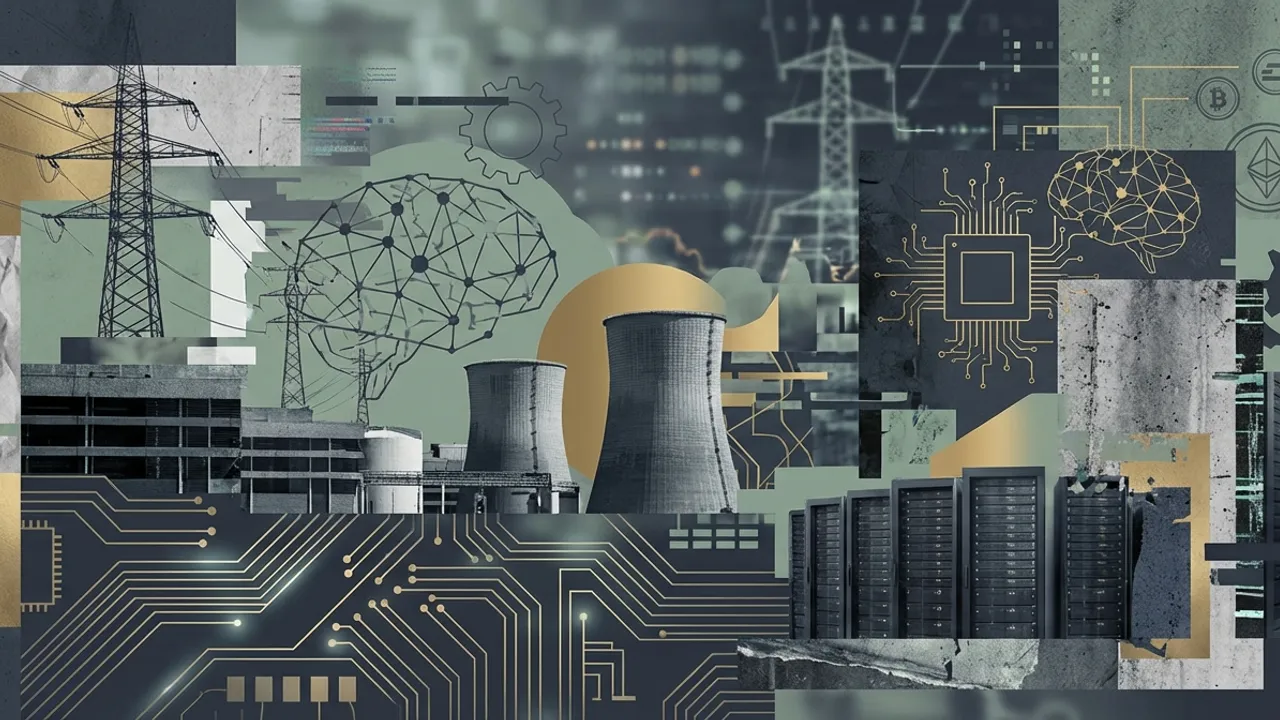
Major Bitcoin mining companies are fundamentally restructuring their business models, shifting from pure mining operations to integrated energy management and AI infrastructure—signaling a maturation of the industry amid tightening margins and post-halving economics.
Key Takeaways
• Bitcoin mining is transitioning from pure hash generation to integrated energy management businesses that control power assets and toggle between Bitcoin mining, AI computing, and grid services based on economic optimization
• Sub-$0.03/kWh electricity costs in strategic locations like Texas are becoming critical competitive moats, driving consolidation as companies acquire operational power assets rather than simply purchasing electricity
• Major energy companies like Engie exploring Bitcoin mining to monetize curtailed renewable generation signals mining's evolution into grid-balancing infrastructure that facilitates clean energy deployment
• The wave of AI conversions among miners (Bitfarms, Bitdeer, IREN) represents rational capital allocation in response to post-halving economics, not abandonment of Bitcoin—most operators maintain optionality to switch between workloads
• Vertical integration from chip manufacturing through power generation (exemplified by Canaan's strategy) is becoming the dominant business model for surviving mining operations, suggesting the industry is maturing into a capital-intensive infrastructure sector
The Mining Industry's Strategic Metamorphosis Accelerates
Bitcoin mining is undergoing its most significant strategic transformation since the industrial-scale operations emerged in 2017. What we're witnessing isn't simply miners diversifying revenue streams—it's a fundamental reimagining of mining companies as energy management and computational infrastructure providers. The recent acquisition by Canaan of Cipher Mining's Texas stakes, combined with global energy giants like Engie exploring Bitcoin mining to address grid inefficiencies, reveals an industry evolving from opportunistic hash generation to sophisticated energy arbitrage and infrastructure control.
This convergence of vertical integration, AI pivoting, and strategic power acquisition represents the mining sector's response to structural profitability pressures following the 2024 halving. The companies surviving this transition are those controlling the entire value chain—from electricity generation to chip manufacturing to flexible computational deployment.
The Facts
Canaan, a leading Bitcoin mining hardware manufacturer, has acquired Cipher Mining's 49% stake in three fully operational Texas mining facilities for $39.75 million, paid entirely through share issuance [1][2]. The transaction covers Alborz LLC, Bear LLC, and Chief Mountain LLC—collectively known as the ABC Projects—which operate 120 megawatts of combined power capacity and generate approximately 4.4 exahashes per second of Bitcoin mining hashrate [1]. Canaan now holds 49% ownership while renewable energy infrastructure company WindHQ retains the controlling 51% stake [1].
The deal also included 6,840 Avalon A15Pro mining rigs originally deployed at Cipher's Black Pearl facility, which is currently being converted into an artificial intelligence and high-performance computing data center [1][2]. Critically, these Texas operations benefit from electricity costs below $0.03 per kilowatt-hour within the ERCOT power market, among the lowest disclosed rates in the United States, and incorporate off-grid wind power at the Alborz site [1][2].
Canaan CEO Nangeng Zhang emphasized the strategic nature of controlling power assets: "By increasing our exposure to high-quality, low-cost operational power assets in Texas, we are aligning our proprietary technology with critical infrastructure to drive long-term efficiency and scale" [1][2]. Cipher CEO Tyler Page highlighted his confidence in the equity-based transaction, stating: "We were willing to take a meaningful position in Canaan because we see significant opportunity ahead. Canaan's vertical integration, technology leadership, and energy platform make them the right steward for the next phase of growth" [2].
This transaction follows Canaan's strong fourth quarter 2024 performance, with revenue increasing 121.1% year-over-year to $196.3 million and Bitcoin mining revenue climbing 98.5% to $30.4 million, expanding its treasury to 1,750 BTC [1]. The company shipped a record 14.6 EH/s of computing power and expanded installed hashrate to 9.91 EH/s [1].
Meanwhile, the AI conversion trend is accelerating across the sector. MARA Holdings recently acquired a 64% stake in French infrastructure company Exaion, while companies including Hive, Hut 8, TeraWulf, and Iren are converting mining facilities into data center operations [1]. Bitfarms has outlined plans to wind down Bitcoin mining operations through 2026-27 and convert its Washington State facility into an AI-ready GPU-as-a-Service hub with $128 million in upgrades [3]. Bitdeer Technologies has completely liquidated its corporate Bitcoin treasury, reporting zero BTC held as of February 20 after selling approximately 2,000 BTC, as it transitions to AI infrastructure deployment in Malaysia [3].
In a parallel development demonstrating Bitcoin mining's emerging role in global energy systems, French utility giant Engie is exploring installing battery storage or Bitcoin mining data centers at its newly launched 895-megawatt-peak Assu Sol solar plant in Brazil [3]. Eduardo Sattamini, Engie's Brazil country manager, told reporters the company is evaluating potential offtakers to absorb excess generation and offset mounting curtailment losses that have cost the Brazilian renewable sector billions of reais since 2023 [3]. However, he cautioned any such initiative would take years to implement [3].
Analysis & Context
This wave of strategic repositioning reveals three critical forces reshaping Bitcoin mining's economic foundation. First, the post-2024-halving environment has permanently altered profitability dynamics, forcing miners to optimize every aspect of their operations or exit the industry entirely. Companies that survive aren't just mining Bitcoin—they're managing energy portfolios with Bitcoin mining as one application among several.
Second, the convergence of Bitcoin mining infrastructure with AI computing represents a natural evolution of specialized data center expertise. Mining companies have spent years developing relationships with power providers, building grid-scale energy management capabilities, and operating high-density computational facilities. These competencies transfer directly to AI infrastructure, which faces similar challenges around power availability, cooling, and operational efficiency. The ability to switch between Bitcoin mining and AI workloads based on relative profitability creates optionality that pure-play miners lack.
Third, and perhaps most significant for Bitcoin's long-term security model, is the emergence of mining as a grid-balancing tool rather than merely a profit-seeking enterprise. Engie's exploration of Bitcoin mining to address curtailment in Brazil exemplifies how major energy companies are recognizing mining's unique value proposition: providing a flexible, interruptible load that monetizes otherwise stranded renewable energy. This positions Bitcoin mining as infrastructure that actually facilitates renewable energy deployment by improving project economics—a profound shift from the narrative of mining as wasteful energy consumption.
The Canaan-Cipher transaction specifically demonstrates consolidation toward vertically integrated operations controlling the full stack from chip design to power generation. The sub-$0.03/kWh power costs in Texas provide sustained competitive advantage in an industry where electricity represents 60-80% of operational costs. Canaan's willingness to issue significant equity rather than use cash or debt suggests confidence that controlling strategic power assets justifies dilution—a calculation that makes sense only if they view these facilities as long-term competitive moats.
For Bitcoin's network security, this consolidation trend presents both opportunities and concerns. Sophisticated, well-capitalized miners with diversified revenue streams provide stability and operational excellence that strengthens network security. However, concentration of hashrate among fewer large players potentially increases coordination risks, though geographic and jurisdictional diversity mitigates this concern. The fact that renewable energy companies and major hardware manufacturers are deepening commitments to mining infrastructure suggests confidence in Bitcoin's long-term value proposition despite short-term margin compression.
Sources
AI-Assisted Content
This article was created with AI assistance. All facts are sourced from verified news outlets.