Bitcoin Miners Sell Billions in BTC as Industry Faces Structural Reckoning
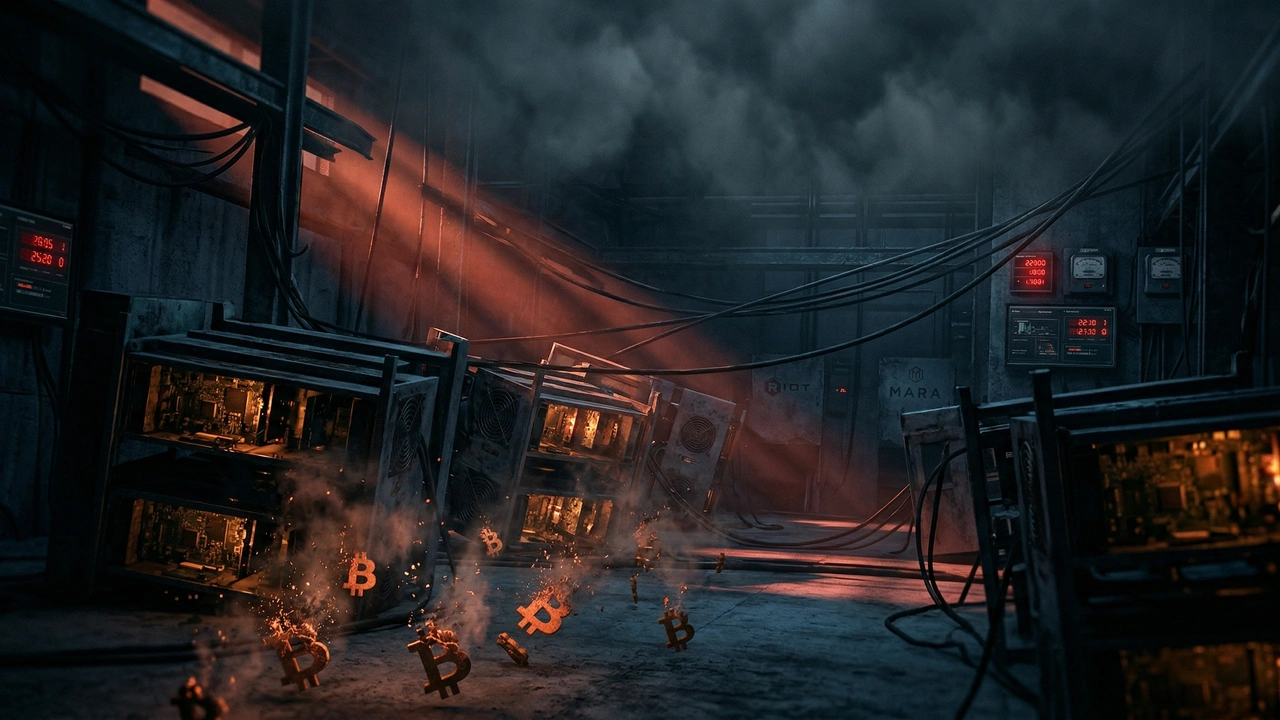
A wave of large-scale Bitcoin liquidations by major miners, combined with layoffs and debt restructuring, signals the industry is undergoing a fundamental transformation driven by tightening margins and strategic pivots toward AI infrastructure.
Key Takeaways
- Miner sell pressure is structural, not incidental: The scale and coordination of Bitcoin sales across Riot, MARA, and others reflects genuine margin compression driven by energy costs and debt obligations — not temporary opportunism. Investors should treat this as a meaningful near-term headwind.
- MARA's debt restructuring is significant: Retiring $1 billion in convertible debt at a 9% discount while simultaneously cutting staff and pivoting to AI signals a company in serious strategic transition — the era of miners as pure Bitcoin treasury vehicles is evolving rapidly [2].
- Network health metrics warrant monitoring: The drop in hashrate from 1.16 ZH/s to ~990 EH/s and the difficulty reduction from 145T to 133T confirm that weaker miners are already exiting — watch these metrics as leading indicators of market stabilization [1].
- Miner capitulation historically precedes recovery: Past cycles show that large-scale miner liquidation events, while disruptive, often mark the later stages of market stress rather than the beginning — the difficulty adjustment mechanism is Bitcoin's built-in shock absorber.
- The identity of Bitcoin's largest holders is changing: As publicly traded miners shift from accumulation to active treasury management and debt servicing, the composition of Bitcoin's institutional ownership is evolving in ways that have long-term implications for price dynamics and market structure.
When Miners Become Sellers: The Industry Stress Signal No One Should Ignore
Something significant is happening beneath the surface of the Bitcoin mining industry. When the very entities whose economic purpose is to accumulate Bitcoin begin selling it at scale — not as opportunistic profit-taking, but as a survival mechanism — it tells a deeper story about the state of the ecosystem. The combined liquidation of tens of thousands of Bitcoin by major publicly traded miners in recent weeks is not a coincidence. It is the visible symptom of an industry caught between rising operational costs, crushing debt loads, and an accelerating identity crisis about what these companies actually are.
For investors watching from the sidelines, this wave of miner selling deserves careful attention. It represents both a near-term headwind for Bitcoin's price and a longer-term structural shift in who controls significant portions of Bitcoin's circulating supply — and what their incentives are.
The Facts
Riot Platforms sold 3,778 Bitcoin during the first quarter of 2025 at an average price of $76,626, generating approximately $289.5 million in proceeds [1]. This despite the company having produced only 1,473 Bitcoin over the same period — meaning Riot sold more than twice what it mined, drawing down its treasury to 15,680 BTC by the end of Q1 [1]. Blockchain intelligence platform Arkham separately flagged a 500 BTC outflow from a wallet attributed to Riot on the same day the operational update was released [1].
Riot's activity, however, was modest compared to MARA Holdings, which executed an even more dramatic balance sheet reset. Between March 4 and March 25, MARA sold 15,133 Bitcoin for approximately $1.1 billion, using the proceeds to retire a substantial portion of its convertible debt [2]. Specifically, the company repurchased $367.5 million of its 2030 notes for $322.9 million and $633.4 million of its 2031 notes for $589.9 million — retiring that debt at an average discount of roughly 9% to par [2]. The transactions are expected to generate approximately $88.1 million in cash savings and reduce MARA's total convertible debt load by around 30%, from roughly $3.3 billion to approximately $2.3 billion [2].
The financial maneuvering was followed almost immediately by company-wide layoffs across multiple departments, executed in what sources described as a piecemeal fashion across at least two rounds [2]. The total number of employees affected has not been disclosed. MARA CEO Fred Thiel framed the Bitcoin sale as a deliberate capital allocation decision designed to strengthen the company's balance sheet and improve financial flexibility, rather than a distress signal [2]. In the same week, companies including Genius Group and Nakamoto Holdings also disclosed Bitcoin sales, with the combined tally across all firms reaching approximately 15,501 BTC sold in just seven days [1].
On the cost side, blockchain developer and investor Kadan Stadelmann pointed to rising energy prices — exacerbated by Middle East geopolitical tensions escalating since February — as a primary driver forcing miners to liquidate holdings [1]. Bitcoin's mining difficulty dropped from approximately 145 trillion to 133 trillion on March 20, while the network hashrate declined from 1.16 zettahash to roughly 990 exahash over the same period, suggesting less efficient miners are already shutting down rigs they can no longer afford to run [1].
Analysis & Context
This is not the first time miner capitulation has preceded or coincided with Bitcoin market stress. Students of Bitcoin's price cycles will recognize the pattern: as BTC price declines or stagnates, miners with higher cost structures begin selling reserves to cover fixed operational costs, adding sell-side pressure to an already weakened market. In the 2022 bear market, the collapse of several mid-tier miners — including Compute North and Core Scientific's near-bankruptcy — followed exactly this script. What is different this cycle is the scale of the publicly traded miners and the sophisticated financial engineering layered on top of their operations through convertible note issuance. These companies raised billions in cheap debt during the 2021 bull market and the post-halving enthusiasm of 2024, and those obligations are now maturing into a far less forgiving environment.
The strategic pivot toward artificial intelligence and high-performance computing — explicitly signaled by MARA — is a development worth examining critically [2]. While the narrative of repurposing energy infrastructure for AI workloads is compelling, it also reflects an acknowledgment that pure-play Bitcoin mining margins alone may not sustain these capital-intensive businesses at their current scale. This diversification trend mirrors what happened in the early cloud computing era, when companies with significant data center footprints began monetizing excess capacity in new ways. Whether Bitcoin miners can successfully execute this pivot remains unproven, but the direction of travel is clear. MARA has even stated that selling Bitcoin will become a recurring element of its treasury strategy going forward, describing planned BTC sales "from time to time" throughout 2026 [2].
For Bitcoin markets, the near-term implication of large miner sell pressure is meaningful but should not be overstated. Historically, miner capitulation events — while painful — tend to be self-correcting. As difficulty drops and less efficient operators exit, the surviving miners with lower cost structures become more profitable per coin mined, which reduces their urgency to sell and can eventually restore accumulation behavior. Stadelmann noted this dynamic explicitly, suggesting that if energy prices ease or Bitcoin's price recovers, even sidelined miners could return [1]. The network's self-adjusting difficulty mechanism is precisely designed for this scenario.
Sources
AI-Assisted Content
This article was created with AI assistance. All facts are sourced from verified news outlets.