Bitcoin Mining at a Crossroads: Margins Shrink, Pivots Begin
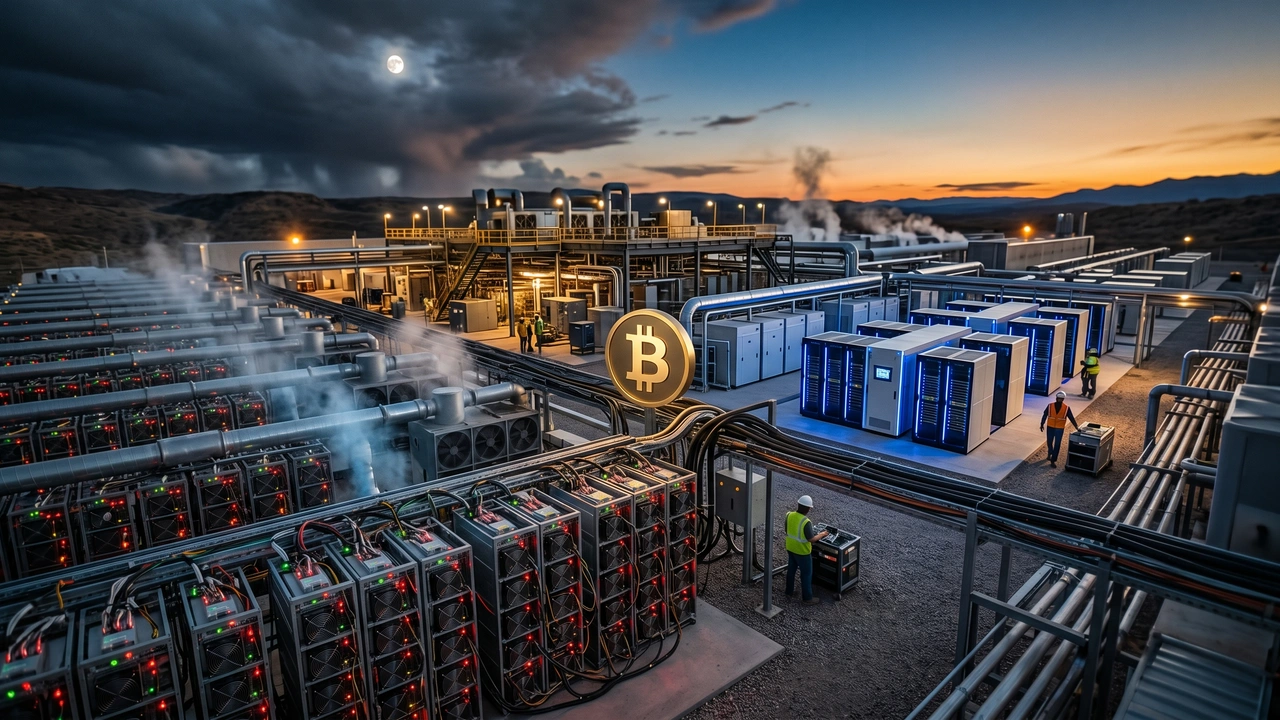
With hashprice near breakeven and difficulty climbing, Bitcoin miners are being forced to reinvent themselves - and the industry will never look quite the same again.
Key Takeaways
- Hashprice has fallen to $36-$38 per petahash-second per day, leaving up to 20% of Bitcoin miners at or below breakeven - a critical stress signal for the industry [2]
- Riot Platforms' experience in Q1 2026 - mining revenue down, data center revenue up - is becoming a template, not an exception, as major miners diversify into AI infrastructure [1]
- The AI data center pivot trades Bitcoin's asymmetric upside for more predictable dollar-denominated revenue, representing a structural shift in how listed mining companies manage risk
- Rising difficulty combined with higher energy costs creates a compounding pressure that will likely drive further consolidation, benefiting operators with the lowest cost per kilowatt-hour and the newest generation of mining hardware
- Mining pool centralization deserves close monitoring - open standards for pool communication are a meaningful step toward preserving Bitcoin's decentralization at the infrastructure level [2]
Bitcoin Mining at a Crossroads: Margins Shrink, Pivots Begin
Something structural is happening inside the Bitcoin mining industry, and it goes well beyond the typical post-halving squeeze. A convergence of rising network difficulty, soaring energy costs, and compressed profitability metrics is forcing miners to make a fundamental choice: adapt the business model or risk becoming unprofitable. The early movers are already placing their bets, and the direction they are heading tells us a great deal about where Bitcoin infrastructure is going next.
The numbers are stark. Up to one in five Bitcoin miners is currently operating in the red, and the survivors are scrambling to find new revenue legs. The pivot to artificial intelligence data centers - once dismissed as a distraction from core mining operations - is now looking like the lifeline that keeps some of the industry's biggest names solvent.
The Facts
Bitcoin mining difficulty is on track to rise again, with the next adjustment expected on May 15, 2026, pushing the difficulty figure from 132.47 trillion to an estimated 135.64 trillion [2]. That upward march is relentless and, by design, self-reinforcing - as more hashrate joins the network, the bar rises for everyone already competing. Compounding the challenge, energy costs are also climbing, tightening the margin between revenue and operating expense for miners running older or less efficient hardware [2].
The profitability signal that miners watch most closely - hashprice - has fallen to a range of $36 to $38 per petahash-second per day, a level that CoinShares describes as near or at breakeven for a meaningful portion of the industry [2]. When hashprice compresses to this degree, smaller or less efficient operations either shut down rigs or sell Bitcoin reserves to cover costs, accelerating a Darwinian consolidation at the top end of the market.
Riot Platforms illustrates both the pressure and the response. The company reported $167.2 million in total revenue for Q1 2026, but the internal composition of that figure is telling [1]. Bitcoin mining revenue dropped to $111.9 million from $142.9 million in the same quarter a year prior - a meaningful decline [1]. Filling some of that gap was Riot's newly launched data center business, which generated $33.2 million in revenue during the quarter [1]. That is a significant contribution for a business line that did not exist in its current form not long ago.
Riot is far from alone in this pivot. Core Scientific, MARA Holdings, Hive, Hut 8, and Iren are all either converting existing mining facilities into AI-capable data centers or acquiring compute assets to serve artificial intelligence workloads [1]. The trend points toward a broader reorientation of what a "Bitcoin mining company" actually is. Meanwhile, on the infrastructure side, new open standards for mining pool communication are being developed to counteract growing centralization in pool operations, giving individual miners more flexibility over which block templates they participate in [2].
Analysis & Context
This moment rhymes strongly with what happened in the months following Bitcoin's 2020 halving, when compressed block rewards forced a wave of industrial consolidation and pushed marginal miners offline. But there is a new variable this cycle that did not exist with the same urgency before: the AI compute boom has created an alternative revenue market that is physically compatible with mining infrastructure. Mining facilities require large power connections, cooling systems, and security - exactly what hyperscale AI workloads demand. The overlap is not coincidental, and it is not temporary.
What makes the current situation more complex is that the AI pivot introduces a different kind of business risk. Bitcoin mining revenue, while volatile, is directly tied to Bitcoin's price and network activity - two things that have historically trended upward over long time horizons. AI data center contracts, by contrast, are typically priced in dollars with fixed-term agreements, offering more predictability but also capping upside. Miners making this transition are essentially trading asymmetric Bitcoin exposure for steadier cash flow, which is a rational near-term decision but represents a meaningful philosophical shift for companies that built their identity around accumulating and hodling Bitcoin.
The centralization concern in mining pools is worth watching separately. As difficulty rises and only well-capitalized operators can afford to stay competitive, hashrate tends to concentrate among fewer pools. A small number of pools controlling outsized shares of global hashrate creates systemic risk for Bitcoin's censorship resistance - one of its core value propositions. The development of open, operator-neutral pool standards is a constructive counterweight to that trend, and it deserves more attention from the Bitcoin community than it typically receives. Decentralized mining infrastructure is not just an operational footnote - it is foundational to Bitcoin's long-term security model.
Sources
AI-Assisted Content
This article was created with AI assistance. All facts are sourced from verified news outlets.