Bitcoin Mining at a Crossroads: Smarter Tools or a Full Pivot
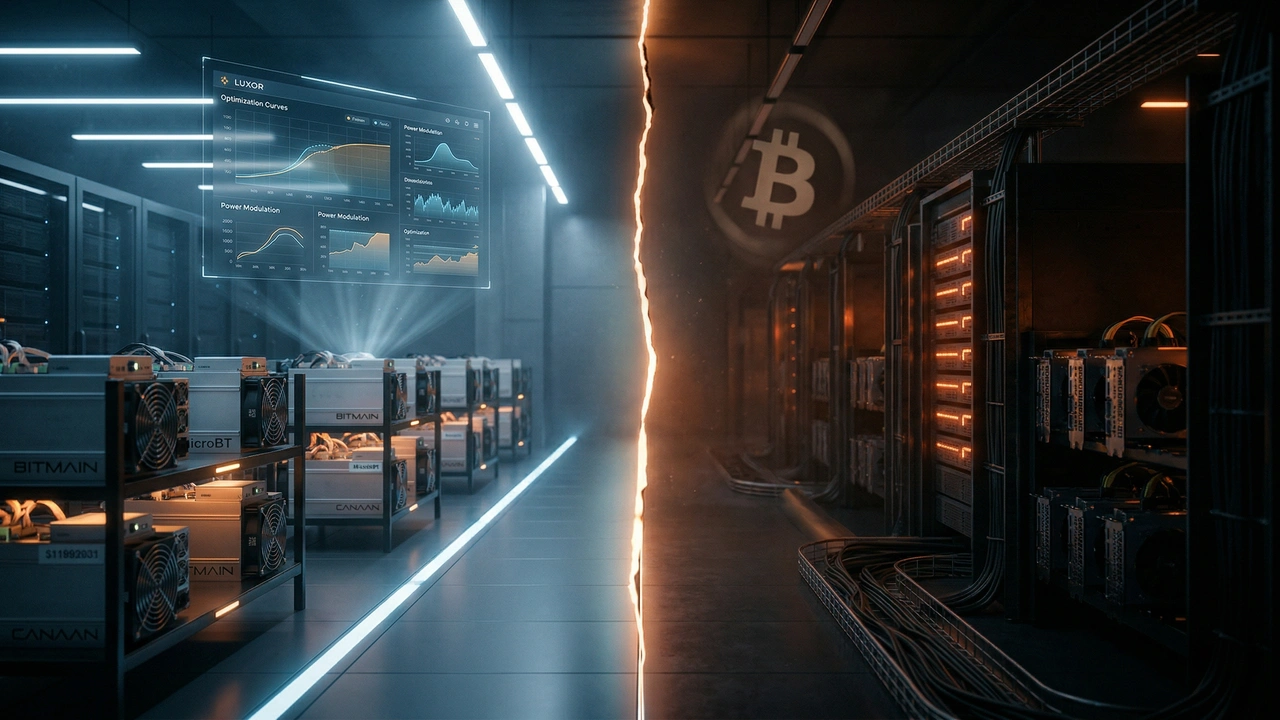
Two contrasting strategies are reshaping the Bitcoin mining industry: Luxor's new Commander platform doubles down on intelligent optimization, while Bitfarms abandons mining altogether in favor of AI infrastructure — revealing a sector under serious structural pressure.
Key Takeaways
- Mining is bifurcating rapidly: Operators are splitting between those investing in sophisticated optimization technology to stay competitive in Bitcoin mining and those pivoting entirely to AI/HPC infrastructure — there is diminishing middle ground.
- Intelligent automation is becoming table stakes: Luxor's claim that "binary miners won't be able to compete" is not hyperbole — in a low-hashprice environment, the 8–14% profitability gap from real-time optimization can determine whether an operation is viable at all [1].
- Bitfarms' full Bitcoin exit is a landmark signal: A publicly traded miner explicitly targeting zero BTC on its balance sheet, combined with a full rebrand, represents one of the strongest public-market signals yet that legacy mining economics are under severe structural strain [2].
- AI infrastructure pivots carry real execution risk: The revenue from Bitfarms' AI buildout is not expected until 2027, meaning the company must fund a capital-intensive transition while winding down its primary income source — a precarious runway that investors should scrutinize closely [2].
- For Bitcoin's network, consolidation favors the technically sophisticated: As less competitive operators exit or pivot, hashrate is likely to concentrate among operators with intelligent fleet management and lower cost structures, reinforcing mining's evolution into a high-specialization industry.
Bitcoin Mining at a Crossroads: Intelligent Optimization vs. Full Retreat
The Bitcoin mining industry is splitting into two distinct camps, and the divergence has never been more visible. On one side, infrastructure technology firms are doubling down on sophisticated software to squeeze every last satoshi of profit from tightening margins. On the other, publicly traded miners are abandoning the business entirely, redeploying their energy assets toward AI and high-performance computing. Together, these two developments tell a single, uncomfortable story: mining Bitcoin at scale is becoming an increasingly specialized — and unforgiving — endeavor.
This week delivered a sharp illustration of that split, with Luxor Technology unveiling its Commander fleet management platform while Bitfarms confirmed it is systematically liquidating its Bitcoin holdings on the path to becoming an AI infrastructure company. These aren't isolated headlines. They represent competing survival strategies in an industry squeezed by halving cycles, compressed hashprice, and the rising allure of contracted AI revenue.
The Facts
Luxor Technology, a Seattle-based Bitcoin mining software firm that already oversees more than one gigawatt of mining and data center compute, launched Commander — a unified fleet management and profitability optimization platform designed to consolidate pool services, firmware control, energy management, and financial tools into a single operational layer [1]. The company positions Commander as a critical component of what it calls a "full-stack mining infrastructure" approach.
At the heart of Commander is a feature called Intelligent Miner, an automated optimization engine that re-evaluates hashrate pricing and electricity costs every five minutes, then dynamically adjusts miner power settings accordingly [1]. Unlike traditional binary curtailment strategies — which simply switch machines on or off — Intelligent Miner modulates power consumption continuously based on prevailing market conditions. Luxor's internal benchmarking suggests this approach delivers between 8% and 14% better profitability compared to conventional on/off management methods [1]. The platform is compatible with both Luxor's proprietary LuxoOS firmware and standard firmware from major ASIC manufacturers including Bitmain, MicroBT, and Canaan, reducing friction for operators looking to integrate it into existing setups [1].
"Every mining operation has fleet management. What separates the best-in-class operators is the intelligence layer on top," said Jamie Gill, Senior Vice President of Business Development at Luxor. "Binary miners won't be able to compete in this new paradigm" [1].
Meanwhile, Bitfarms is charting an entirely different course. The Nasdaq-listed miner confirmed during its fourth-quarter earnings call that it has begun selling its Bitcoin holdings and intends to continue until none remain on its balance sheet [2]. CEO Ben Gagnon stated plainly, "In time, we will have no bitcoin" [2]. As of its most recent disclosure, the company held 1,827 BTC, and it has already generated $28.2 million in realized gains from Bitcoin sales in 2025 [2]. The capital is being redirected into a 2.2 gigawatt AI and high-performance computing infrastructure development pipeline spanning sites in Pennsylvania, Washington, and Québec, with revenue contributions targeted to begin in 2027 [2].
The pivot comes despite a 72% year-over-year revenue increase to $229 million in 2025, as Bitfarms simultaneously posted a net loss of $284 million — losses driven largely by fair value changes in digital assets and impairment charges [2]. The company is also redomiciling from Canada to the United States and rebranding as Keel Infrastructure, with shares expected to trade under the ticker KEEL around April 1 [2]. Total liquidity stood at approximately $520 million at the time of reporting [2].
Analysis & Context
These two developments, read together, reveal the full spectrum of responses to the structural pressures now confronting Bitcoin mining. The April 2024 halving cut block rewards from 6.25 BTC to 3.125 BTC, and with hashprice hovering near historically depressed levels, the economics of running large-scale mining operations have become genuinely brutal for operators without a competitive edge. Luxor's Commander is essentially a bet that the path to survival lies in operational precision — that the difference between profitability and loss increasingly comes down to real-time decision-making at the machine level. The 8–14% profitability improvement claimed for Intelligent Miner may sound modest, but at industrial scale and razor-thin margins, that delta can be the difference between a business that survives the next bear market and one that doesn't.
Bitfarms' exit from Bitcoin, by contrast, reflects a judgment that no amount of optimization software changes the fundamental economics of a post-halving world where energy costs are fixed but revenue is perpetually volatile. The pivot to AI infrastructure is not unique to Bitfarms — several major miners including Core Scientific, Hut 8, and Riot Platforms have explored or announced similar diversification strategies — but Bitfarms is among the most explicit in its intent to fully abandon Bitcoin production. Historically, miners that attempted dramatic pivots during periods of market stress have faced mixed outcomes; the AI infrastructure buildout requires enormous capital, long lead times, and successful customer acquisition before it generates revenue. The 2027 revenue target is not imminent, and the company will need to manage its remaining cash carefully during that transition.
What makes the Luxor story particularly significant is the implicit message it carries for smaller and mid-size operators: the commoditization of mining means that without intelligent tooling, manual fleet management is no longer viable. As the industry consolidates, the operators best positioned to endure are those treating mining as a high-frequency optimization problem rather than a passive infrastructure play. Commander's five-minute recalibration cycle is a direct response to the reality that hashprice and power costs are now dynamic variables that demand algorithmic responses, not human ones.
Sources
AI-Assisted Content
This article was created with AI assistance. All facts are sourced from verified news outlets.