Bitcoin Mining Enters a New Era of Scale and Standards
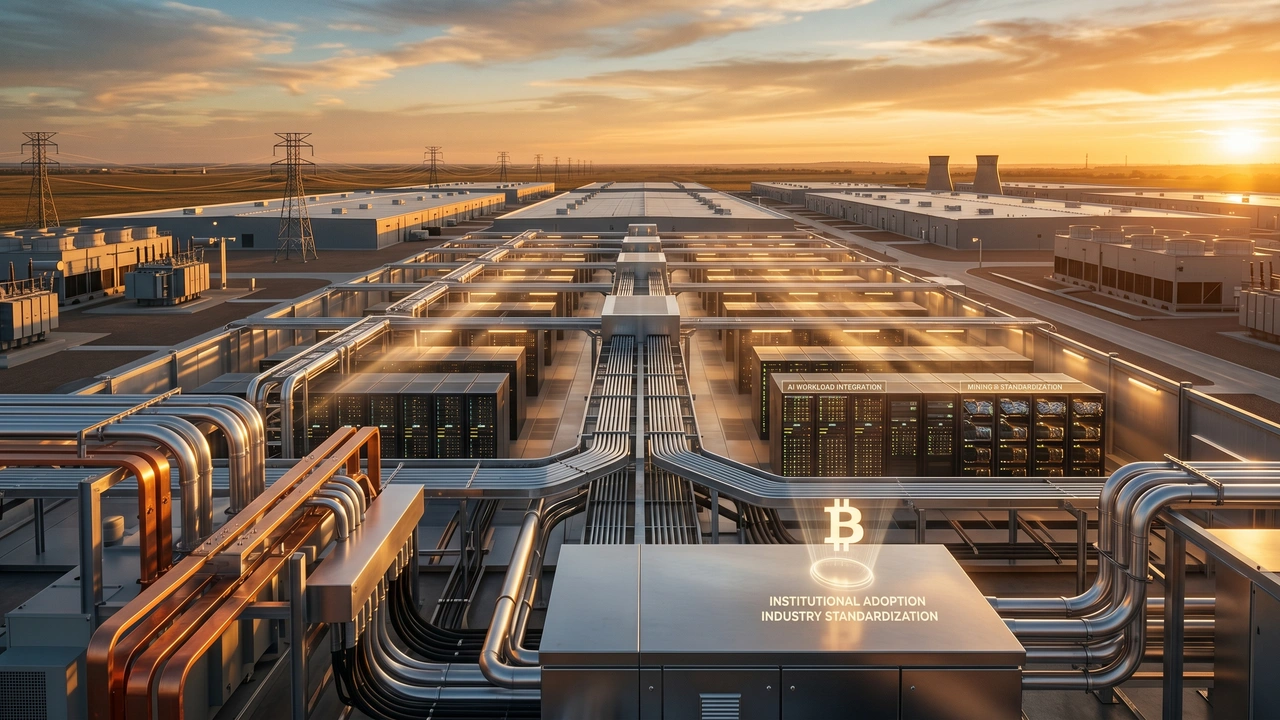
Major mining pools and infrastructure companies are converging on two parallel tracks that will define Bitcoin's next phase: a standardized, decentralized mining protocol and a pivot toward AI-linked data center revenue.
Key Takeaways
- The addition of ANTPOOL, Foundry, F2Pool, and other major pools to the Stratum V2 Working Group represents a credible path toward industry-wide adoption of a protocol that would meaningfully improve Bitcoin's decentralization at the mining layer.
- The miner-template-construction feature in Stratum V2 is the most important security upgrade in the proposal - it removes pool operators' ability to unilaterally control transaction selection, reducing a long-standing centralization risk.
- Core Scientific's Q1 results illustrate that the most successful large-scale miners may increasingly derive their revenue from AI colocation rather than Bitcoin production, reshaping what it means to be a "Bitcoin miner."
- Bitcoin's infrastructure layer is experiencing simultaneous standardization and diversification - both trends strengthen the network's long-term resilience, even if they play out on different timelines.
- Investors evaluating mining companies should now assess two distinct business models within the same sector: pure-play Bitcoin miners and hybrid infrastructure operators with diversified compute revenue streams.
Bitcoin Mining Enters a New Era of Scale and Standards
Two separate but deeply connected developments are reshaping the Bitcoin mining industry from the ground up. On one front, the largest mining pools in the world are lining up behind a common technical standard designed to make mining more secure, efficient, and decentralized. On another, major mining infrastructure operators are quietly transforming their business models, pivoting toward high-performance computing colocation as a primary revenue driver. Together, these shifts signal that Bitcoin mining is maturing into a serious industrial sector - one that is building the institutional foundations it will need to survive and thrive through the next decade.
The implications extend well beyond operational efficiency. Protocol standardization and infrastructure diversification are both forms of resilience-building. When the industry moves in this direction, Bitcoin itself becomes harder to attack, easier to scale, and more attractive to institutional capital.
The Facts
The Stratum V2 Working Group announced a significant expansion of its membership, with ANTPOOL, Block Inc, F2Pool, Foundry, Spiderpool, MARA Foundation, and DMND all joining the initiative [1]. The working group was originally founded in 2022 by Braiins and Spiral with the mandate to develop and maintain Stratum V2 as an open, vendor-neutral protocol specification [1]. The new additions represent some of the largest and most influential players in the global mining ecosystem, making the announcement a genuine industry-wide alignment rather than a niche technical project.
Stratum V2 is a comprehensive upgrade to the original Stratum protocol that has underpinned Bitcoin mining communications for over a decade. The new standard introduces end-to-end encryption, more efficient fleet management for large mining operations, and - critically - the ability for individual miners to construct their own block templates rather than accepting template assignments from pool operators [1]. ANTPOOL CEO Andy Zhou framed the move as a competitive advantage for the industry as a whole: "Aligning around an open, interoperable standard enables the industry to collaborate more effectively and drive improvements in efficiency, security and decentralization" [1]. Spiderpool CTO Kenway Wang emphasized the protocol's value for miners operating in bandwidth-limited environments, noting that miner-constructed templates are central to the company's decentralization mission [1].
On the infrastructure side, Core Scientific reported a dramatic revenue transformation in its first quarter results. Colocation revenue tied to artificial intelligence workloads surged to $77.5 million in Q1, up from just $8.6 million in the same period a year earlier [2]. That growth came almost entirely from high-density computing hosting rather than Bitcoin production, with the company's mining output actually declining during the period [2]. The revenue engine powering this shift is a series of long-term agreements with CoreWeave, a cloud computing company specializing in GPU infrastructure. CoreWeave's total contracted capacity with Core Scientific has grown to approximately 590 megawatts across six sites [2]. In a further signal of confidence in this model, Core Scientific announced plans to scale its Muskogee, Oklahoma campus to roughly 1.5 gigawatts of gross power, partly through the planned acquisition of data center operator Polaris DS [2].
Despite weaker Bitcoin mining results, Core Scientific's stock has appreciated roughly 19.6% over the past six months, closing at $24.63 before a pre-market pullback [2]. The market appears to be rewarding the company's strategic pivot rather than penalizing its mining decline - a telling signal about where institutional capital sees long-term value in this sector.
Analysis & Context
The Stratum V2 coalition is arguably the most consequential development for Bitcoin's protocol layer since the SegWit upgrade. The original Stratum protocol was designed in an era when mining was far less concentrated, and it shows its age in several important ways. Pool operators currently control block template construction for the vast majority of the network's hashrate, which creates a centralization risk that has concerned Bitcoin security researchers for years. The template-delegation feature in Stratum V2 directly addresses this by allowing miners to select transactions themselves, reducing the ability of any pool operator to censor specific transactions or manipulate block content. With ANTPOOL, F2Pool, Foundry, and MARA Foundation now inside the working group - entities that collectively represent a substantial fraction of global hashrate - the protocol has crossed from a promising spec into something that can realistically become the network standard.
The history of Bitcoin protocol upgrades teaches a consistent lesson: broad industry buy-in is the hardest part. Technical specifications can sit dormant for years without adoption. The 2017 SegWit activation took years of political friction before reaching a critical threshold. Stratum V2 has been in development since 2019 and has moved more deliberately - but the working group model, with a public spec and a coordination layer between developers and operators, appears to be an effective approach for achieving consensus without the contentious public battles that have characterized other Bitcoin upgrades. The current roster of members suggests the tipping point may be close.
The Core Scientific story reflects a broader structural shift that every Bitcoin mining investor needs to understand. The post-halving economics of 2024 compressed mining margins significantly, and the companies that built large, power-rich campuses now face a strategic choice: operate at thin margins chasing Bitcoin block rewards, or lease that power and infrastructure to other computationally intensive industries. The AI boom has created enormous demand for exactly the kind of dense, reliable power infrastructure that miners have spent years assembling. Core Scientific's success in pivoting toward CoreWeave colocation is likely to accelerate this trend across the industry. Miners who built for Bitcoin may find their most durable competitive advantage is not their ASICs but their land, power contracts, and cooling infrastructure.
Sources
AI-Assisted Content
This article was created with AI assistance. All facts are sourced from verified news outlets.