Bitcoin Mining: From Lottery Wins to Industrial Cost Cuts
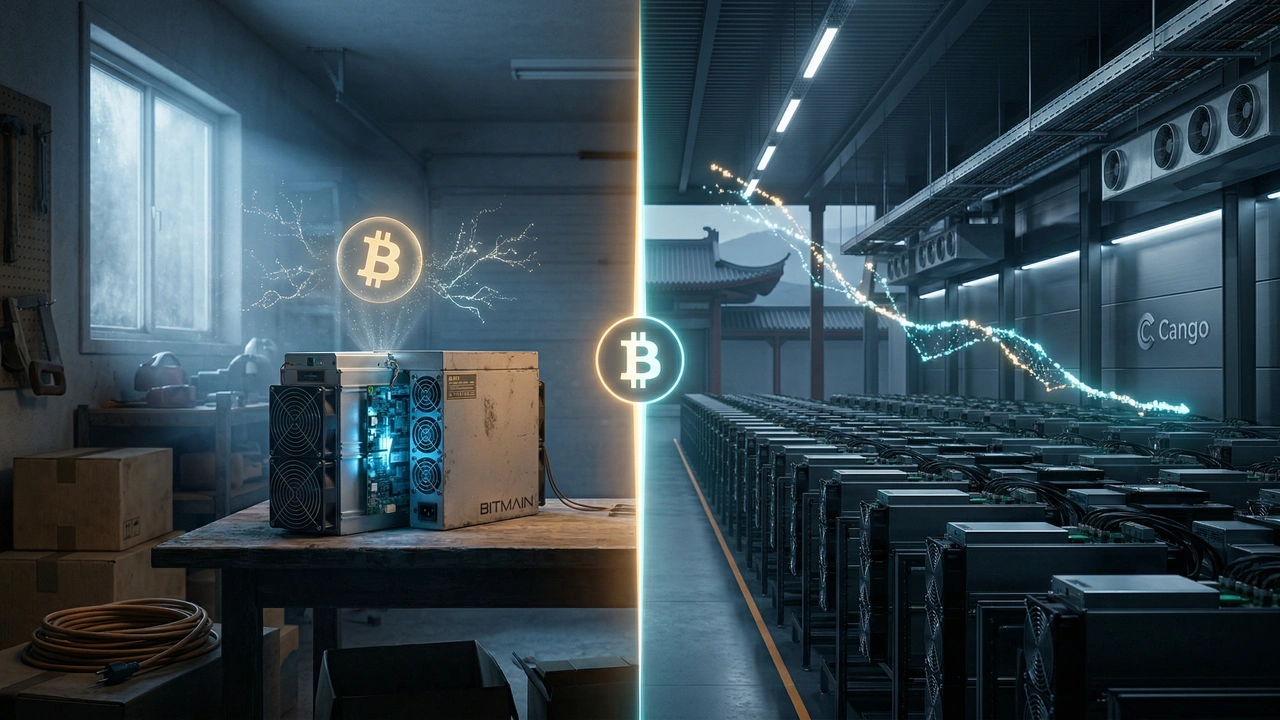
Two solo miners have beaten astronomical odds to claim full block rewards worth over $200,000 each, while industrial miner Cango slashes production costs by 19% — together painting a vivid picture of Bitcoin mining's vast, stratified landscape.
Key Takeaways
- Solo mining remains mathematically open but practically a lottery — this week's $222,000 win required defeating odds of roughly 1 in 100,000 per day, equivalent to an expected wait of ~300 years; it is a feature of Bitcoin's design, not a repeatable strategy [1][2].
- CKpool offers a practical middle ground for small miners who want solo exposure without building independent infrastructure, stripping away operational complexity while preserving the full-reward upside [1][2].
- Industrial miners are prioritizing financial discipline over growth — Cango's 19.3% cost reduction and active deleveraging reflect a sector-wide shift toward margin resilience as post-halving economics tighten [3].
- The gap between retail and industrial mining is measured in exahashes — Cango alone operates at 37 EH/s; the solo miner who won $222,000 controlled 0.00007 PH/s, illustrating the vast stratification within the same network [1][2][3].
- Miner selling behavior is a market signal worth tracking — with multiple listed miners selling significant BTC holdings to manage debt while Strategy continues to accumulate, the tug-of-war between miner supply pressure and institutional demand remains a key variable in Bitcoin's price dynamics [3].
Bitcoin Mining Tells Two Stories at Once — And Both Matter
Within the span of a single week, Bitcoin's mining ecosystem delivered a striking contrast: a hobbyist miner wielding computing power comparable to a five-year-old consumer machine defied odds of 1-in-100,000 to pocket $222,000, while industrial-scale miner Cango announced it had trimmed its cost to produce a single Bitcoin by nearly 20%. These events are not unrelated noise. Together, they illuminate the full spectrum of Bitcoin mining in 2025 — from its lottery-like grassroots origins to the ruthlessly efficient corporate machinery that now dominates block production.
The deeper story here is about how Bitcoin's proof-of-work mechanism continues to function exactly as designed: permissionless, probabilistic, and open to anyone with a machine and an electricity connection, even as the economics increasingly favor scale. Understanding both ends of this spectrum is essential for anyone serious about Bitcoin.
The Facts
On April 9, a solo miner successfully validated block 944,306 on the Bitcoin network, claiming a total reward of 3.128 BTC — worth approximately $222,000 at the time [1]. The payout included the standard 3.125 BTC block subsidy plus 0.003 BTC in transaction fees [1]. The miner operated through CKpool in solo configuration, meaning no hashpower was shared with other participants, and the entire reward went to a single operator [2].
CKpool developer Con Kolivas confirmed the win on social media, noting the miner ran just 70 terahashes per second (TH/s) — the equivalent of a single Bitmain Antminer S17+, a machine launched in 2019 [1]. At that hashrate, the miner controlled roughly 0.0000069% of the network's total computing power, which stood near 1.02 zettahashes per second on the day the block was found [2]. Kolivas estimated the statistical probability at roughly one in 100,000 per day — or once every approximately 300 years under normal expectations [2]. Remarkably, this was not an isolated incident: just days earlier, a separate solo miner using the same platform had earned around $210,000 by mining block 943,411, operating at higher hashpower but still facing odds of roughly 1 in 28,000 per day [1].
On the industrial side, Chinese-American Bitcoin mining company Cango reported a sharp reduction in its cost of production, bringing the average cash cost per Bitcoin mined down to $68,215 in the first quarter — a 19.3% improvement from the $84,552 per coin average reported in the fourth quarter of 2024 [3]. The company credited a shift to what it calls a "lean-production model" focused on margin resilience rather than raw hashrate growth [3]. Cango sold 2,000 BTC in March at prices between $68,000 and $69,000, generating approximately $137 million in proceeds that were directed toward repaying Bitcoin-backed loans [3]. As of March 31, the company held 1,025.69 BTC in treasury with $30.6 million in outstanding Bitcoin-backed debt [3].
Cango currently ranks as the world's sixth-largest Bitcoin mining company by hashrate, operating 27.9 exahashes per second in self-mining and an additional 9.02 EH/s through hashrate leasing, for a combined 37.01 EH/s — representing 2.82% of global Bitcoin mining power [3]. The company also disclosed a $65 million equity investment from its own leadership and a $10 million convertible bond from DL Holdings, signaling confidence in its strategic pivot toward energy and AI infrastructure [3]. For context on the scale gap, publicly listed miners like MARA Holdings and Bitdeer operate at 61.7 EH/s and 71 EH/s respectively [2].
Analysis & Context
The solo mining victories this week are a reminder that Bitcoin's core architecture has not changed. The protocol doesn't know or care whether a valid block comes from a mining farm burning megawatts in rural Wyoming or a single ASIC humming in someone's garage — if the hash is valid, the reward is paid. This is not a bug or a nostalgic artifact; it is a deliberate feature of the proof-of-work design. However, context is critical: these wins are genuine statistical anomalies. The miner behind block 944,306 beat odds that, under average expectations, would require centuries of continuous operation. The Bitcoin community should celebrate these moments for what they are — proof that the network remains open — without drawing the misleading conclusion that small-scale solo mining is a viable income strategy. It is, by design, a lottery.
What makes the Cango story more structurally significant is the direction of travel it represents for the industrial mining sector. A 19% cost reduction in a single quarter, achieved not through adding more machines but through financial discipline and operational efficiency, is a meaningful signal. With Bitcoin hovering near $68,000-$69,000 at the time of Cango's March sales — prices that aligned almost perfectly with their cost basis — the margin for error in industrial mining is razor-thin [3]. The broader pattern emerging across listed miners reinforces this: MARA used $1.1 billion in Bitcoin sales to buy back convertible debt at a discount, while Cango used proceeds to reduce loan exposure [3]. This deleveraging trend stands in sharp contrast to Strategy's continued accumulation, which added another $330 million in BTC during the same period [3]. The mining industry is quietly bifurcating — some operators are tightening balance sheets to survive volatility, while financial holding companies with lower cost bases continue to stack. For Bitcoin's price structure, the sustained selling pressure from miners managing tight margins is a factor worth monitoring closely.
Historically, periods following Bitcoin halvings — the most recent of which reduced the block subsidy to 3.125 BTC in April 2024 — put intense pressure on miners with higher production costs. The companies that survive these cycles are typically those that locked in cheap energy, upgraded hardware proactively, or diversified revenue streams. Cango's pivot toward AI and energy infrastructure reflects a growing acknowledgment that pure-play Bitcoin mining economics have become structurally demanding. The solo miner's lottery win, by contrast, costs nothing to analyze strategically: it is simply one of Bitcoin's most human stories, repeated occasionally across the network's history.
Sources
AI-Assisted Content
This article was created with AI assistance. All facts are sourced from verified news outlets.