Bitcoin Mining Hits a Breaking Point: Who Survives the Squeeze?
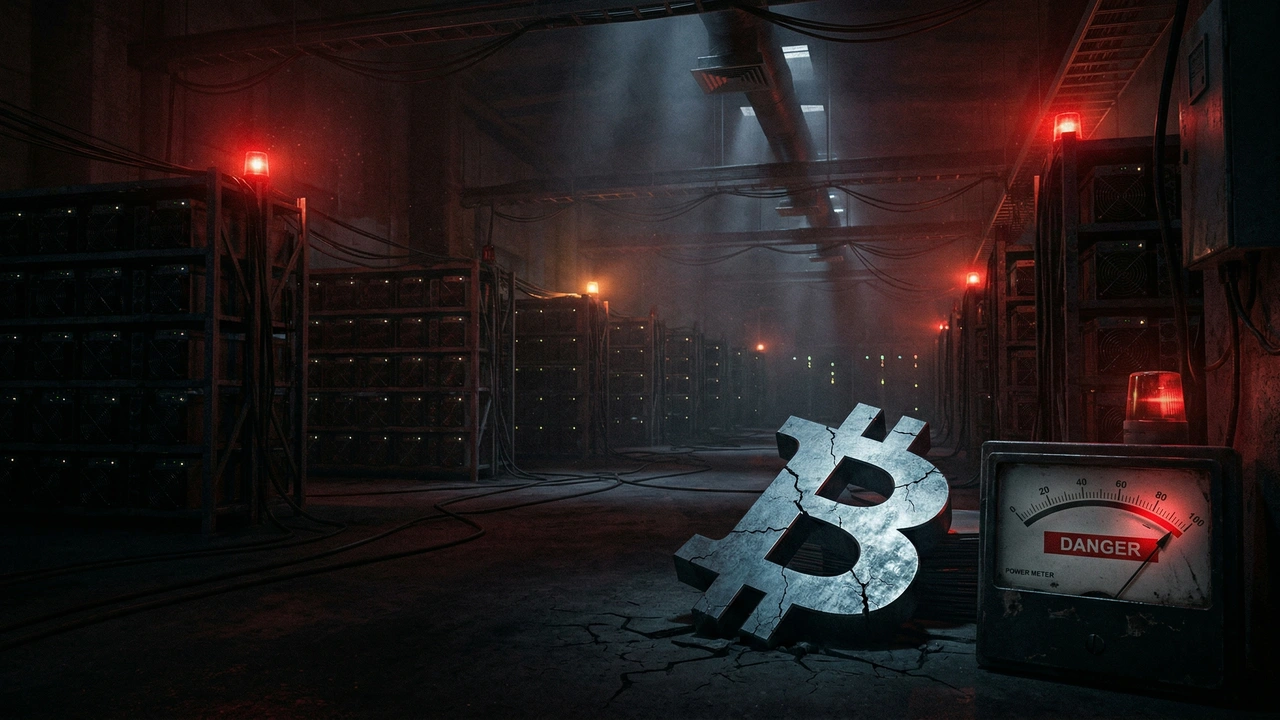
With hashprice near five-year lows and 15-20% of global mining capacity operating at a loss, the Bitcoin mining industry is undergoing a painful but necessary structural reset — and the data suggests the shakeout is already underway.
Key Takeaways
- Mining is bifurcating into winners and losers: Operators with next-generation hardware and sub-five-cent electricity costs remain viable; those with older equipment or higher power costs are being systematically eliminated, with 15-20% of global capacity already underwater [1].
- The difficulty drop is a confirmation signal: The 7.7% mining difficulty reduction in late March is direct network-level evidence that unprofitable miners are shutting down — this is the shakeout beginning in earnest, not a warning of one [1].
- Miner selling pressure is easing: The Miners' Position Index falling to multi-year lows means fewer coins are entering the market from miners, reducing one of Bitcoin's most consistent sources of structural sell-side pressure [2].
- Long-term holders are buying the dip aggressively: A 48.5% surge in accumulator balances over a single week indicates that sophisticated, patient capital is absorbing supply during the drawdown — historically a constructive signal for medium-term price direction [2].
- Consolidation will produce a stronger industry: Cycles of margin stress have consistently reshaped Bitcoin mining toward greater efficiency and institutional quality — the companies that survive this period will emerge with durable competitive advantages.
Bitcoin Mining Hits a Breaking Point: Who Survives the Squeeze?
The economics of Bitcoin mining have rarely looked this brutal. A confluence of post-halving revenue compression, stubbornly high operating costs, and a Bitcoin price that has struggled to reclaim higher ground has pushed a significant slice of the global mining industry into the red. What CoinShares is now describing is not merely a cyclical dip — it is a structural reckoning that will reshape who mines Bitcoin and under what conditions. The operators who emerge on the other side will be leaner, better capitalized, and technologically superior to those who came before them.
Yet within this pressure cooker, a counterintuitive story is quietly unfolding. Even as miners face existential margin stress, long-term Bitcoin holders are aggressively accumulating, and miner selling — historically a key source of market overhang — is actually cooling. The two dynamics together paint a nuanced picture of a market in transition, not collapse.
The Facts
The core metric telling the mining industry's story right now is the hashprice — a measure of how much revenue a miner generates per unit of computational power deployed. In February, that figure dropped to approximately $28 per petahash per second per day, marking a new post-halving low [1]. While a partial recovery has since lifted the hashprice to around $33 per PH/s per day according to Hashrate Index data, that level still sits near the lowest readings of the past five years [1]. At current conditions, CoinShares estimates that between 15 and 20 percent of global Bitcoin mining capacity is operating at a loss [1].
The pressure falls hardest on operators running mid-generation hardware and those paying elevated electricity rates. CoinShares notes that miners using equipment from previous hardware generations are frequently crossing below the breakeven threshold when electricity costs reach or exceed $0.05 per kilowatt-hour [1]. To remain cash-flow positive, these operators need power costs below five cents per kilowatt-hour — a target that is increasingly difficult to meet outside of the most advantageous energy markets. Miners running the latest-generation ASICs, by contrast, retain comparatively resilient margins even at standard industrial power rates [1].
The strain is registering directly in the Bitcoin network itself. On March 20, mining difficulty declined by approximately 7.7 percent — one of the sharpest downward adjustments of the year [1]. Difficulty reductions occur automatically when blocks are being found more slowly than the target rate, which typically signals that hashing power has been switched off. In practical terms, this is confirmation that unprofitable operators have already begun pulling machines offline [1].
CoinShares Head of Research James Butterfill has warned that a prolonged period of low Bitcoin prices could force additional miners to shut down uneconomical equipment, and that Bitcoin liquidations by mining companies are likely to increase in such a scenario [1]. MARA, one of the largest publicly listed miners, recently sold approximately one billion dollars worth of Bitcoin — a data point that illustrates the financial pressure large-scale operators are already navigating [1].
On the demand side, however, a different dynamic is emerging. CryptoQuant data shows that Bitcoin accumulator addresses grew their holdings from roughly 138,000 BTC on March 23 to approximately 205,000 BTC by March 30 — a 48.5 percent increase in just one week [2]. This accumulation intensified precisely during the recent price decline, suggesting that long-term participants are actively absorbing available supply rather than retreating [2]. Simultaneously, the Miners' Position Index 30-day moving average has fallen to -1.042, a level last seen at the 2024 lows, indicating that miner outflows relative to their one-year average have dropped significantly — meaning fewer coins are flowing from miners onto exchanges [2].
Analysis & Context
The current mining environment bears a strong resemblance to the post-halving stress periods that followed the 2020 and 2016 halvings. In both prior cycles, the months immediately after the block subsidy reduction produced margin compression that drove out inefficient operators, temporarily pushed difficulty lower, and ultimately concentrated hash power among well-capitalized survivors. What followed in each case was a more competitive, professionalized mining sector — and eventually, a Bitcoin price recovery that rewarded those who had held on. History does not guarantee a repeat, but the structural mechanics are familiar.
What makes the current cycle particularly instructive is how it exposes the mining industry's dependency on two variables simultaneously: Bitcoin's price and the efficiency of deployed hardware. The April 2024 halving cut block rewards from 6.25 BTC to 3.125 BTC per block, effectively halving revenue overnight for every miner regardless of their operational sophistication. Operators who had relied on a rising Bitcoin price to compensate for aging hardware suddenly found themselves exposed. The industry had expanded aggressively during the bull market, and some of that capacity was always going to prove uneconomical at lower price levels. The 7.7 percent difficulty drop in late March is essentially the network's self-correcting mechanism beginning to function as designed.
The cooling of miner selling is a meaningful development for price dynamics. Miners are one of the few Bitcoin market participants with a structural imperative to sell — they must convert BTC to fiat to cover electricity bills and operational costs. When that selling pressure recedes, as the MPI data now suggests, one persistent source of downside pressure on price is reduced. Combined with the aggressive accumulation being documented among long-term holders, the supply absorption picture is more constructive than broader market sentiment might imply. Exchange flow data does show negative net taker flows on major venues and a sentiment index deep in bearish territory, which reflects real short-term selling pressure [2] — but the on-chain fundamentals tell a story of informed money moving in the opposite direction.
Sources
AI-Assisted Content
This article was created with AI assistance. All facts are sourced from verified news outlets.