Bitcoin Mining in Crisis: $19K Losses Per Coin Signal Industry Reset
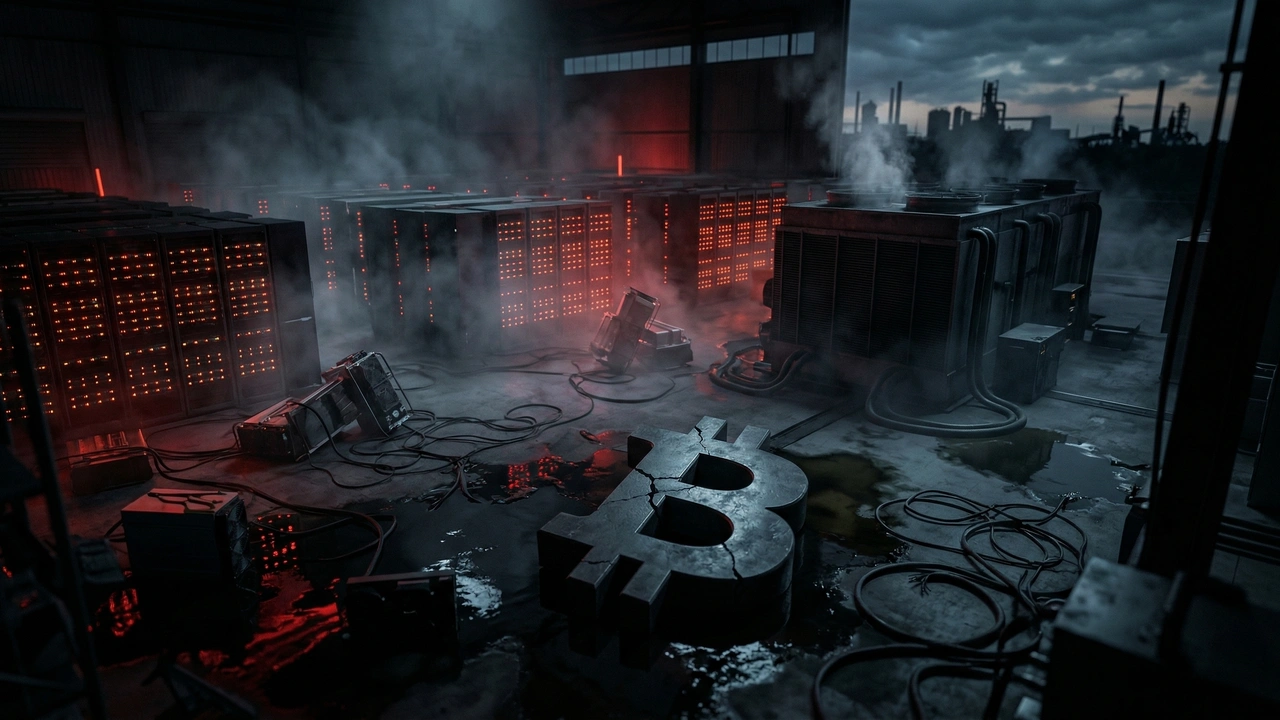
A 7.7% difficulty drop and production costs towering $19,000 above spot price are forcing miners to the brink — and reshaping the economics of the entire network.
Key Takeaways
- Miners are losing over $19,000 per coin at current production costs of ~$88,000 versus a ~$69,000 spot price, creating one of the most severe margin crunches since the last bear market [1].
- The 7.7% difficulty drop is the network working as intended — automatically easing conditions for surviving miners — but it also confirms that meaningful hashrate has already left the network [2].
- Forced miner selling represents a genuine near-term price headwind: when operators must liquidate Bitcoin holdings to cover costs, it adds structural sell pressure that can suppress price recovery in the short term [1].
- The pivot to AI and HPC by major miners like Marathon Digital and Cipher Mining signals a broader industry rethink — pure Bitcoin mining economics are increasingly difficult to sustain without diversified revenue [1][2].
- Historical precedent is cautiously reassuring: post-halving miner capitulation cycles have resolved before, typically when difficulty-adjusted profitability recovers and price stabilizes — but the timeline and severity of the current episode remain uncertain.
Bitcoin Mining's Reckoning: When the Numbers Stop Adding Up
For Bitcoin miners, the arithmetic has turned brutal. Production costs are running nearly $20,000 above the current market price, the network's difficulty just posted its sharpest decline in months, and hashrate is sliding. Together, these signals point to something more consequential than a routine market correction — they suggest the mining industry is undergoing a genuine structural stress test, one that could reshape who participates in securing the network and how they do it.
This isn't merely a story about miner pain. The ripple effects touch market liquidity, Bitcoin's price trajectory, and the long-term decentralization of the network itself. Understanding what's happening — and why — matters for every participant in the Bitcoin ecosystem.
The Facts
The numbers are unambiguous. Average Bitcoin production costs currently sit at approximately $88,000 per coin, while Bitcoin's spot price has been trading at just under $69,000 [1]. That gap — exceeding $19,000, or more than 21% per mined block — means the typical miner is operating at a loss on every coin produced [1]. This isn't a marginal squeeze; it's a significant structural deficit.
The difficulty adjustment made on March 20 tells the story from the network's perspective. Mining difficulty fell by approximately 7.7%, landing at 133.79 trillion — the steepest single-period decline since February [2]. To put the magnitude in context: difficulty stood at roughly 145 trillion in mid-March and approximately 148 trillion at the start of the year [2]. The trigger was a measurable slowdown in block production. Over the preceding 2,016-block epoch, the average block time stretched to around 12 minutes and 36 seconds, well beyond the protocol's 10-minute target [2]. Bitcoin's self-correcting difficulty algorithm responded exactly as designed, easing the computational requirements to bring block times back in line.
Hashrate corroborates the weakness. Network hashrate has declined to approximately 945 EH/s [1], reflecting the departure or throttling of mining capacity that can no longer operate profitably. A critical profitability benchmark — the hashprice, which measures revenue per unit of computing power — currently sits near $33.30 per petahash per second per day [1], pushing many operators close to or below breakeven.
The macroeconomic backdrop is compounding operational pressures. Geopolitical tensions involving the United States, Israel, and Iran have contributed to rising energy prices, directly inflating the variable costs that dominate mining economics [1]. When energy — the primary input — becomes more expensive while the output price declines, the margin compression accelerates rapidly.
Larger publicly traded mining companies are already pivoting in response. Firms including Marathon Digital and Cipher Mining are redirecting capital toward artificial intelligence infrastructure and high-performance computing data centers, seeking revenue streams that aren't subject to Bitcoin's price volatility [1][2].
Analysis & Context
What we're witnessing follows a well-documented pattern in Bitcoin's history: post-halving miner capitulation. Bitcoin's block subsidy was cut in half in April 2024, instantly halving the primary revenue source for every miner on the network. When this structural revenue reduction collides with a pullback from cycle highs — Bitcoin traded as high as $126,000 before the current drawdown [1] — miners who expanded aggressively during the bull run find themselves caught badly offside. This same dynamic played out after the 2020 halving and again in 2022's bear market, each time flushing out higher-cost operators before the network stabilized and eventually recovered.
The difficulty drop is, paradoxically, one of Bitcoin's most elegant self-healing mechanisms. As unprofitable miners shut down rigs or reduce capacity, the network automatically recalibrates — making it easier and more profitable for remaining participants to mine. This is precisely what the 7.7% reduction achieves: distributing the same block rewards across a smaller pool of active hashrate, temporarily improving per-unit economics for those who stay the course [2]. History suggests that sustained difficulty declines eventually attract fresh hashrate back in, as improved margins and any price recovery make investment viable again — as illustrated by the roughly 15% difficulty rebound that followed February's weather-related outage in the United States [2].
The more concerning medium-term dynamic is the forced selling pressure. Miners who cannot cover operational costs through revenues alone must liquidate Bitcoin reserves to fund electricity bills and debt service [1]. This creates a feedback loop: miner selling adds supply to the market, suppressing price, which further widens the loss per mined coin, which compels more selling. The shift by major listed miners toward AI and HPC infrastructure is a rational hedge against this cycle — but it also signals that these companies no longer view pure-play Bitcoin mining as a reliably profitable standalone business at current economics. That strategic reorientation has implications for network security long-term, as it reduces the marginal commitment of capital to Bitcoin's proof-of-work mechanism.
Sources
- [1]btc-echo.de
- [2]btc-echo.de
AI-Assisted Content
This article was created with AI assistance. All facts are sourced from verified news outlets.