Bitcoin Mining Leaves Earth: Starcloud's Orbital Ambitions Explained
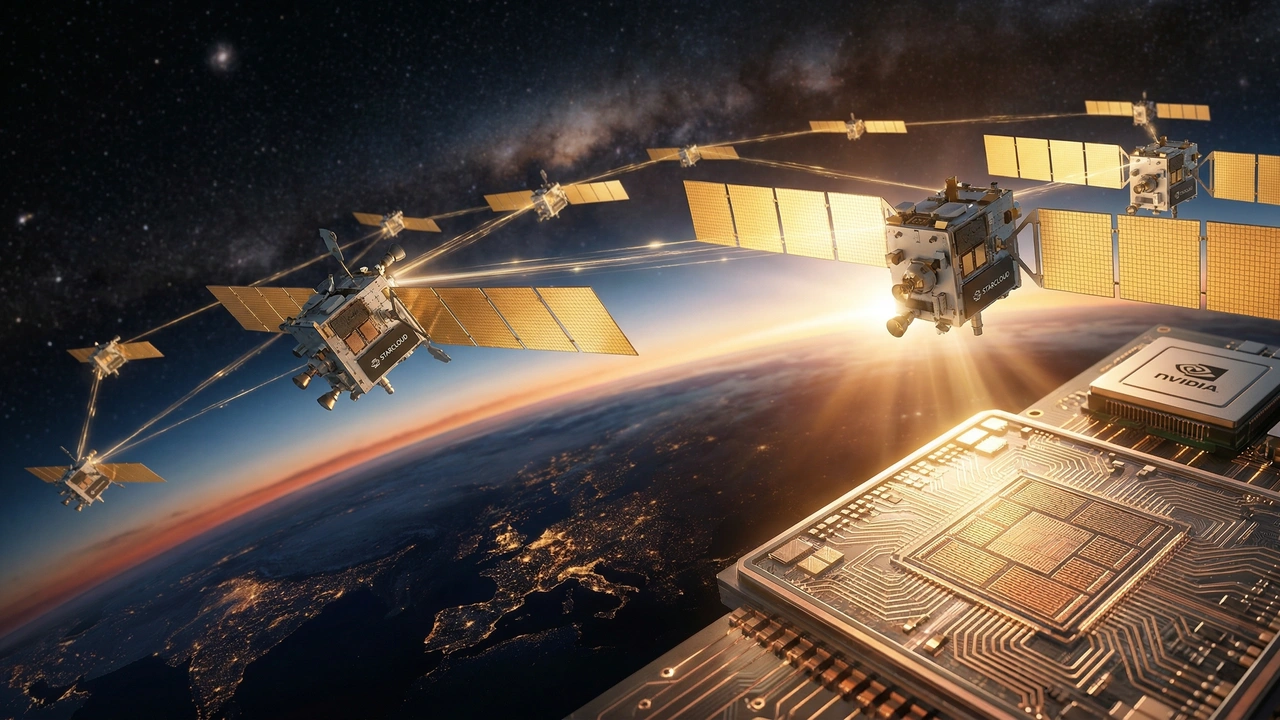
Nvidia-backed startup Starcloud plans to become the first company to mine Bitcoin from orbit, arguing that space-based solar power and cheap ASIC hardware could make terrestrial mining economically obsolete.
Key Takeaways
- Starcloud, an Nvidia-backed orbital data center company, is on track to become the first entity to mine Bitcoin from space when its second satellite launches later in 2026, powered by solar energy with no grid dependency.
- The economic rationale is driven by a 30-to-1 cost-per-kilowatt advantage of ASIC mining hardware over GPU chips, making Bitcoin mining one of the most cost-efficient workloads to deploy in the weight-sensitive orbital environment.
- Space-based solar power eliminates the three largest structural risks facing terrestrial miners: regulatory interference, grid energy price volatility, and geographic concentration of hash rate.
- The announcement reflects a broader, accelerating trend of Bitcoin mining following cheaper and more resilient energy sources — a pattern with strong historical precedent that consistently proved skeptics wrong.
- While full-scale orbital mining remains years away from maturity, investors and industry participants should treat this development as an early signal of where long-term mining economics are heading, rather than dismissing it as science fiction.
The Final Frontier of Bitcoin Mining Is Literally Space
For years, the Bitcoin mining industry has chased cheap energy across deserts, arctic tundra, and hydroelectric valleys. Now, one well-funded startup is making the argument that the most logical destination for mining hardware was always above our heads. Starcloud, backed by Nvidia, is preparing to launch its second spacecraft later this year — and when it does, Bitcoin ASICs will be running in orbit for the first time in history. If the company's CEO is right, this is not a publicity stunt. It is the opening move in what could become a fundamental restructuring of how Bitcoin secures its network.
The implications extend well beyond one startup's ambitions. If space-based Bitcoin mining proves economically viable, it challenges every assumption the industry has made about energy sourcing, regulatory risk, and geographic distribution of hash rate. This is a development worth examining carefully.
The Facts
Starcloud CEO Philip Johnston confirmed the company's Bitcoin mining plans in an interview with HyperChange and subsequently on X, stating plainly that Starcloud "will be the first to mine Bitcoin in space" [1]. The timeline is tied to the launch of the company's second spacecraft, expected later in 2026 [1].
The economic case Johnston makes rests on a stark hardware cost differential. Application-specific integrated circuit miners, the chips that power the Bitcoin network, are dramatically cheaper per unit of power than the GPU hardware Starcloud already deploys for artificial intelligence workloads. Johnston quantified the gap directly: a 1-kilowatt Nvidia B200 GPU chip costs roughly $30,000, while a 1-kilowatt ASIC can be acquired for approximately $1,000 — a 30-to-1 cost ratio [1][2]. That asymmetry makes ASICs far more practical to deploy in the weight- and cost-constrained environment of orbital infrastructure.
Starcloud was founded in early 2024 with the original mandate of building satellite-based data centers to meet surging AI compute demand [2]. The company's satellites run predominantly on solar energy, eliminating the fuel and grid dependency that defines terrestrial mining operations [2]. In November 2025, the company demonstrated the viability of its platform by successfully operating an Nvidia H100 GPU aboard a satellite in orbit — the first time a processor of that class had ever functioned in space [1][2]. A constellation of approximately 88,000 satellites forms the long-term infrastructure vision [1].
Johnston did not understate his ambitions for the broader industry. He argued that Bitcoin mining's current terrestrial energy consumption of roughly 20 gigawatts of continuous power "makes no sense" to sustain on Earth, and projected that space will ultimately absorb the entire workload [1]. Separately, entrepreneurs Jose E. Puente and Carlos Puente have explored the adjacent question of interplanetary Bitcoin transactions, theorizing that optical links via NASA or Starlink infrastructure could relay a Bitcoin transaction to Mars in as little as three minutes — though actual mining on Mars remains impractical due to communication latency [1].
Analysis & Context
Starcloud's announcement arrives at a moment of genuine stress for the Bitcoin mining sector. Bitcoin's price has retreated nearly 48% from its October 2025 peak, and while mining difficulty has eased roughly 7% from its all-time high of 155.9 trillion units to around 145 trillion, profit margins remain thin for many operators [1]. That context matters: when terrestrial miners are under financial pressure, any credible pathway to dramatically lower operating costs commands serious attention.
The core insight here is not that space mining is imminent at scale — it clearly is not — but that Starcloud is exposing a structural inefficiency in how the industry thinks about energy. Terrestrial Bitcoin mining is perpetually locked in a negotiation with grid operators, regulators, and energy markets. Space-based solar power sidesteps all three. There are no utility contracts to renegotiate, no local governments threatening moratoriums, and no fossil fuel price shocks to absorb. The energy source is as close to free and permanent as physics allows. The capital expenditure challenge shifts entirely to launch costs and hardware miniaturization, both of which have followed steep deflationary curves over the past decade thanks to companies like SpaceX.
Historically, Bitcoin mining has migrated toward wherever energy is cheapest and regulation most permissive — from China's coal regions to Iceland's geothermal fields to Texas's deregulated grid. Each migration was dismissed as impractical until it was not. Space represents a more dramatic leap, but the underlying logic is identical. The 30-to-1 cost advantage of ASICs over GPUs that Johnston cites also signals something important: Starcloud is not retrofitting a data center designed for AI into a mining operation. The economics of ASICs make Bitcoin mining a purpose-built, primary use case for this platform, not an afterthought. That suggests the company has done genuine margin analysis, not just made a headline-grabbing claim.
Sources
AI-Assisted Content
This article was created with AI assistance. All facts are sourced from verified news outlets.