Bitcoin Mining's Energy Revolution: Survival Through Adaptation
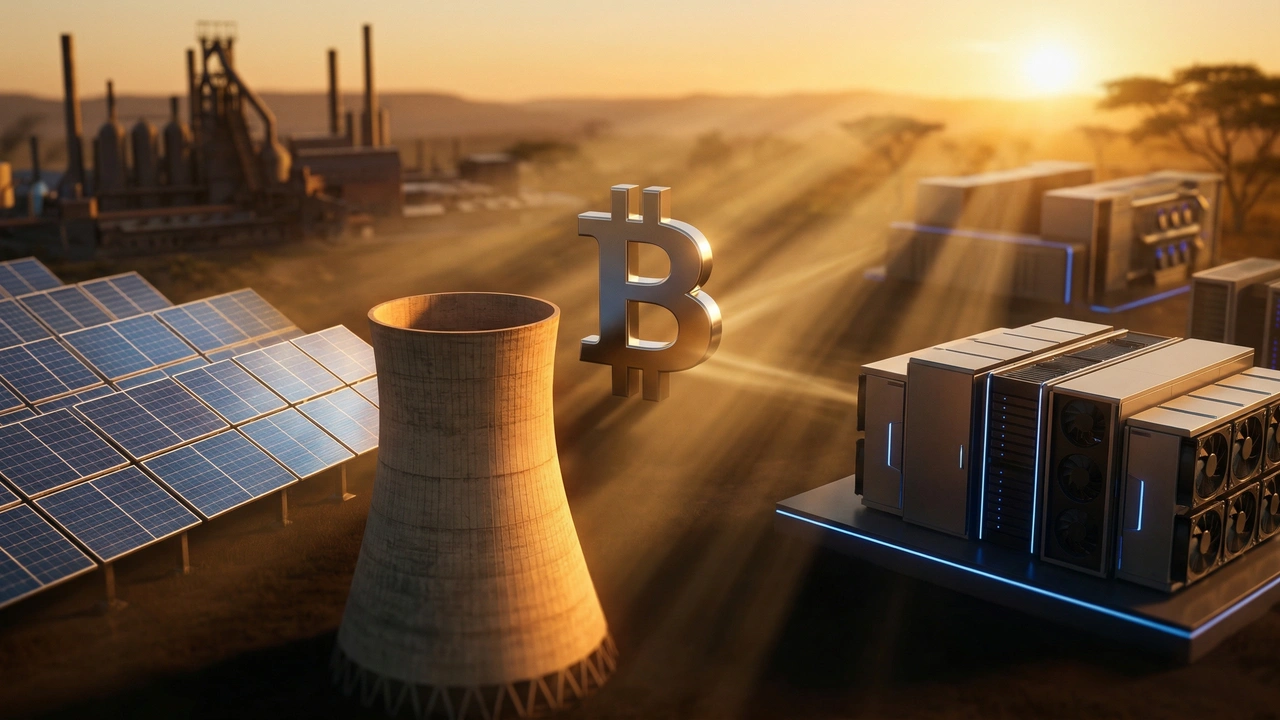
As halving pressure squeezes mining margins to historic lows, the industry is forging an unexpected path forward — one paved with nuclear power, AI infrastructure, and creative energy partnerships from South Africa to Pennsylvania.
Key Takeaways
- Mining economics are structurally stressed: For the first time in a full market cycle, Bitcoin's price performance has failed to offset halving revenue cuts, forcing miners to seek income beyond block rewards [1].
- Treasury management is an underexploited lifeline: Miners collectively hold close to 1% of all Bitcoin supply, and deploying that through derivatives strategies or lending protocols could generate material yields that help bridge margin gaps [1].
- Bitcoin miners pioneered the nuclear energy playbook: Long before AI hyperscalers began signing nuclear power contracts, miners like TeraWulf were colocating next to nuclear plants — giving the industry credibility and relationships that could prove strategically valuable as SMR development accelerates [2].
- Surplus energy markets are opening new frontiers: Eskom's consideration of discounted power for Bitcoin miners reflects a global trend of utilities recognizing mining's value as flexible, interruptible demand — a dynamic that could lower miners' energy costs in multiple emerging markets [3].
- Adaptation, not capitulation, defines the industry's trajectory: Whether through AI hosting pivots, smarter treasury management, or novel energy partnerships, the miners who survive this cycle will likely be those who treated adversity as a catalyst for structural innovation rather than a reason to exit.
Bitcoin Mining Stands at a Strategic Crossroads — and the Industry Is Responding with Ingenuity
The Bitcoin mining industry is undergoing one of its most consequential transformations since the technology's inception. Caught between the relentless economics of post-halving revenue compression and surging global electricity demand driven by artificial intelligence, miners are being forced to rethink everything — from how they source power to how they manage the Bitcoin sitting on their balance sheets. What's emerging is not a story of an industry in decline, but one in the midst of a profound and necessary reinvention.
Three converging developments illuminate this shift: a candid assessment from market maker Wintermute warning that traditional mining models may no longer suffice, a growing recognition that Bitcoin miners pioneered the nuclear energy strategies now being adopted by Big Tech, and a bold proposal from South Africa's national utility Eskom to sell surplus solar-displaced electricity directly to miners. Together, they sketch the outline of a new energy economy — and Bitcoin mining is at its center.
The Facts
The financial pressure on Bitcoin miners has never been more acute. According to market maker Wintermute, this is the first time in a four-year market cycle that Bitcoin has failed to deliver the roughly two-times price appreciation needed to offset the revenue hit from a halving event [1]. Gross margins have peaked at levels that, in prior cycles, were associated with bear market bottoms — not mid-cycle conditions. Transaction fees, which some had hoped would structurally compensate for reduced block subsidies, have remained episodic rather than reliable, while energy costs continue to erode what little margin remains [1].
In response, Wintermute is urging miners to treat their Bitcoin holdings as productive assets rather than static reserves. The firm estimates that miners collectively hold nearly 1% of Bitcoin's total supply — a significant treasury that remains largely unoptimized [1]. Wintermute argues that tools including covered calls, cash-secured puts, and Bitcoin lending protocols could generate meaningful yield from these holdings. "The miners who treat their BTC holdings as a working asset rather than a passive reserve will carry a structural edge into the next halving," the firm stated [1]. Meanwhile, the AI pivot is gaining real momentum: MARA Holdings recently filed with the SEC signaling its intent to sell Bitcoin to fund an AI infrastructure push, and publicly listed miners have collectively offloaded more than 15,000 BTC since October [1].
On the energy front, Bitcoin miners are increasingly being recognized as pioneers of a model that the broader tech industry is now racing to replicate. Nuclear power's role in Bitcoin mining has been quietly growing for years — Cambridge Centre for Alternative Finance data shows nuclear's share of mining electricity consumption rising from roughly 4% in 2021 to nearly 9% in 2022, with the figure edging toward 10% today [2]. Sustainable sources overall, including nuclear, hydro, and wind, now account for approximately 52.4% of Bitcoin mining's electricity mix [2]. One of the earliest examples of nuclear-adjacent mining was TeraWulf's 2021 joint venture with Pennsylvania's Talen Energy to develop the Nautilus Cryptomine facility directly beside the Susquehanna nuclear plant [2]. That same model is now being pursued by AI hyperscalers including Microsoft, Amazon, and Meta, who are signing long-term power contracts with nuclear facilities to secure around-the-clock, carbon-free electricity [2].
Perhaps the most geographically surprising development comes from South Africa. Eskom, the country's state-owned electricity utility, is evaluating a plan to offer discounted electricity to Bitcoin mining companies during peak solar generation hours [3]. The driver is structural: widespread rooftop solar adoption has created a predictable midday surplus on the national grid, leaving Eskom with excess capacity it currently cannot monetize. Eskom chairman Mteto Nyati described the initiative at the Biznews Conference 2026, noting that Bitcoin mining and AI data centers represent exactly the kind of flexible, high-consumption demand that could absorb this surplus [3]. Eskom CEO Dan Marokane has separately flagged Bitcoin mining, AI infrastructure, and large-scale data centers as strategic opportunities for the utility's long-term revenue model [3].
Analysis & Context
What these three developments reveal, when read together, is that Bitcoin mining is no longer simply a financial bet on BTC price appreciation — it is becoming a critical piece of global energy infrastructure. The industry's decade-long obsession with securing the cheapest possible electricity has inadvertently positioned miners as experts in large-scale power procurement, grid balancing, and flexible load management. These are precisely the skills that a world grappling with AI-driven electricity demand now desperately needs.
The nuclear connection is particularly significant. Bitcoin miners were derided for years as energy gluttons with no social utility. Yet it was miners, not Google or Microsoft, who first demonstrated that colocating high-performance computing next to baseload nuclear generation was technically and commercially viable. TeraWulf's Nautilus facility, operational before the current AI energy panic, is now a template being studied by the world's largest technology companies. This is a meaningful reputational pivot for an industry accustomed to defending its energy use rather than being celebrated for it. The rise of small modular reactors (SMRs) adds another dimension — their modular, deployable nature makes them ideal partners for both Bitcoin mining and AI workloads, and miners' existing relationships with nuclear operators could translate into competitive advantages as SMR projects scale.
The Eskom proposal deserves particular attention as a signal of things to come. Utilities worldwide are grappling with the same structural challenge: renewable energy penetration is creating volatile, location-specific surplus power that traditional demand cannot absorb. Bitcoin mining's unique characteristic — its ability to switch on and off rapidly, consuming power opportunistically — makes it an almost ideal grid-balancing tool. If Eskom moves forward, it would join a growing list of jurisdictions recognizing that miners are not energy parasites but flexible demand partners. For the mining industry, access to deeply discounted surplus electricity could meaningfully improve unit economics at a time when every basis point of margin matters. The broader implication is that Bitcoin mining may increasingly be structured around energy arbitrage — consuming power that would otherwise be wasted — rather than competing head-to-head for premium grid capacity.
Sources
AI-Assisted Content
This article was created with AI assistance. All facts are sourced from verified news outlets.