Bitcoin Mining's Identity Crisis: From Earth to Orbit and Into AI
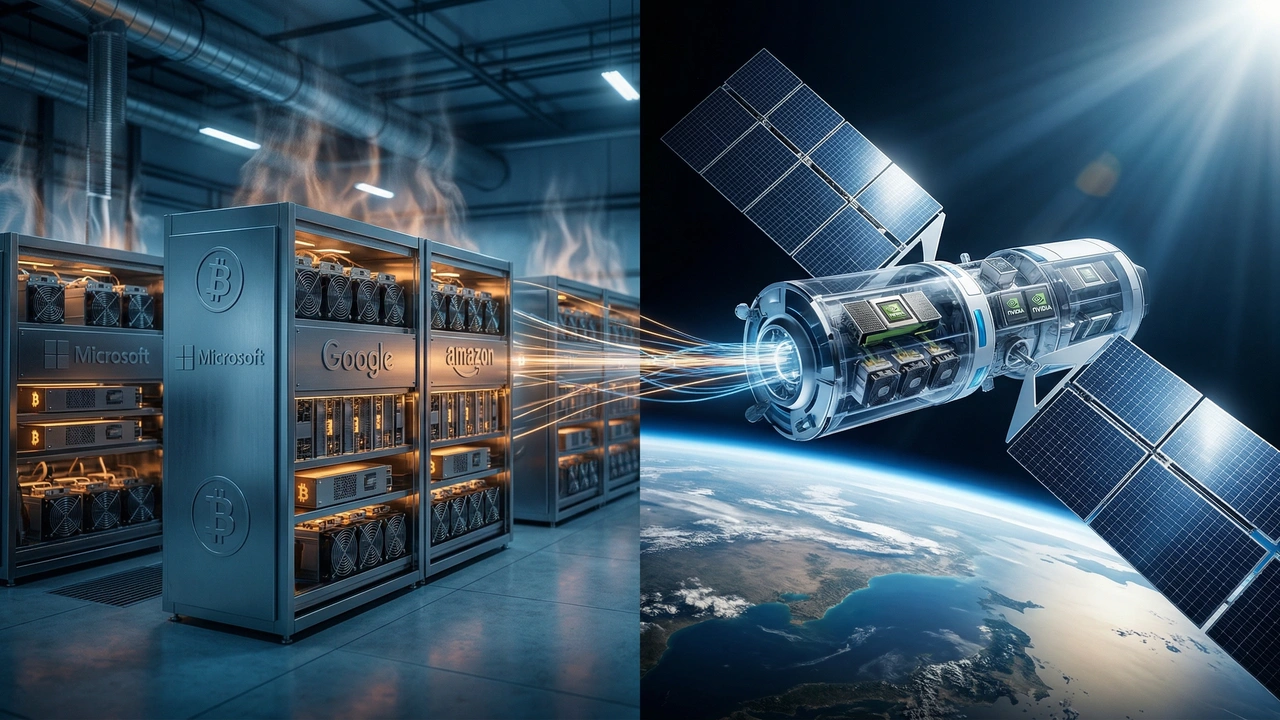
As public Bitcoin miners abandon the orange coin for AI data center contracts, a daring startup wants to mine Bitcoin in space — together, these developments reveal a mining industry at a profound strategic crossroads.
Key Takeaways
- The AI pivot by major public Bitcoin miners — including Cipher Digital, Bitfarms, IREN, and Core Scientific — represents a bet on infrastructure build-out returns that history suggests is structurally risky; the railroad and fiber-optic analogies are not hyperbole.
- Bitcoin mining remains profitable at the frontier for operators with access to genuinely cheap, renewable energy; the "mining is dead" narrative is largely a story about high-cost, grid-dependent U.S. operations, not the global industry.
- Starcloud's planned orbital Bitcoin mining launch marks a genuine technological frontier: if space-based solar energy can slash energy costs below terrestrial benchmarks, it could eventually reshape mining economics in ways the industry has not yet fully priced in.
- Public miners dumping Bitcoin holdings to fund AI pivots at cyclical lows represent a potential long-term strategic miscalculation — surrendering hard-money balance sheet assets for fiat-denominated infrastructure leases tied to a sector facing serious valuation questions.
- The convergence of orbital computing and Bitcoin mining, however speculative today, signals that the next phase of innovation in proof-of-work may come from outside the traditional mining establishment entirely.
Bitcoin Mining's Identity Crisis: From Earth to Orbit and Into AI
The Bitcoin mining industry is simultaneously reaching for the stars and questioning its own foundations. On one hand, a growing cohort of publicly traded miners are stripping 'Bitcoin' from their brand names and leasing their infrastructure to Microsoft, Google, and Amazon. On the other, an Nvidia-backed startup is preparing to launch ASIC mining hardware into Earth's orbit. These two developments, seemingly from different galaxies, are actually telling the same story: the mining industry's relationship with Bitcoin itself is being stress-tested as never before.
The Facts
In November 2025, the U.S. startup Starcloud — formerly known as Lumen Orbit and based in Redmond, Washington — successfully launched its first test satellite, Starcloud-1, in partnership with Nvidia [1]. The satellite carried Nvidia H100 GPUs capable of performing AI training and inference in orbit, powered by solar energy collected in space. Now, Starcloud CEO Philip Johnston has announced plans to go further: the company's next SpaceX launch, expected before year's end, will include ASIC Bitcoin miners, with the explicit ambition of becoming the first operation to mine Bitcoin in outer space [1].
The rationale for orbital computing is compelling on paper. Solar panels in certain Earth orbits can operate at up to eight times the efficiency of their terrestrial counterparts, free from night cycles and weather disruptions [1]. Heat dissipation is handled passively by radiating into the vacuum of space, eliminating the enormous water and power demands of conventional cooling systems. Johnston envisions a constellation of 88,000 AI satellites ultimately capable of delivering 10 gigawatts of new computing capacity annually, with regular launches potentially becoming feasible around 2029 [1]. Analysts project the orbital data center market could expand from $1.77 billion in 2029 to roughly $39.1 billion by 2035, representing annual growth of approximately 67% [1].
Back on Earth, however, the story is grimmer for traditional miners. Kent Halliburton, Co-Founder and CEO of Sazmining, told Bitcoin Magazine that the average cost to mine one Bitcoin currently stands at approximately $87,000, while spot prices have hovered around $70,000 — meaning most of the industry is operating at a loss [2]. Public miners have seized upon this financial pressure as justification for pivoting to AI. Cipher Digital — formerly Cypher Mining and valued at roughly six billion dollars — divested a 49% stake in three major mining sites and rebranded entirely around high-performance computing (HPC) [2]. Bitfarms CEO Ben Gagnon went so far as to declare, "We are no longer a Bitcoin company" [2]. Meanwhile, IREN Limited announced a $9.7 billion, five-year agreement with Microsoft; Core Scientific expanded its HPC operations to 270 MW through partnerships serving Microsoft and OpenAI workloads; and Hut 8 signed a 15-year, 245 MW lease backed by Google [2].
Halliburton, whose company operates in Paraguay and Ethiopia, pushed back sharply on the narrative that Bitcoin mining is fundamentally unprofitable. "At our sites in Paraguay and Ethiopia, our clients are producing bitcoin on an energy cost basis of $50,000 to $64,000, on 100% renewable energy," he said [2]. His broader critique is pointed: public miners "had the power contracts, the land, the infrastructure — everything you need to mine bitcoin cheaply — and they're handing it to Microsoft and Google in exchange for lease checks" while having sold over 15,000 Bitcoin from their balance sheets to fund the pivot [2].
Analysis & Context
The historical parallel Bitcoin Magazine draws is worth sitting with carefully. The railroad barons of the 1870s and the fiber-optic builders of the late 1990s both constructed the essential infrastructure of transformative eras — and most of them went bankrupt or were swallowed by consolidators for pennies on the dollar [2]. J.P. Morgan picked up the railroads; Google and Meta absorbed the fiber lines. The winners weren't the builders; they were the patient capital that arrived after the crash. Goldman Sachs has already flagged AI valuations as "frothy," and Sequoia's David Chan has identified a $600 billion gap between AI-driven revenues and capital expenditures — with hyperscaler capex commitments for 2026 exceeding $700 billion against revenues that, even including OpenAI's impressive $20 billion ARR, cover only a fraction of that spending [2].
For Bitcoin specifically, the irony runs deep. Miners who abandoned the protocol at its most capital-intensive moment — right after a halving that compressed margins — may be handing away their most durable competitive moat: low-cost energy infrastructure that is extraordinarily difficult to replicate. Bitcoin's security model depends on a globally distributed, competitive mining ecosystem. When large miners exit in waves, it concentrates hash rate and potentially increases network vulnerability in the medium term. More practically, if AI infrastructure spending triggers the kind of speculative bubble collapse that history suggests is possible, those miners will have given up Bitcoin exposure at the bottom to hold AI infrastructure at the top.
The orbital mining concept from Starcloud operates on a different philosophical plane entirely. Rather than fleeing Bitcoin economics, it attempts to fundamentally disrupt the energy cost equation. ASIC hardware is estimated to cost roughly $200 per kilogram to launch versus $500 per kilogram for AI GPU hardware, making Bitcoin mining proportionally more cost-effective in space [1]. Whether the economics close in the near term is genuinely uncertain — Johnston himself acknowledges the initial orbital tests are primarily about understanding technical challenges rather than generating profit [1]. But the concept demonstrates something important: there are entrepreneurs willing to innovate within Bitcoin mining rather than abandon it, betting that cheap, abundant energy will always have a buyer in the protocol's proof-of-work mechanism. Cosmic radiation failures — five GPUs already failed on Starcloud-1 — and orbital maintenance challenges are real obstacles, but they are engineering problems, not conceptual dead ends [1].
Sources
AI-Assisted Content
This article was created with AI assistance. All facts are sourced from verified news outlets.