Bitcoin Mining's Infrastructure Revolution: Software, Scale, and AI
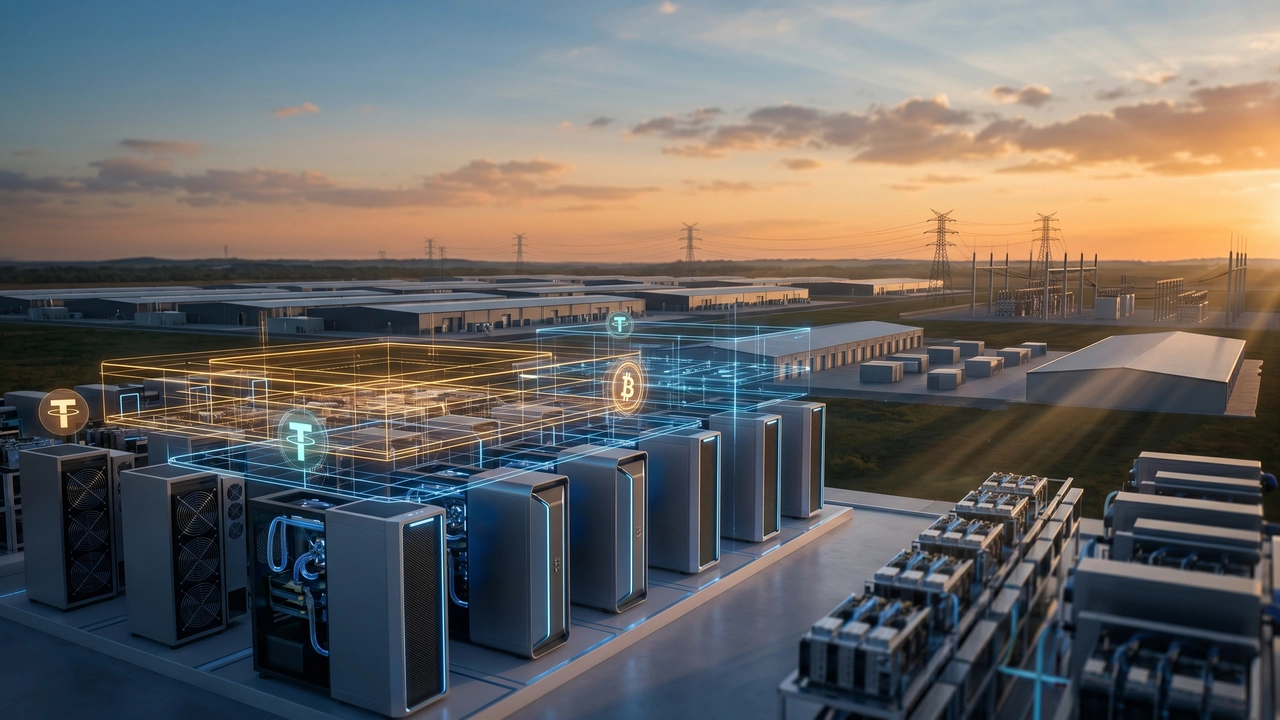
Tether's open-source Mining Development Kit and Core Scientific's billion-dollar land acquisitions signal a profound structural transformation in Bitcoin mining — one that is quietly reshaping the industry from a hardware race into a programmable infrastructure play.
Key Takeaways
- Tether's MDK is an open-source bid to become the Linux of Bitcoin mining — if it achieves broad adoption, it could shift competitive advantage from hardware access to software optimization and automation capability [1].
- The mining-to-AI infrastructure pivot is accelerating across the industry, with Core Scientific, MARA, TeraWulf, Hut 8, Hive, and Iren all actively converting or expanding facilities for high-performance computing alongside Bitcoin mining [2].
- Physical asset acquisition at scale is becoming a defining competitive moat — Core Scientific's 200-acre land grab and $4.3 billion in new financing reflect a land-and-power consolidation race that will be difficult for smaller operators to compete with [2].
- Software standardization and AI automation are the next frontier — Tether's explicit focus on autonomous mining systems and AI-driven optimization signals that future mining efficiency gains will be primarily software-driven, not hardware-driven [1].
- The risk of hardware-vendor resistance to MDK is real — Bitmain and other ASIC manufacturers have significant incentives to maintain proprietary firmware ecosystems, and MDK's ultimate impact will depend heavily on community adoption and third-party developer engagement [1].
Bitcoin Mining Is Being Rebuilt From the Ground Up
The Bitcoin mining industry is undergoing a fundamental architectural shift, and most observers are missing it. Two developments this week — Tether's launch of its Mining Development Kit and Core Scientific's aggressive land and capital acquisitions — tell a unified story: the era of ad hoc, fragmented mining operations is ending. What is emerging in its place is a more sophisticated, institutionalized, and increasingly software-defined infrastructure layer that will determine who controls Bitcoin's hash power for the next decade.
This is not merely a story about bigger mining rigs or cheaper energy. It is a story about who controls the software stack, who owns the physical real estate, and who is best positioned to serve the dual demands of Bitcoin mining and artificial intelligence computing — two industries that are converging faster than most anticipated.
The Facts
Tether — best known as the issuer of the world's most widely used stablecoin, USDT — has been quietly building a serious Bitcoin infrastructure stack. The company currently holds 97,141 BTC, making it one of the largest institutional Bitcoin holders on the planet, having added more than 900 BTC to its balance sheet this month alone [1]. But its ambitions extend well beyond simply accumulating coins.
Earlier this year, Tether released Mining OS (MOS), a purpose-built operating system for mining facilities, followed by an open-source Software Development Kit (SDK) that gives developers standardized APIs to interface with mining hardware [1]. These two projects now form the foundation for the newly unveiled Mining Development Kit (MDK) — a comprehensive, open-source development platform designed to unify the historically fragmented software layer that governs Bitcoin mining operations [1].
The problem MDK is designed to solve is real and well-documented. Today's large-scale mining operations typically rely on a patchwork of incompatible tools: manufacturer-controlled firmware from companies like Bitmain, fleet management platforms like Foreman or HiveOS, pool communication protocols such as Stratum V2, and proprietary dashboards — none of which speak seamlessly to one another [1]. MDK's two core components aim to dissolve these silos. The MDK Core provides a JavaScript-based open-source backend SDK for real-time hardware control, independent of any manufacturer's ecosystem. The UI Development Kit offers modular interface components that operators can use to build custom dashboards and automation workflows without building every integration from scratch [1]. "Infrastructure is the heartbeat of every mining operation," said Tether CEO Paolo Ardoino. "MDK creates the blueprint for a universally compatible mining infrastructure with unprecedented programmability and scalability" [1].
On the physical infrastructure side, Core Scientific is making moves of a different but complementary magnitude. The company — whose shares are up 44% year-to-date — has acquired more than 200 acres of land to support expanded data center construction [2]. It has also secured an additional 300 megawatts of power under contract with its utility provider and last week announced plans to raise $3.3 billion through senior secured notes due 2031 to fund expansion across Georgia, Texas, North Carolina, and Oklahoma [2]. This follows a separate $1 billion credit facility secured from Morgan Stanley in March [2]. Core Scientific is not alone in this pivot: MARA Holdings acquired a 64% stake in French AI infrastructure firm Exaion in February, while Hive, Hut 8, TeraWulf, and Iren are all repurposing mining facilities into high-performance computing and AI data centers [2]. TeraWulf, for instance, acquired Century Aluminum's Hawesville smelter in Kentucky for $200 million with precisely this conversion in mind [2].
Analysis & Context
What connects these two seemingly separate developments is a shared recognition: Bitcoin mining infrastructure has become too strategically valuable to remain a purely opportunistic hardware business. Tether's MDK represents the software layer of this maturation — an attempt to establish an open standard that liberates operators from hardware vendor lock-in, much as Linux eventually liberated enterprise computing from proprietary operating systems. If MDK gains meaningful adoption, it could fundamentally shift competitive advantage in mining away from who has access to the latest ASIC chip and toward who can program and optimize their fleet most efficiently. The explicit mention of AI agents and autonomous workflows in Ardoino's comments is not marketing fluff — it reflects where the industry is heading as energy management, hash rate optimization, and thermal control grow complex enough to demand machine-learning solutions [1].
The physical consolidation happening at companies like Core Scientific mirrors historical patterns from other capital-intensive industries. When utilities, telecommunications networks, and data centers matured, the operators who survived long-term were those who locked in land, power contracts, and financing before the cycle turned. The aggressive capital raises Core Scientific is executing — $3.3 billion in notes plus a $1 billion credit facility — suggest that management believes it is still early enough in the AI infrastructure super-cycle to justify the leverage [2]. The conversion of idle industrial assets like aluminum smelters into mining and computing facilities is particularly telling: these sites offer rare combinations of large power infrastructure, industrial zoning, and physical scale that are nearly impossible to replicate with new construction at comparable cost.
Historically, Bitcoin mining has gone through several distinct phases: the hobbyist GPU era, the ASIC hardware arms race, the geographic arbitrage phase driven by cheap energy, and now what appears to be a platform infrastructure phase. In each prior transition, early movers who understood the structural shift — not just the current price cycle — captured disproportionate value. The risk for Tether's MDK is that hardware manufacturers like Bitmain have strong incentives to resist standardization that undermines their firmware ecosystems. But open-source standards have a habit of winning in the long run when they solve genuine interoperability problems, and the mining industry's current software fragmentation is a genuine and costly problem.
Sources
AI-Assisted Content
This article was created with AI assistance. All facts are sourced from verified news outlets.