Bitcoin Mining Faces a Regulatory Reckoning on Two Fronts
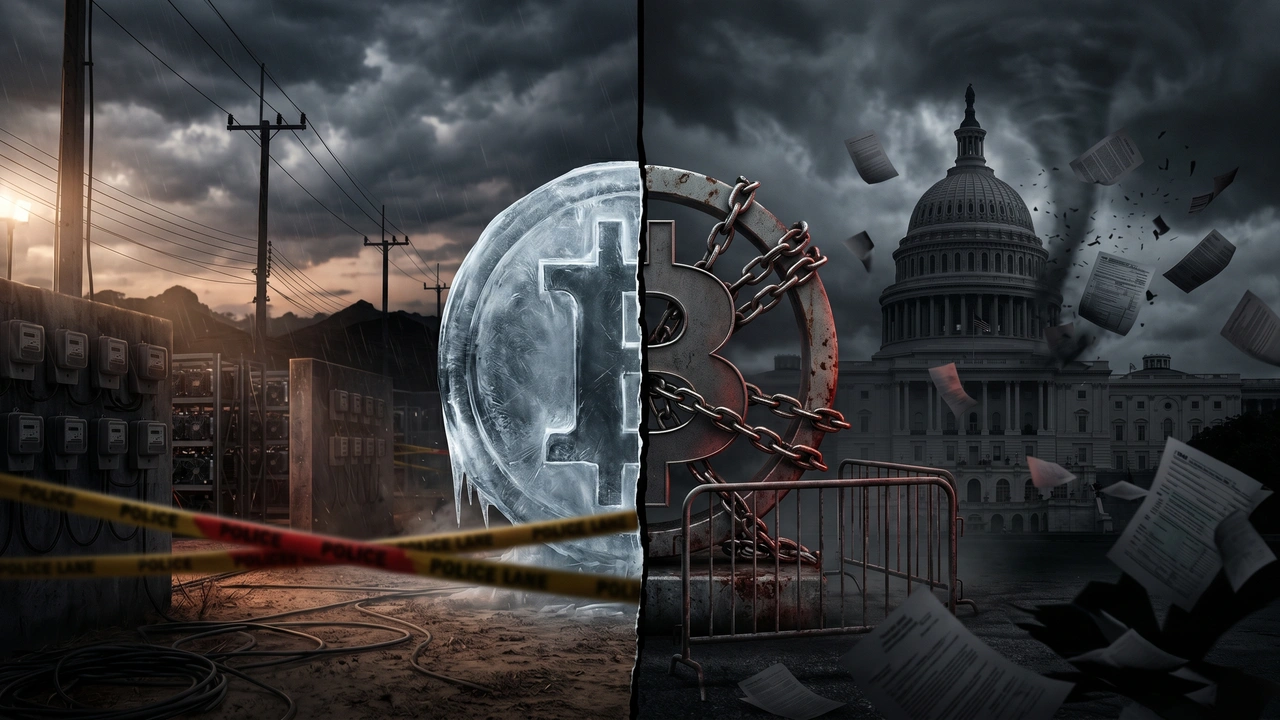
From electricity theft crackdowns in rural Thailand to a landmark U.S. tax reform bill backed by the entire crypto industry, Bitcoin mining is entering a defining regulatory moment that will shape where - and how - the network is built.
Key Takeaways
- Thailand's enforcement action - 315 machines seized across 14 sites in five provinces - illustrates how lighter grid oversight in economically peripheral regions creates conditions that attract illicit mining operations, with losses to the public utility exceeding $2.2 million in combined theft and unpaid bills.
- The IRS rules at the heart of the U.S. legislative fight have been in place since 2014, meaning American miners have operated under tax uncertainty for over a decade - the current reform push represents the most concrete opportunity for relief in that entire period.
- H.R. 9175 does not remove miners' tax burden; it restructures when that burden is recognized, shifting the taxable event from creation to sale and potentially reducing the sell pressure that current rules incentivize.
- The coordinated industry letter from all three major U.S. crypto trade associations signals rare sectoral unity, but the legislative window is narrow - the August recess and Senator Lummis's 2027 departure create a hard deadline for meaningful progress.
- Taken together, both developments point to the same underlying dynamic: regulatory ambiguity around mining - whether on energy law or tax law - consistently pushes activity toward jurisdictions with weaker oversight, at the expense of both network security and legitimate operators.
Bitcoin Mining Faces a Regulatory Reckoning on Two Fronts
Bitcoin mining has never existed in a regulatory vacuum, but the pressure is tightening from every direction at once. This week brought two developments that, taken together, reveal just how fragile the operating environment for miners has become: Thai authorities dismantled a network of illicit mining operations draining millions from the public grid, while in Washington, the U.S. crypto industry made its most coordinated legislative push yet to overhaul a tax framework that has punished domestic miners for over a decade. The connecting thread is simple - unresolved regulatory uncertainty, whether around energy law or tax law, creates distortions that ultimately undermine the network's long-term health.
These two stories are not isolated incidents. They are pressure points in a global contest over who gets to mine Bitcoin, under what conditions, and at what cost.
The Facts
Thai authorities executed coordinated raids across 14 locations spanning five northeastern provinces, seizing 315 mining machines in the process [1]. The trigger was not a tip-off from a rival, but something more mundane: anomalous consumption patterns flagged by the national utility. Investigators followed those irregularities to their source and found operators who had physically tampered with electricity meters to divert power from the public grid without paying for it [1].
The financial damage tallied by officials runs into seven figures. Electricity theft alone amounted to roughly 40.38 million baht - approximately $1.22 million - while unpaid utility bills added a further 35 million baht, or about $1.06 million on top of that [1]. Deputy government spokesperson Lalida Periswivattana confirmed the scope of the enforcement action. The northeastern region targeted in the raids is among Thailand's less economically developed areas, where grid oversight has historically been lighter than in the country's major industrial hubs - a combination that apparently made it attractive to operators looking to cut costs by any means necessary [1].
On the other side of the planet, the U.S. crypto industry was taking a very different approach to its mining-related grievances: lobbying Congress. The three largest American crypto trade associations - the Blockchain Association, the Crypto Council for Innovation, and the Digital Chamber - co-signed a letter to the House Ways and Means Committee on June 21, urging passage of H.R. 9175, the Tax Clarity for Mining and Staking Act [2]. The legislation was introduced by Representative Mike Carey of Ohio.
The bill addresses a dispute with the IRS that has festered for well over a decade. Back in 2014, the agency ruled that miners must declare the fair market value of newly minted Bitcoin as gross income at the moment of creation - not when they sell it [2]. That logic was extended to proof-of-stake validators in 2023 via a separate IRS revenue ruling, forcing stakers to recognize taxable income on rewards they may have no intention of liquidating [2]. The trade groups, whose joint letter was signed by CEOs Summer Mersinger, Ji Hun Kim, and Cody Carbone, described H.R. 9175 as "a durable compromise" [2].
What the bill actually does is give miners and stakers a choice rather than an obligation. Participants could elect to classify freshly created digital assets as self-created property, pushing any tax recognition to the point of sale [2]. There is also a technical provision for grantor trusts holding digital assets, allowing them to receive staking rewards without losing their trust status - a detail that matters considerably for institutional fund managers [2]. The Ways and Means Committee convened its first full-committee hearing on digital asset taxation in years on June 9, with H.R. 9175 among six bills under consideration [2]. Senator Cynthia Lummis has separately introduced Senate-side legislation pointing in the same direction. Time pressure is real: Congress faces a compressed calendar before the August recess, and Lummis herself exits the Senate in January 2027 [2]. The networks these rules govern are not small - proof-of-work and proof-of-stake chains together secure more than $1.7 trillion in digital assets [2].
Analysis & Context
The Thailand crackdown follows a well-worn pattern. Whenever Bitcoin's price rises enough to make mining profitable, and whenever a jurisdiction offers loose oversight or subsidized electricity, bad actors emerge to exploit the gap. It happened in China's coal-heavy provinces before the 2021 ban, it has surfaced repeatedly across Central Asia, and it is now playing out in Thailand's northeast. The enforcement response is always reactive - authorities chase the anomaly after the damage is done rather than building the regulatory architecture to prevent it. That reactive posture matters because it means the reputational cost of illicit mining keeps accruing to the broader industry, even as the majority of miners operate entirely above board.
The U.S. tax fight is the more consequential story for Bitcoin's long-term trajectory. The current IRS framework essentially taxes miners on phantom income - value that exists on paper at the moment of creation but that the miner may never realize if prices fall before they sell. This creates a structural incentive to either operate offshore, where tax treatment is more favorable, or to immediately liquidate newly mined coins to cover the liability, adding consistent sell pressure to the market. H.R. 9175 would not eliminate the tax obligation; it would simply move the recognition event to the moment of sale, aligning mining with how most other asset creation is treated. The industry's unified front here is notable precisely because such coordination is rare. When three competing trade bodies co-sign the same letter using the same language, it signals that the underlying grievance is broadly felt - and that the political moment may finally be ripe enough to act on it.
Sources
AI-Assisted Content
This article was created with AI assistance. All facts are sourced from verified news outlets.