Bitcoin Moves Into Main Street: Homes, Burgers, and Real Economy
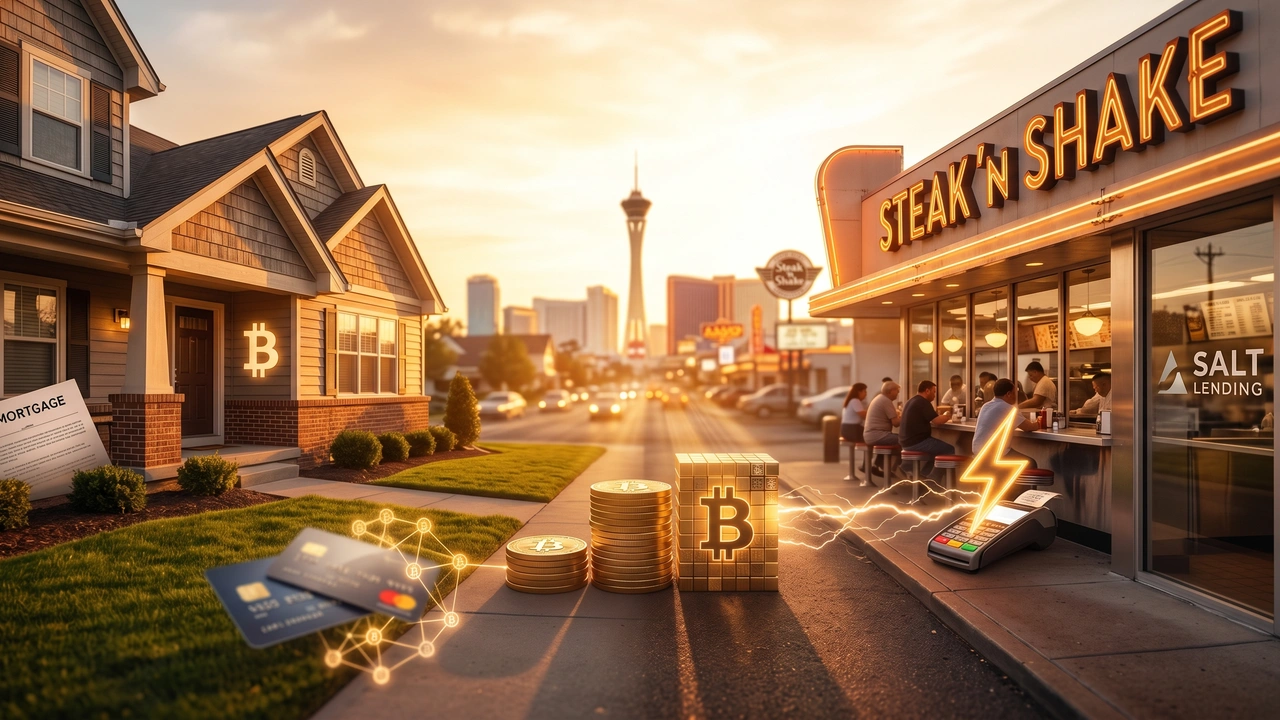
From Bitcoin-backed mortgages enabling homeownership without selling BTC, to Steak 'n Shake's Lightning Network payments driving record same-store sales, Bitcoin is quietly becoming embedded in the foundations of everyday economic life.
Key Takeaways
- Bitcoin is transitioning from a pure store-of-value asset into functional economic infrastructure, with real adoption driven by measurable cost and capital advantages rather than ideology alone.
- Bitcoin-backed mortgages represent a structural solution to the "HODLer's dilemma" — allowing long-term holders to access housing capital without selling appreciated assets or triggering tax events, a strategy previously reserved for high-net-worth private banking clients.
- Steak 'n Shake's Lightning Network payment results — 15% same-store sales growth in Q3 2025 outpacing major QSR rivals — offer one of the most concrete real-world data points yet for Bitcoin's commercial utility as a payment rail.
- The closed-loop Bitcoin economy model, where merchant payment receipts fund employee compensation and a corporate reserve, offers a replicable template for businesses looking to integrate Bitcoin beyond simple payment acceptance.
- As Bitcoin-backed financial products mature and expand downmarket, the asset's role in everyday financial life — mortgages, wages, business operations — is likely to deepen regardless of short-term price movements, building a more resilient adoption base.
Bitcoin's Quiet Revolution: From Collateral to Cash Register
For years, critics dismissed Bitcoin as a speculative toy — too volatile for real commerce, too abstract for real people. The developments emerging from the Bitcoin 2026 Conference in Las Vegas suggest that narrative is aging poorly. Bitcoin is no longer just a store of value sitting in cold wallets. It is becoming structural infrastructure for how people buy homes, how businesses reduce costs, and how workers get paid. Two stories from the conference, each compelling on their own, tell an even more powerful story together: Bitcoin is finding its footing in the real economy, one transaction at a time.
The thread connecting these developments is not ideology. It is economics. When Bitcoin saves a restaurant chain millions in payment processing fees, or allows a homebuyer to access capital without liquidating an appreciating asset, the adoption is driven by rational financial incentives — not belief systems. That distinction matters enormously for understanding how durable this integration might prove to be.
The Facts
On the housing front, the case for Bitcoin-backed mortgages is being made with striking personal conviction. CJ Konstantinos, who runs Peoples Reserve, recounted paying 100 Bitcoin for a house in 2019 — a property now worth around $500,000, while the Bitcoin spent to buy it would be valued at approximately $7.6 million today [1]. Rather than lamenting that transaction, Konstantinos uses it as a teaching moment: the next generation of Bitcoin holders should be able to access housing capital without ever selling their coins.
Speaking alongside Hunter Albright, Chief Revenue Officer at SALT Lending, at the Bitcoin 2026 conference, Konstantinos outlined why Bitcoin makes superior collateral. Unlike gold, which is physical and logistically cumbersome, or U.S. Treasuries, which carry inflation exposure tied to expanding money supply, Bitcoin is finite, settles on-chain, and moves with frictionless speed [1]. Albright reinforced this from a lending perspective, arguing that strong, liquid collateral allows firms like SALT — which is approaching its tenth year of Bitcoin-backed lending — to raise capital at attractive rates and pass better terms on to borrowers [1]. SALT has even developed technology to convert Bitcoin collateral into stablecoins during periods of heightened volatility, protecting both lender and borrower [1]. The company identifies four customer profiles for these products: those needing access to traditional finance, those seeking speed advantages in competitive real estate markets, those requiring agility to buy before selling an existing home, and those pursuing long-term wealth acceleration [1].
The payments story is equally concrete. Michael Boes, Chief MAHA Officer at Steak 'n Shake, told conference attendees that the chain launched Bitcoin payments via the Lightning Network on May 16, 2025, and watched same-store sales climb 11% quarter-over-quarter in Q2 2025, then accelerate to 15% in Q3 2025 — outpacing McDonald's, Taco Bell, and Domino's [2]. Boes attributed much of this momentum to the financial efficiency of Bitcoin payments: traditional credit card processors charge merchants between 2.5% and 3.5% per transaction, while Bitcoin via Lightning slashes that cost by roughly 50% [2]. If the entire credit card customer base switched to Bitcoin, Boes estimated annual savings of approximately $6 million — money he said flows directly into product quality improvements, including removing microwaves, switching to grass-fed beef, and replacing seed oils with beef tallow [2]. The company has built a closed-loop Bitcoin economy: customer payments accumulate in a strategic reserve now worth $10 million, which funds a $0.21 per hour Bitcoin bonus program for hourly workers that launched March 1 [2]. Boes himself accepts Bitcoin as part of his executive compensation package.
Analysis & Context
What makes these two developments historically significant is the layer of economic logic beneath them. Bitcoin has passed through several distinct adoption phases since 2009 — cypherpunk experiment, dark web currency, speculative asset, institutional reserve. What we appear to be entering now is a functional utility phase, where Bitcoin earns its place not through price appreciation alone, but through genuine cost and capital efficiency advantages. The Steak 'n Shake case is particularly instructive: this is not a tech company signaling progressive values. It is a fast-food chain in a margin-compressed industry, adopting Bitcoin because the numbers work. That is a different and more durable form of adoption than ideological commitment.
The Bitcoin-backed mortgage space is similarly underappreciated in its long-term significance. For the better part of a decade, the dominant Bitcoin narrative was "HODL" — never sell, accumulate forever. The problem with that framework is that it creates an illiquid trap: holders accumulate significant paper wealth but cannot access it for life's most important financial needs without triggering taxable events and losing their exposure to future appreciation. Structured Bitcoin lending solves this. It mirrors strategies that wealthy families have used for generations with equity portfolios and real estate — borrowing against assets rather than liquidating them. Bringing that capability to a broader class of Bitcoin holders is a meaningful democratization of financial tools, as Albright explicitly noted [1]. The acknowledgment that these products have historically served wealthier clients, but are now expanding downmarket, reflects a maturing product category following a predictable adoption curve.
The risk dimension cannot be entirely set aside. Bitcoin-backed loans carry margin call exposure during sharp price drawdowns — a dynamic that played out painfully for some borrowers during the 2022 bear market. And merchant Bitcoin adoption, while growing, still depends on customer willingness to spend an asset many holders treat as savings. But the infrastructure being built — Lightning Network rails for fast, cheap payments; smart collateral management systems for volatile assets — is reducing these friction points systematically. The direction of travel is increasingly hard to dispute.
Sources
AI-Assisted Content
This article was created with AI assistance. All facts are sourced from verified news outlets.